
Short Answer
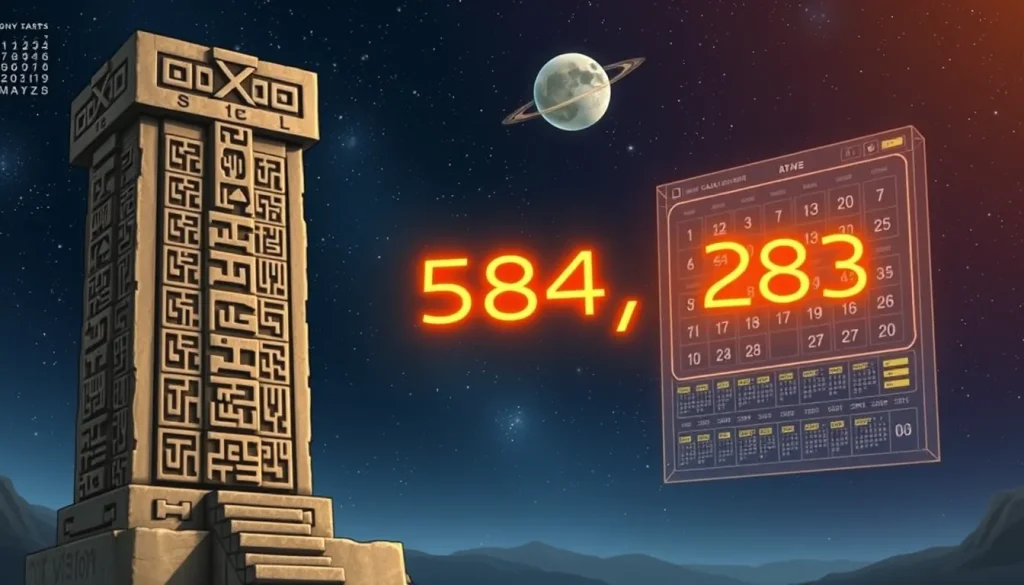
The GMT correlation constant stands as one of the most critical numerical values in Mesoamerican archaeology and archaeoastronomy. It serves as the mathematical bridge connecting the ancient Maya Long Count calendar system with the modern Western Gregorian and Julian calendars. Without this constant, inscriptions found on stelae across sites like Palenque, Tikal, and Copán would remain isolated in time, unable to be synchronized with historical events recorded in other civilizations. The constant represents the number of days that must be added to a Maya Long Count date to arrive at the corresponding Julian Day Number, a continuous count of days used by astronomers. While various correlation constants were proposed during the early 20th century, the Goodman-Martinez-Thompson (GMT) correlation has achieved near-universal acceptance among scholars due to robust astronomical and historical evidence.
Main Explanation
The core function of the GMT correlation constant is to align the Maya concept of linear time with the Western linear timeline. The Maya Long Count is a vigesimal (base-20) system that counts the number of days elapsed since a mythical creation date. To translate a Long Count date, such as 9.8.9.13.0, into a recognizable Western date, archaeologists apply the correlation constant. The most widely accepted value is 584,283 days, often referred to as the Lounsbury or modified GMT correlation. This specific number places the zero date of the Maya Long Count, written as 0.0.0.0.0, on August 11, 3114 BC in the proleptic Gregorian calendar. Alternatively, in the proleptic Julian calendar, this corresponds to September 6, 3114 BC. The difference arises from the later introduction of the Gregorian reform, which adjusted leap year rules to align the calendar year more closely with the solar tropical year.
Understanding this constant requires grasping the structure of the Long Count itself. The system is composed of five units: the Kin (1 day), Winal (20 days), Tun (360 days), Katun (7,200 days), and Baktun (144,000 days). When a date is recorded, it lists the number of each unit completed since creation. For example, the birth of K’inich Janaab Pakal I of Palenque is recorded as 9.8.9.13.0, which translates to 1,357,074 days since the creation of the Maya universe. By adding the correlation constant of 584,283 to this total, researchers derive the Julian Day Number, which can then be converted into a standard month, day, and year format. This process allows historians to place Maya rulers within a global chronological framework, facilitating comparisons with contemporary civilizations in Europe, Asia, and Africa.
Evidence & Sources
The acceptance of the 584,283 constant is not arbitrary; it is grounded in multiple lines of archaeological and astronomical evidence. One of the primary validations comes from the correlation of Maya records with known historical events during the Spanish Conquest. Colonial documents often record Maya dates alongside Western dates, providing fixed points for calibration. Furthermore, astronomical data recorded in Maya codices, such as the Dresden Codex, offer precise predictions of celestial cycles, particularly those of Venus and the Moon. When these recorded cycles are calculated using the GMT constant, they align accurately with astronomical reality as observed from the Maya region. For instance, the Venus Table in the Dresden Codex tracks the synodic period of Venus. If the correlation constant were off by even a few days, the predicted heliacal risings of Venus would not match the recorded ritual dates.

Digital heritage tools have further solidified the utility of this constant. Modern calculators and software applications used by archaeologists rely on the GMT value to automate conversions. These tools utilize universal arithmetic to apply the constant worldwide without jurisdictional assumptions, ensuring consistency across international research teams. The constant also accounts for the lack of leap days in the Maya Haab calendar, a 365-day vague year that drifts relative to the seasons. Unlike the Western calendar, which requires periodic leapday corrections to maintain seasonal alignment, the Maya 260-day astrological calendar, known as the Tzolkin or Tonalpouhalli, does not connect to the seasons. Therefore, the correlation constant must account for the cumulative drift between the Haab and the solar year over millennia. Historical analysis of the constant shows its evolution from early proposals by Goodman and Martinez to the refinement by Thompson and later Lounsbury, who adjusted the value to 584,283 to better fit the astronomical data.
Deep Dive Analysis
Definition
The GMT correlation constant is defined as the specific number of days separating the start of the Maya Long Count era from the start of the Julian Day Number system. It is the offset required to synchronize two distinct chronological frameworks. In academic literature, it is often denoted as the number of days to add to a Long Count total to achieve the Julian Day Number (JDN). The standard value is 584,283, though earlier variations such as 584,285 exist in historical literature. This constant is essential for converting the vigesimal notation of the Maya into the decimal notation of the Western world.
How it works
The mechanism of the correlation is purely arithmetic. First, the Long Count date is converted into a total number of days. For example, a date of 0.0.0.0.0 represents zero days elapsed. To find the Western equivalent, the constant is added: 0 + 584,283 = 584,283. This resulting number is the Julian Day Number. Astronomers and software then convert this JDN into a Gregorian or Julian calendar date. The process respects the discontinuities in the Western calendar, such as the absence of a Year Zero and the shift from Julian to Gregorian rules in 1582. The constant effectively anchors the floating Maya timeline to a fixed point in astronomical history.
Key components
Several components are integral to the application of the constant. The primary component is the Julian Day Number, a continuous count of days since January 1, 4713 BC in the Julian calendar. The second component is the Long Count units (Baktun, Katun, Tun, Winal, Kin), which must be accurately calculated before the constant is applied. The third component is the calendar choice, as the constant yields different Gregorian and Julian dates due to calendar reform. Source data indicates that the Gregorian date for the creation is August 11, 3114 BC, while the Julian date is September 6, 3114 BC. The Tzolkin and Haab positions are also derived simultaneously, providing the Calendar Round date, such as 4 Ahau 8 Kumku.
Example
A definitive example of the constant in action is the end of the 13th Baktun cycle, which garnered significant public attention. Using the GMT constant of 584,283, the Long Count date 13.0.0.0.0 converts to December 21, 2012, in the Gregorian calendar. This date marked the completion of a major cycle in the Maya Long Count, not the end of the world as popularized by modern media. Another example is the creation date itself. The Long Count 0.0.0.0.0 corresponds to the Julian Day Number 584,283. This specific alignment allows researchers to calculate the day of the week and the ritual day sign for any historical Maya event with precision.
Historical evidence
The historical development of the constant involves the work of several key figures. Goodman initially proposed a correlation based on colonial records. Martinez refined this using astronomical data. Thompson consolidated these efforts, advocating for the value that became standard. Later, Lounsbury modified the Thompson value slightly to 584,283 to resolve discrepancies in Venus cycle calculations. Archaeological evidence from sites like Quirigua and Palenque supports this value. Inscriptions that reference astronomical events, such as eclipses or planetary conjunctions, align with modern astronomical retrocalculations only when the 584,283 constant is used. This cross-verification between epigraphy and astronomy provides the strongest validation for the constant.
Common misconceptions
A prevalent misconception is that the GMT constant predicts apocalyptic events. The correlation simply marks cycle endings, such as the 2012 date, which functioned like an odometer rolling over rather than a cessation of time. Another misconception involves the leap day. The Maya Haab calendar does not utilize leap days, causing it to drift through the seasons over time. The correlation constant accounts for this drift when converting to the Western calendar, which does include leap days. Some alternative theories propose different constants, such as 584,285, but these fail to align as precisely with the Venus tables and colonial historical records. The 584,283 value remains the modern standard because it satisfies both historical documentation and astronomical precision.
FAQ
Why is the GMT constant 584,283 and not another number?
This value was selected because it aligns Maya astronomical records, particularly Venus cycles and eclipses, with modern astronomical calculations and colonial historical records.
Does the correlation constant change for different Maya sites?
No, the GMT constant is universal for the Classic Maya civilization. It applies worldwide with no jurisdictional assumptions, ensuring consistent dating across all sites.
What happened on December 21, 2012, according to the constant?
It marked the end of the 13th Baktun cycle in the Long Count calendar, equivalent to an odometer rolling over, not the end of the world or time itself.



Leave a Reply