
Short Answer
The Maya calendar system is renowned for its complexity and precision, encompassing multiple interlocking cycles that governed ritual, agricultural, and civic life. Among the lesser-known but significant components of this system is the cycle of the Nine Lords of the Night. This sequence consisted of nine deities who presided over successive nights in a continuous cycle, independent of but running parallel to the more famous 260-day Tzolk’in and 365-day Haab calendars. Identified primarily through the epigraphic analysis of Glyph G within the Supplementary Series of Maya inscriptions, the Lords of the Night offer profound insights into Maya cosmology and the personification of time.
Understanding the Nine Lords of the Night requires navigating the history of Maya epigraphy, where early 20th-century breakthroughs laid the groundwork for modern interpretations. While the Tzolk’in and Haab are often the focus of popular interest, the Supplementary Series, which includes lunar data and the Lords of the Night, provides critical context for how the Maya recorded specific historical dates. This article examines the identification, function, and archaeological evidence surrounding these enigmatic deities, distinguishing historical records from modern misconceptions.
Main Explanation
The Nine Lords of the Night functioned as a nine-day cycle within the broader Maya calendrical framework. Each lord was associated with a specific glyph, often referred to by epigraphers as Glyph G1 through G9, although in inscriptions they appear as variations of Glyph G within the Supplementary Series. This cycle did not reset with the solar year or the sacred round; instead, it counted continuously, providing a unique timestamp for any given date when combined with the Long Count, Tzolk’in, and Haab.
The concept of night lords was not unique to the Maya. Comparative evidence from Central Mexico, particularly Aztec sources such as the Codex Borbonicus, documents a similar cycle of nine deities known as the Lords of the Night. In 1929, J. Eric Thompson made the pivotal connection between these Aztec records and Maya hieroglyphs. He demonstrated that Glyph G of the Supplementary Series represented these nine lords, marking the first identification of this cycle within Maya inscriptions. This cross-cultural correlation was essential because the names of the Maya lords were not fully phonetically deciphered at the time, relying instead on positional logic and cyclical recurrence.
Functionally, the Lords of the Night added a layer of cosmological significance to daily timekeeping. In Maya belief, time was not merely a numerical count but a burden carried by deities. Each night lord influenced the events of their governed night, affecting rituals, agriculture, and political decisions. The cycle’s integration into the Supplementary Series suggests it was considered vital for accurate historical recording, particularly during the Classic Period. However, unlike the Lunar Series, which tracks the moon’s phases, the Lords of the Night cycle is purely calendrical, devoid of astronomical observation beyond the passage of days.
Evidence & Sources
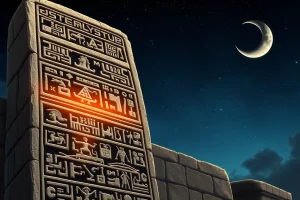
The archaeological and textual evidence for the Nine Lords of the Night is rooted in the epigraphic analysis of stone stelae and codices. The primary source of identification is the Supplementary Series, a cluster of glyphs often found alongside Initial Series dates in Classic Maya inscriptions. J. Eric Thompson’s 1929 publication was the landmark study that demonstrated Glyph G represented the nine Lords of the Night. Thompson noted that these hieroglyphs might represent an introductory glyph for the lunar series and may, according to Sylvanus G. Morley, name deities connected with the moon. However, subsequent research refined this understanding.
Andrews (1936) realized that Glyph G is outside of the Lunar Series, as there is evidence for some of them standing isolated only with a Calendar Round. This distinction is crucial for modern archaeologists, as it separates lunar astronomy from the deity cycle. Thompson associated the nine G-Glyphs with the nine Lords of the Night known from the Mixtec Codex Borbonicus, establishing a pan-Mesoamerican context for this timekeeping feature. This association is supported by the consistent nine-day interval observed in inscriptions across different Maya sites.
Further analysis by scholars such as Sven Gronemeyer has explored the specific iconography of these glyphs. In a 2006 study, Gronemeyer identified Glyphs G and F as aspects of the Maize God, suggesting complex theological overlaps between calendrical markers and agricultural deities. This highlights the fluidity of Maya religious iconography, where a single glyph could embody multiple divine aspects depending on context. Additionally, Bruce Frumker’s 1999 research on “Nights Errant” examined instances where the Lords of the Night in Maya inscriptions were “incorrect,” meaning they did not agree with the rest of the calendric information. These errant lords were usually attributed to scribal error, though some debate remains regarding whether these represent intentional variations or mechanical mistakes by the original sculptor or the astronomer priest who gave instructions.
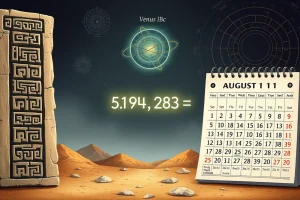
Modern digital tools have also aided in verifying these cycles. Contemporary Maya calendar converters, built on the GMT 584283 correlation, include the 9 Lords of the Night as a standard output alongside the Tzolk’in and Haab. These digital reconstructions allow researchers to test the consistency of the nine-day cycle against known Long Count dates, confirming Thompson’s original hypothesis across centuries of inscriptions.
Deep Dive Analysis
Module D: Calendar System Analysis
Units: The fundamental unit of this system is the “night,” governed by one of nine distinct deities. The cycle consists of exactly nine units before repeating. In epigraphic terms, these are represented by variations of Glyph G within the Supplementary Series. The cycle is independent of the 20-day months of the Haab or the 13-number cycle of the Tzolk’in.
Calculation: The calculation of the Lord of the Night is a simple modulo operation based on the continuous count of days. Given a known starting point in the Long Count, one can determine the governing lord for any subsequent date by dividing the total number of elapsed days by nine. The remainder corresponds to the specific lord in the sequence. This calculation runs continuously without intercalary adjustments, unlike the Haab which requires correction to align with the solar year.
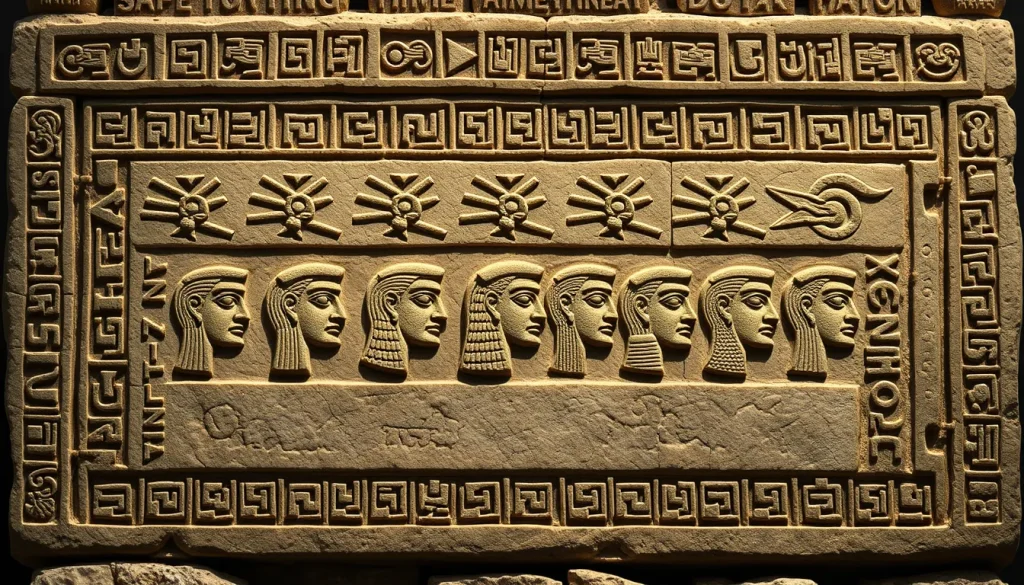
Diagram Description: Visually, the cycle can be imagined as a wheel with nine segments, each labeled with a specific glyph variant (G1 through G9). This wheel rotates once every nine days. In inscriptions, this is often depicted linearly within the Supplementary Series block, positioned near the Lunar Series glyphs but distinct from them. The glyphs themselves often feature portrait heads or symbolic attributes associated with specific divine characteristics.
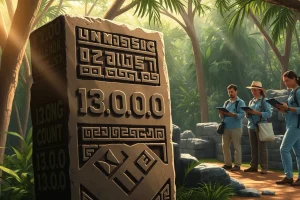
Example Date: Using the GMT 584283 correlation, researchers can calculate the Lord of the Night for any historical or modern date. For example, if a Long Count date is known, the kin (day) coefficient can be used to determine the position in the nine-day cycle. Modern online converters often display this as “Lord 1” through “Lord 9” alongside the standard Tzolk’in date, facilitating cross-referencing with archaeological data.
Relationship to Other Calendars: The Nine Lords of the Night run parallel to the 260-day Tzolk’in and the 365-day Haab. Together with the Lunar Series, they form the Supplementary Series, which elaborates on the primary Long Count date. While the Tzolk’in is used for ritual timing and the Haab for civil affairs, the Lords of the Night provide a nocturnal counterpoint, emphasizing the significance of the night cycle in Maya cosmology. The cycle does not synchronize perfectly with the Tzolk’in or Haab, creating a unique composite date that rarely repeats over short periods.
Historical Use: This system was predominantly used during the Classic Period (c. 250–900 CE). Inscriptions containing the Supplementary Series, including the Lords of the Night, are most common on monumental stelae and lintels. The presence of Glyph G in these inscriptions indicates a high level of scribal sophistication, as it required maintaining a separate continuous count alongside the primary calendar rounds. Its usage declined in the Postclassic period, though the concept persisted in Central Mexican cultures.
Current Traditions: While the specific nine-day cycle of the Classic Maya is not actively used in modern Maya communities, the broader concept of day lords remains vital. Contemporary Maya priests in the Guatemalan highlands still utilize the 260-day Tzolk’in for divination and ritual. Some modern calendar converters include the Nine Lords of the Night for historical accuracy, but they are not part of the living ritual tradition in the same way the Tzolk’in day names are.
Misconceptions: A common misconception is that the Lords of the Night are astronomical bodies like planets or moons. While Thompson initially noted a potential connection to the moon, Andrews clarified that Glyph G is outside the Lunar Series. Another error involves “errant” lords; when an inscription shows a lord that does not match the calculated cycle, it is often assumed to be a mystical variation. However, scholarly consensus, such as that presented by Frumker, attributes most discrepancies to scribal error or wrong readings of the Initial Series rather than theological deviation.
FAQ
Who first identified the Nine Lords of the Night in Maya inscriptions?
J. Eric Thompson first demonstrated in 1929 that Glyph G of the Supplementary Series represented the nine Lords of the Night, correlating them with known Aztec sources.
Are the Nine Lords of the Night related to the moon?
Initially, Thompson noted they may name deities connected with the moon, but Andrews (1936) realized Glyph G is outside the Lunar Series, indicating a separate calendrical function.
What are 'Errant Lords' in Maya epigraphy?
Errant Lords are instances in inscriptions where the recorded Lord of the Night does not match the calculated cycle, usually attributed to scribal error or incorrect Initial Series readings.
Leave a Reply