
Short Answer
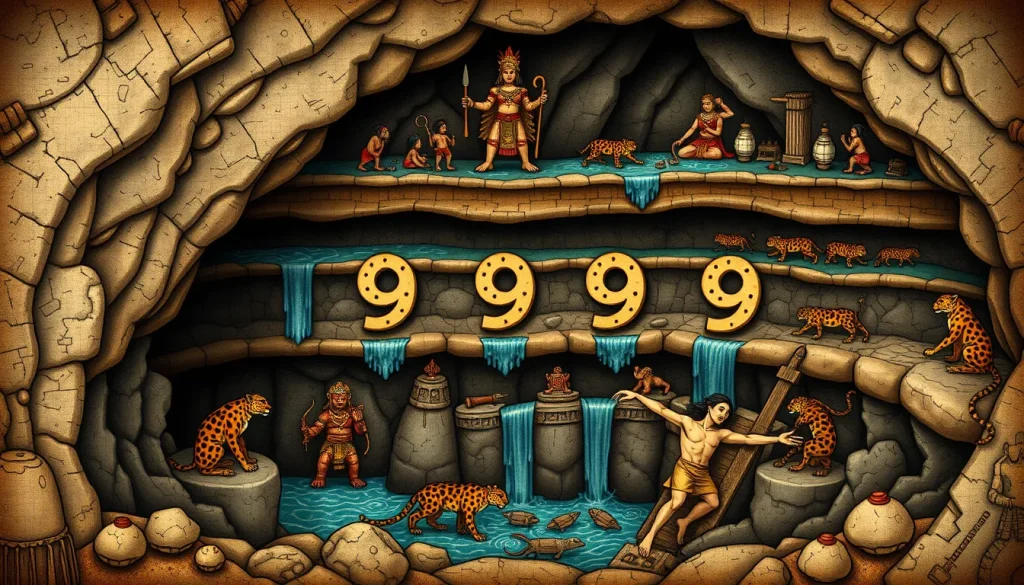
In the intricate worldview of the ancient Maya, the cosmos was not a singular plane but a stratified structure comprising the heavens, the earthly realm, and the underworld. This tripartite division was fundamental to their understanding of time, space, and existence. Within this cosmological framework, specific numbers held potent symbolic weight, acting as keys to unlock the mysteries of the divine order. Among these, the number nine stands out as a critical marker of the underworld, known as Xibalba to the K’iche Maya and Metnal to the Yucatec Maya. The significance of this number extends beyond simple arithmetic; it embodies concepts of culmination, transformation, and the sacred cycles that governed both the celestial and terrestrial domains.
Understanding the role of the number nine requires a multidisciplinary approach, weaving together insights from epigraphy, iconography, linguistics, and archaeology. Recent advancements in these fields have allowed scholars to piece together ancient Maya mythology with a clarity that was once deemed impossible. The number nine, or Bolon, is not merely a count but a symbol of the completion of stages and the convergence of cosmic forces. It is deeply embedded in the architecture of the underworld, the ritual practices of the living, and the mathematical systems used to track time. This article explores the archaeological and historical evidence surrounding the number nine, distinguishing verified ancient beliefs from modern interpretations.
Main Explanation
The significance of the number nine in Maya cosmology is primarily anchored in its association with the underworld. While the heavens were often associated with the number thirteen (representing the layers of the upper world), the underworld was conceptualized as having nine layers. These layers were not merely physical depths but spiritual states through which the sun traveled during the night. As the sun set, it was believed to descend into the underworld, facing trials and transformations before rising again in the east. The number nine marked the depth of this journey and the completeness of the nocturnal cycle.
Linguistically, the number nine is expressed as Bolon in Classic Maya. According to linguistic analysis, Bolon signifies culmination, transformation, and the completion of cycles. While lower numbers establish structure and balance, Bolon embodies the initiation of renewal processes. This duality—ending and beginning—is central to Maya thought, where death is not a finality but a transition. The underworld, therefore, was not just a place of punishment or fear, although it was indeed feared. It was a place of necessary transformation. The name Xibalba translates as ‘Place of Fright’, indicating the terror the place held in the Maya imagination, yet it was also a realm of powerful gods and blood-thirsty predators that tested the soul.

In ritual practice, the number nine frequently appears in contexts related to death and ancestry. Offerings placed in tombs often involved quantities linked to this number, and certain ceremonies were timed according to cycles involving nine days. The convergence of cosmic and terrestrial forces was believed to be strongest during these periods. Furthermore, the association with water is strong; the underworld was strongly associated with water, caves, and cenotes, which served as physical portals to the nine layers below. The integration of numerical, symbolic, and cosmological knowledge in Maya civilization demonstrates that Bolon was a cornerstone of their spiritual mathematics.
Evidence & Sources
The understanding of the number nine’s significance is derived from a convergence of ethnohistoric sources and archaeological data. Ethnohistoric records, such as those analyzed in studies of the K’iche and Yucatec Maya, provide the names and general descriptions of the underworld. For instance, sources confirm that for the Yucatec Maya, the underworld was known as Metnal, while the K’iche called it Xibalba. These texts describe a landscape filled with gods and dangers, where only those who died a violent death might avoid entering this realm. However, ethnohistory alone provides only a vague outline. It is through the piecing together of ancient Maya mythology and cosmology using modern interdisciplinary methods that specific details spring into focus.
Archaeological evidence supports the textual data through iconography found on ceramics and murals. Vases depicting the underworld often show deities associated with the night and death, frequently grouped in sets that align with the nine Lords of the Night. These Lords governed the nights in a repeating cycle, reinforcing the connection between the number nine and the passage of time in the dark realm. Epigraphers have deciphered glyphs that explicitly reference Bolon in contexts related to underworld deities and ritual completions. The work of iconographers and epigraphers has been crucial in moving beyond broad generalizations to identify specific details within the framework of Maya cosmology.
Furthermore, digital heritage initiatives have played a role in preserving and analyzing this data. High-resolution 3D modeling of ceramic vessels allows researchers to examine glyphic texts and iconographic details that are worn or obscured to the naked eye. Digital databases of Maya glyphs enable cross-referencing of the term Bolon across different sites and time periods, confirming its consistent association with underworld themes. This technological integration ensures that the interpretation of the number nine is based on comprehensive data rather than isolated examples. The collaboration between dirt archaeologists, linguists, and digital specialists continues to shed new light on the still only dimly perceived underworld of the ancient Maya.
Deep Dive Analysis
Module A: Definition and Conceptual Framework
Definition: In the context of Maya cosmology, the number nine (Bolon) is defined as the sacred numeral representing the underworld, the completion of cyclical time, and the state of transformation necessary for renewal. It is the cosmological counterpart to the number thirteen of the heavens.
How it works: The concept operates on multiple levels: spatial, temporal, and ritual. Spatially, it maps the nine layers of the underworld through which the sun travels at night. Temporally, it governs the cycle of the nine Lords of the Night, who rule over successive nights in a sequence. Ritually, it dictates the structure of ceremonies involving death, burial, and communication with ancestors, often requiring offerings or timings based on multiples of nine.
Key components: The system comprises the nine layers of Xibalba/Metnal, the nine Lords of the Night, and the linguistic concept of Bolon as culmination. These components interact to form a cohesive worldview where the underworld is a dynamic place of power rather than a static void. The association with water and caves serves as the physical manifestation of these components in the landscape.
Example: A classic example is found in the depiction of the Maize God’s resurrection. In many vase paintings, the Maize God emerges from a crack in the earth or a turtle shell, symbolizing the underworld. The scenes often include attendant deities numbered or grouped in ways that suggest the nine-layered structure, facilitating the god’s transformation from death to life. This visual narrative reinforces the idea that the number nine is the threshold of rebirth.
Historical evidence: Evidence is drawn from the Classic Period codices, ceramic iconography, and Postclassic ethnohistoric texts. Sources indicate that the number nine was integral to calendrical systems and ritual practices. The consistency of the number nine across different Maya regions, from the Yucatan to the Peten, suggests a pan-Maya cosmological standard. Linguistic studies confirm the semantic weight of Bolon across Mayan languages, highlighting its role in signifying transformation.
Common misconceptions: A frequent misconception is interpreting the number nine through modern New Age lenses as solely a symbol of ‘universal love’ or ‘spiritual enlightenment’ without grounding in the harsh realities of Maya belief. The Maya underworld was a ‘Place of Fright’, filled with blood-thirsty predators and gods who demanded respect and offering. Another misconception is that the number nine was only related to death; in reality, it was equally about renewal and the cyclical nature of existence, where the end of one stage initiates the next. Academic rigor requires distinguishing between these ancient, often fearsome, cosmological realities and modern spiritual reinterpretations.
FAQ
Did all Maya groups call the underworld Xibalba?
No. While Xibalba is the K'iche Maya name, the Yucatec Maya referred to the underworld as Metnal. Both concepts share similar cosmological structures involving nine layers.
Why is the number nine associated with the underworld?
The number nine, or Bolon, represents culmination and transformation. It corresponds to the nine layers of the underworld through which the sun traveled at night.
Could anyone avoid going to the underworld after death?
According to Maya belief systems, most souls went to the underworld. Only those who died a violent death, such as in sacrifice or childbirth, were believed to avoid Xibalba.

Leave a Reply