
Short Answer
The Wakah Chan, translated as the “Raised Up Sky,” represents one of the most fundamental pillars of ancient Maya cosmology. Far from being a mere decorative motif, the World Tree served as the axis mundi—the central axis of the universe—providing a structural and metaphysical link between the three primary layers of existence: the celestial heavens, the earthly plane, and the subterranean underworld (Xibalba). This cosmic architecture allowed for the flow of divine energy and the movement of deities and ancestral souls between realms, ensuring the continuity of life, death, and rebirth in a cyclical universe.
The Metaphysical Significance of the World Tree
In the Maya worldview, the cosmos was not a void but a structured environment requiring a central support system to prevent collapse. The Wakah Chan functioned as this support, effectively holding up the sky. Its significance is rooted in several key cosmological functions:
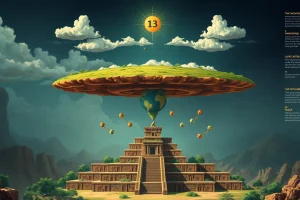
- Cosmic Connectivity: The tree’s roots penetrated the depths of the underworld, its trunk existed within the human realm, and its branches reached into the thirteen levels of heaven. This verticality allowed the Maya to conceptualize a unified universe where different planes of existence were interdependent.
- The Conduit of Souls: The World Tree acted as a pathway. It was believed that souls of the deceased, as well as gods descending to earth, utilized the axis of the tree to navigate between the realms. This is particularly evident in funerary art, where the tree facilitates the transition from death to ancestral apotheosis.
- Directional Orientation: The Wakah Chan was not always a single tree but often a system of five trees—one at the center and one at each of the four cardinal directions. Each cardinal tree was associated with a specific color and deity, mirroring the fourfold nature of the Maya universe and grounding the center in a precise geographic and spiritual coordinate.
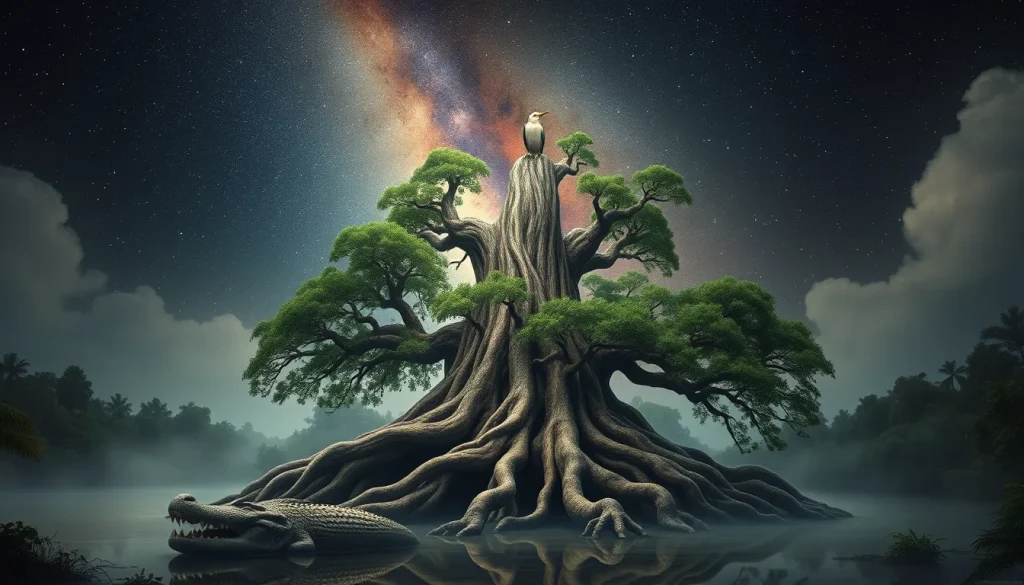
- Celestial Mirroring: The Maya observed the night sky as a reflection of their earthly cosmology. The Milky Way, when positioned vertically, was interpreted as the glowing manifestation of the World Tree in the heavens, linking astronomical observation with theological belief.
Evidence and Archaeological Sources
The existence and significance of the Wakah Chan are documented through a combination of epigraphy, iconography, and botanical analysis. The evidence is distributed across various media, from monumental stone stelae to intimate ceramic vessels.
One of the most iconic representations is found on the lid of K’inich Janaab’ Pakal’s sarcophagus at Palenque. This masterpiece of Classic period art depicts the king at the moment of death, falling into the jaws of the underworld while a cruciform World Tree rises from his body. The tree is topped by a celestial bird, symbolizing the ascent of the soul and the king’s transformation into a divine ancestor. This imagery confirms the tree’s role as a vehicle for transcendence.
Botanically, scholars like J. Andrew McDonald have analyzed the morphic characteristics of these depictions. While some interpretations suggest the maize plant (Zea mays) due to its vital importance to survival, the prevailing archaeological and ethnographic consensus identifies the Ceiba tree (Ceiba pentandra) as the primary model. The Ceiba’s massive size, wide-spreading canopy, and buttressed roots make it a natural earthly analogue for a cosmic pillar. In the Yucatan region, this is still referred to as the Ya’axche’.
Furthermore, the base of the World Tree is frequently depicted as a crocodilian monster or a turtle carapace, representing the earth floating upon the primordial waters of creation. This synthesis of vegetal, animal, and celestial elements underscores the Maya belief in an integrated, living cosmos.
Deep Dive Analysis: The Concept of Wakah Chan
Definition
The Wakah Chan is the conceptual “Cosmic Tree” or “World Tree” of the Maya, acting as the central vertical axis of the universe. It is a symbolic representation of the connection between the underworld, the earth, and the heavens.
How it Works
The Wakah Chan operates as a metaphysical bridge. In Maya ritual and myth, the tree is the medium through which communication with the divine occurs. Shamanic practitioners and kings—who were seen as the earthly intermediaries—would perform rituals to “activate” this axis, allowing them to send prayers upward or retrieve wisdom from the ancestors below.
Key Components
- The Root System: Associated with Xibalba (the underworld), often depicted as intertwined with aquatic monsters or skeletal figures.
- The Trunk: The terrestrial plane where humans reside; the site of ritual sacrifice and agricultural labor.
- The Canopy: The celestial realm, often inhabited by the Principal Bird Deity (Itzam-Ye) or other sky gods.
- The Cardinal Trees: Four auxiliary trees that define the boundaries of the world, ensuring the stability of the center.
Historical Example
During the Classic Period (c. 250–900 AD), the Wakah Chan was integrated into the architecture of royal plazas. Stelae were often erected to function as “stone trees,” effectively turning the city center into a sacred landscape where the king stood at the center of the axis mundi, legitimizing his power as the maintainer of cosmic order.
Common Misconceptions
A frequent modern misconception is the attempt to link the Wakah Chan to the “Tree of Life” in a biblical or New Age sense, suggesting it provides immortality or magical healing. In the historical Maya context, the tree was not about individual immortality in a spiritualist sense, but about the eternal recurrence of the cosmos and the legitimate transition of power and soul within a strict hierarchical and cosmological framework. It was a structural necessity of the universe, not a magical object for personal gain.
FAQ
Is the Wakah Chan a real tree or a myth?
It is a mythological concept based on a real botanical species, the Ceiba tree (Ceiba pentandra), which was revered by the Maya for its immense size and structure.
How does the Milky Way relate to the World Tree?
The Maya viewed the Milky Way as the celestial version of the Wakah Chan; when it appeared upright in the sky, it was seen as the glowing axis connecting the cosmic realms.
What is the significance of the bird at the top of the tree?
The bird, often identified as the Principal Bird Deity (Itzam-Ye), represents the highest celestial realm and the ultimate destination of the ascending soul.
Leave a Reply