

Short Answer
The question of whether the Ancient Maya tracked the movements of Mars has long intrigued archaeologists and astronomers alike. While the Maya are renowned for their precise observations of Venus, the Moon, and the Sun, evidence regarding the Red Planet remained elusive until recent decades. Contemporary research into pre-Columbian manuscripts, specifically the Dresden Codex, has provided compelling proof that Maya astronomers not only observed Mars but developed complex mathematical tables to predict its movements. This discovery underscores the breadth of Maya celestial knowledge and their ability to integrate disparate planetary cycles into their cosmological framework.
Main Explanation
The identification of Mars tracking in Maya culture stems from rigorous analysis of the Dresden Codex, one of the few surviving pre-Columbian Maya books. For many years, scholars focused heavily on the Venus Table, which dominates pages 46–50. However, groundbreaking work published in the early 21st century revealed that other sections of the codex were dedicated to the synodic cycle of Mars. The research indicates that the Maya understood the cyclic nature of planetary movements, recognizing that Mars, like Earth and Venus, follows predictable patterns relative to the stars.
The difficulty in deciphering Mars’s motion is comparable to the challenges faced by Johannes Kepler in the 17th century. Kepler had to disentangle Mars’ motion from that of Earth to understand its orbit. Similarly, Maya astronomers, observing from a moving Earth, had to calculate the position of Mars relative to the stars over long periods. The surviving documents suggest they achieved this through careful observation and the use of commensurate relationships among celestial cycles. These relationships allowed them to align the irregular movements of Mars with their rigid calendar systems, ensuring that ritual activities could be timed according to celestial events.
Evidence & Sources
The primary evidence for Maya Mars observation is found in the Dresden Codex, specifically on pages 43b–45b and a complex table on pages 69–74. This discovery was detailed in a seminal study by Anthony F. Aveni and Victoria R. Bricker, published in the Proceedings of the National Academy of Sciences (PNAS) in 2001. Their work demonstrated that a large part of the codex is concerned with exploring commensurate relationships among celestial cycles and their relationship to nonastronomical cycles of cultural interest.
Further academic discussion has taken place in journals such as Latin American Antiquity, where scholars continue to refine the understanding of these tables. The research confirms that the Maya were not merely recording random sightings but were engaged in a systematic exploration of planetary mechanics. The texts reveal a concern with aligning the Mars cycle with other cultural and astronomical periods, suggesting that the Red Planet held significant ritual importance. The preservation of these tables in the Dresden Codex serves as a testament to the durability of Maya intellectual traditions and the high value placed on astronomical knowledge within their scribal culture.
Deep Dive Analysis
Celestial Object
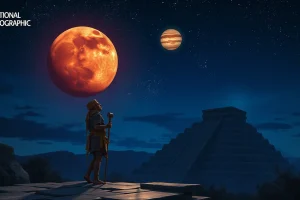
The object of study is Mars, known in Maya cosmology often in association with aggression or warfare, though specific glyphic names vary across periods. In the context of the Dresden Codex, the planet is treated as a wandering star with a distinct periodicity that required monitoring alongside the more prominent Venus.
Observational Cycle
The Maya focused on the synodic cycle of Mars, which is the time it takes for the planet to return to the same position in the sky relative to the Sun as seen from Earth. This cycle is approximately 780 days, though it varies slightly. The Maya tables were designed to account for these variations over long counts of time, allowing for corrections to maintain accuracy.
How Maya Observed It
Observations were conducted with the naked eye, relying on keen, patient monitoring of the night sky. Maya astronomers tracked the planet’s changing position relative to fixed stars and horizon markers. The cyclic nature of planetary movements made this feasible, as astronomers could determine the position of Mars on certain calendar dates over several years in succession. This data was then codified into the mathematical structures found in the codices.
Archaeological and Textual Evidence
The textual evidence is concentrated in the Dresden Codex. Pages 43b–45b are explicitly concerned with the synodic cycle of Mars. Additionally, a complex table on pages 69–74 reveals further concerns regarding the planet’s movements. These pages contain numerical sequences and glyphic annotations that correlate Mars’ positions with the 260-day ritual calendar (Tzolk’in) and the 365-day solar calendar (Haab’).
Calendar Connection
The integration of Mars into the Maya calendar system required finding commensurate relationships. The astronomers sought to align the Martian cycle with the sacred 260-day cycle and the solar year. This allowed them to predict future positions of Mars based on past observations. The ability to synchronize these cycles was crucial for scheduling rituals and understanding the cosmic order.
Architecture Connection
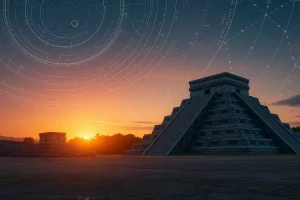
While the primary evidence is textual, Maya architecture often reflects astronomical alignments. Although specific Mars-aligned structures are less definitively identified than Venus alignments (such as at the Caracol in Chichén Itzá), the knowledge encoded in the codices likely informed the orientation of temples and observatories. The architectural landscape served as a fixed reference point against which the wandering planets were measured.
Cultural Meaning
In Mesoamerican cosmology, planets were often associated with deities and specific earthly outcomes. Mars, with its reddish hue, was frequently linked to war and conflict. Tracking its movement allowed priest-astronomers to determine auspicious or inauspicious times for warfare, political maneuvers, and ritual activities. The codices served as manuals for navigating these cosmic influences.
Uncertainty and Debate
Despite the strong evidence, some uncertainties remain. Scholars continue to debate the exact interpretation of certain numerical corrections in the Mars tables. Articles in Latin American Antiquity discuss nuances in the Mars Table, indicating that while the general consensus supports Mars observation, the specific mathematical methods and their accuracy over centuries are subjects of ongoing analysis. Furthermore, distinguishing between Mars and other celestial phenomena in glyphic text requires careful epigraphic work, as symbols can be polysemous.
FAQ
Which codex contains the evidence for Mars tracking?
The Dresden Codex contains the primary evidence, specifically on pages 43b–45b and 69–74.
Who confirmed the Mars tables in the Dresden Codex?
Anthony F. Aveni and Victoria R. Bricker published key research confirming the Mars tables in 2001.
Why was tracking Mars difficult for ancient astronomers?
Mars moves slowly and its position must be disentangled from Earth's motion, requiring complex mathematical corrections.
Did the Maya use telescopes to observe Mars?
No, the Maya conducted all astronomical observations with the naked eye, relying on patience and mathematical modeling.




Leave a Reply