Short Answer
The decipherment of Ancient Maya hieroglyphic writing stands as one of the most significant intellectual achievements of the twentieth century. However, despite over a century of formidable efforts by academics in archaeology and epigraphy, a significant proportion of the Maya hieroglyphic corpus remains open for scholarly interpretation. These inscriptions, located across Mexico and Central America and imprinted on multiple media types and artifacts, contain rich history and societal knowledge embedded within a complex visual narrative. Today, this long-standing goal of comprehensive understanding is being accelerated by the rapid progress of computer science, specifically through multimedia analysis and information management methods capable of organizing, analyzing, and visualizing visual collections.
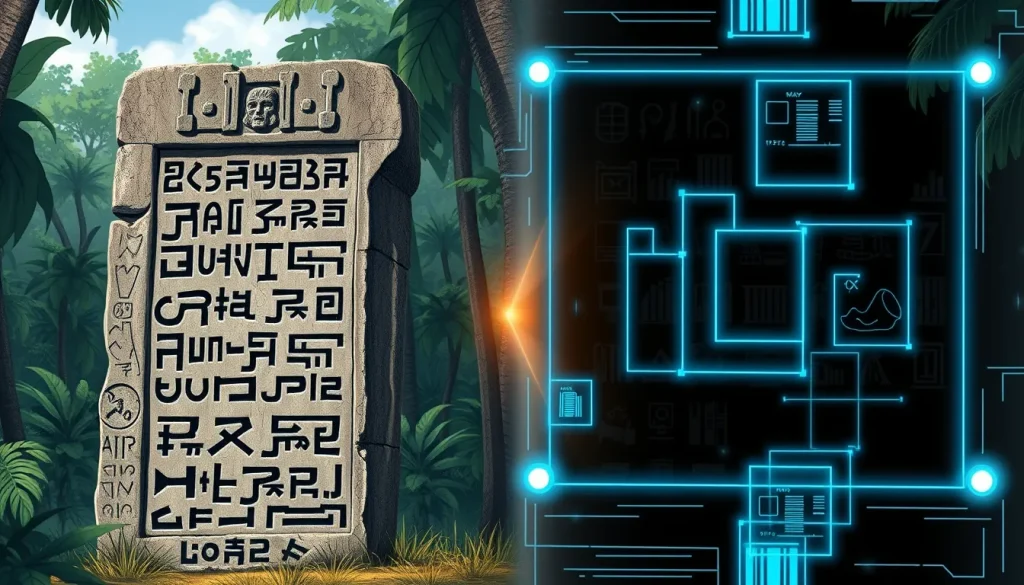
Digital epigraphy has emerged as a critical subfield within digital heritage, leveraging artificial intelligence (AI) and machine learning (ML) to support the work of Maya hieroglyphics experts. This interdisciplinary approach does not seek to replace the epigrapher but to tightly integrate their work with computer scientists to jointly design, develop, and assess new computational tools. By combining expert knowledge with advanced statistical models and shape representation techniques, digital epigraphy aims to advance the state of Maya epigraphy and allow non-specialists access to reading these texts while aiding in the decipherment of those hieroglyphs which continue to elude comprehensive interpretation.
Main Explanation
Digital epigraphy refers to the application of digital technologies to the study of inscriptions. In the context of the Ancient Maya, this involves the digitization of glyphs found on stelae, codices, ceramics, and architecture, followed by computational analysis. The core challenge lies in the variability of the script; Maya glyphs are logographic and syllabic, often exhibiting significant variation in style depending on the artist, region, and time period. Traditional methods rely on manual drawing and comparative analysis, which are time-consuming and subjective.
Machine learning offers a novel lens through which researchers can translate these inscriptions. Modern methods include automatic glyph retrieval, classification, and segmentation. For instance, statistical Maya language models can be combined with shape representation within a hieroglyph retrieval system. This allows researchers to query digital repositories for specific glyph variants or linguistic structures. The aim is to create robust and effective computational tools that support the nuanced work of experts, rather than providing automated translations that lack contextual understanding. The integration ensures that the technology serves the scholarly interpretation rather than dictating it.
Evidence & Sources
The development of digital epigraphy tools is documented through several key interdisciplinary efforts. The Multimedia Analysis and Access for Documentation and Decipherment of Maya Epigraphy (MAAYA) project exemplifies this bi-disciplinary integration. Involving institutions such as the Idiap Research Institute, EPFL, and the University of Bonn, the project focused on defining consistent conventions to generate high-quality representations of Maya hieroglyphs from the three most valuable ancient codices. These codices currently reside in European museums and institutions, making digital access crucial for global scholarship.
Research published in 2015 outlined an integrated framework for multimedia access and analysis of ancient Maya epigraphic resources. This work included the creation of a digital repository system for glyph annotation and management, as well as automatic glyph retrieval and classification methods. Studies examined the impact of applying language models extracted from different hieroglyphic resources on various data types, highlighting the effect of shape representation choices for glyph classification. A novel Maya hieroglyph data set was generated during this period to facilitate further research.
More recently, a 2024 study demonstrated the efficacy of leveraging large foundation models to segment Maya hieroglyphs from open-source digital libraries. Despite the initial promise of publicly available foundation segmentation models, their effectiveness in accurately segmenting Maya hieroglyphs was initially limited. Addressing this challenge, the study involved the meticulous curation of image and label pairs with the assistance of experts in Maya art and history. This process of fine-tuning significantly enhanced model performance, illustrating the potential of fine-tuning approaches and the value of expert-curated data in digital archaeology.
Deep Dive Analysis
Technology Description
The primary technology driving modern digital epigraphy is machine learning, specifically deep learning models capable of computer vision tasks. These include Convolutional Neural Networks (CNNs) for classification and Transformer-based foundation models for segmentation. In the context of Maya studies, these technologies are adapted to recognize non-Latin script variants that differ significantly from standard optical character recognition (OCR) targets. The technology relies on training data consisting of images of glyphs paired with semantic labels provided by human experts.
How It Works
The workflow begins with the digitization of artifacts through high-resolution photography or 3D surveying. These images are processed to isolate individual glyphs or glyph blocks. In traditional machine learning pipelines, features are manually engineered. However, in modern approaches leveraging foundation models, the system learns hierarchical representations of visual data. For Maya glyphs, this means the model learns to identify strokes, contours, and spatial relationships that define specific signs. The fine-tuning process adjusts the pre-trained weights of a general model using a specialized dataset of Maya inscriptions, allowing it to generalize better to the specific stylistic variations of the script.
Field Workflow
The workflow is inherently collaborative. Computer scientists design the architecture, but epigraphers provide the ground truth. Experts in Maya art and history assist in the meticulous curation of image and label pairs. This ensures that the model learns the correct semantic meaning of a glyph, distinguishing between homographs or stylistic flourishes that do not change meaning. The MAAYA project emphasized this tight integration, where tools are assessed jointly by both disciplines to ensure they robustly support scholarly work rather than introducing computational biases.
Output and Data
The primary outputs include segmented images of individual glyphs, classification labels identifying the glyph’s phonetic or logographic value, and similarity metrics for retrieval systems. A digital repository system allows for the management of these annotations. Researchers can retrieve glyphs based on shape or linguistic content, facilitating comparative studies across different sites and time periods. The 2024 segmentation study produced enhanced models capable of accurately isolating glyphs from complex backgrounds, a common issue in weathered stone inscriptions.
Example
A concrete example is the application of fine-tuned foundation models to open-source digital libraries dedicated to Maya artifacts. Initially, generic segmentation models failed to accurately bound the complex shapes of hieroglyphs. By curating specific training data with expert assistance, the model was retrained. The result was a significant enhancement in performance, allowing for the automated processing of large corpora that would otherwise take decades to catalog manually.
Strengths
The primary strength of digital epigraphy is scalability. Machine learning can process thousands of images faster than human teams. It also offers consistency; a model applies the same criteria to every glyph, reducing human fatigue-related errors. Furthermore, it enables new forms of analysis, such as quantifying stylistic changes over time or identifying scribal hands through subtle geometric variations invisible to the naked eye.
Limitations
Despite advancements, limitations remain. The effectiveness of these models is heavily dependent on the quality and quantity of labeled training data. Maya inscriptions are often eroded, fragmented, or obscured, which confuses computer vision algorithms. Additionally, the decipherment of some glyphs remains incomplete; if the expert label is uncertain, the model learns that uncertainty. Publicly available foundation models often lack the specific inductive bias required for ancient scripts without significant fine-tuning.
Accuracy
Accuracy varies by task. Segmentation accuracy has improved significantly through fine-tuning approaches, as illustrated by recent studies. However, semantic classification remains challenging due to the polysemous nature of some glyphs. The combination of statistical Maya language models and shape representation helps mitigate this by contextualizing the glyph within the surrounding text, similar to predictive text on modern keyboards but based on ancient grammar.
Cultural Heritage Considerations
Digital epigraphy raises important cultural heritage considerations. The data often originates from artifacts held in institutions far from their countries of origin. Digital repositories must respect the provenance and cultural significance of the items. Furthermore, the tools are designed to support scholars, not to democratize interpretation to the point of misinformation. The MAAYA project explicitly aims to support Maya hieroglyphics experts, ensuring that the authority of interpretation remains with trained epigraphists who understand the cultural and historical context of the writings.
FAQ
Can AI fully decipher Maya glyphs without human experts?
No. Current AI tools are designed to support Maya hieroglyphics experts, not replace them. Expert knowledge is required to curate training data and interpret contextual meanings that algorithms cannot yet grasp.
What is the MAAYA project?
The MAAYA project is a bi-disciplinary initiative integrating epigraphists and computer scientists to design computational tools for documenting and deciphering Maya epigraphy through multimedia analysis.
Why is fine-tuning necessary for Maya glyph models?
Publicly available foundation models initially showed limited effectiveness on Maya hieroglyphs. Fine-tuning with expert-curated image and label pairs significantly enhances model performance for this specific script.
Leave a Reply