Short Answer
El Caracol, located within the ancient Maya city of Chichén Itzá in the Yucatán Peninsula, stands as one of the most enigmatic and architecturally distinct structures of the Post Classic period. While many Maya buildings served ceremonial or residential purposes, El Caracol is uniquely positioned and designed, leading researchers to propose it functioned primarily as an astronomical observatory. The structure’s name, meaning “snail” in Spanish, derives from the internal spiral staircase that winds toward the upper tower, a feature uncommon in typical Maya architecture. This design facilitated access to elevated viewing platforms, allowing astronomers to observe celestial events over the flat landscape of the Yucatán, which lacks natural topographical markers for horizon-based astronomy.
The primary astronomical function of El Caracol revolves around the tracking of celestial bodies critical to the Maya calendar and cosmology. Research indicates that the building’s windows and shafts align with significant astronomical events, particularly the extremes of Venus, the solar equinoxes, and potentially lunar standstills. Venus held profound cultural significance for the Maya, associated with warfare and the deity Quetzalcoatl (known as Kukulcán in Maya tradition). The ability to predict the heliacal rising and setting of Venus was essential for timing ritual activities and military campaigns. While the observatory hypothesis is widely accepted, academic consensus maintains a degree of caution, noting that not every architectural alignment corresponds to a recognized astronomical event, suggesting some features may have been symbolic rather than functional.
Main Explanation
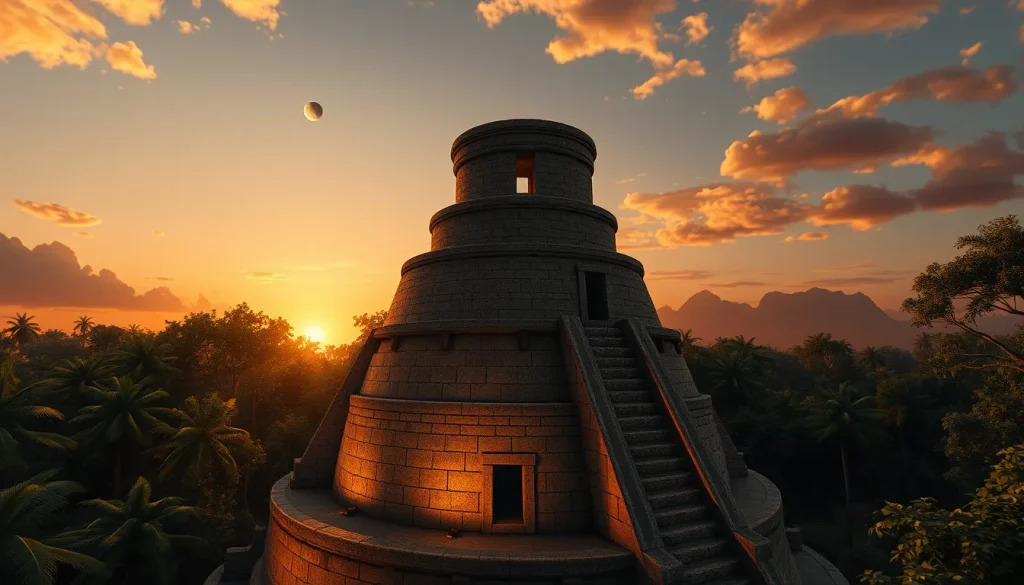
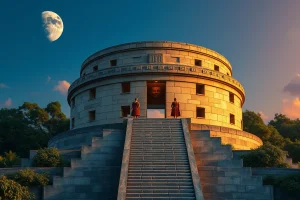
The astronomical utility of El Caracol is derived from the precise orientation of its architectural features relative to the horizon. The structure is situated on a large platform, elevating the viewing tower above the surrounding vegetation. This elevation was crucial for observers to gain an unobstructed view of the sky, compensating for the dense jungle canopy that typically characterizes the Yucatán Peninsula. The upper tower, originally shaped as a smaller cylinder stacked upon a larger one, contains narrow openings that functioned as sighting shafts. These openings were not designed for general ventilation or light but were specifically calibrated to frame celestial bodies at critical points in their cycles.
Central to the function of El Caracol was the observation of Venus. Maya astronomers understood that Venus appeared on the western and eastern horizons at different times throughout the year, completing a synodic cycle of approximately 584 days. Furthermore, they recognized a larger cycle wherein five Venus cycles equaled eight solar years. This harmonic relationship allowed for long-term calendar corrections and ritual scheduling. The windows of El Caracol align with the northerly and southerly extremes of Venus’s setting and rising positions. By monitoring these extremes, priests could maintain the accuracy of the Venus table, a component of the Dresden Codex, which was vital for predicting auspicious and inauspicious dates.
In addition to Venus, the structure facilitated observations of the sun and moon. Specific alignments correspond to the sunset during the equinoxes, marking the division of the solar year. There is also evidence suggesting alignments with lunar extremes, although these are less definitively mapped than the Venusian sightlines. The integration of these celestial cycles into the architecture demonstrates a sophisticated understanding of positional astronomy. However, it is important to distinguish between functional sighting lines and symbolic orientations. Some alignments may reflect cosmological beliefs rather than practical observational needs, serving to reinforce the sacred nature of the building rather than acting as a scientific instrument in the modern sense.
Evidence & Sources
The hypothesis that El Caracol served as an observatory is supported by interdisciplinary studies combining archaeology, astronomy, and digital heritage technologies. A seminal study published in Science in 1975 by Anthony F. Aveni, Sharon L. Gibbs, and Horst F. Hartung initiated a systematic investigation into the astronomical orientation of the Caracol. Their work involved careful measurement of the structure’s alignments and comparison with significant astronomical events. The study revealed that many measured alignments coincided with sun, moon, and planetary extremes, as well as the setting positions of bright stars. However, the authors explicitly noted that not every alignment had a recognizable astronomical match, suggesting that only some sighting possibilities were actually functional.
Modern digital heritage techniques have further validated these findings. Laser scans of El Caracol have provided precise three-dimensional models of the structure, allowing researchers to analyze sightlines without the interference of modern decay or restoration efforts. These scans confirm that the three surviving openings in the upper tower are small, narrow, and irregularly placed, consistent with their use as viewing shafts rather than windows for habitation. The digital reconstruction of the original form—a double-decker cylindrical tower—helps visualize how observers would have utilized the upper platform. These technological advancements allow for a more nuanced understanding of how the building interacted with the landscape and the sky.
Historical documents and stelae also provide contextual evidence. A stele on the Upper Platform dates the structure to around AD 906, placing it firmly in the Post Classic period of Mesoamerican chronology. This era is characterized by increased influence from central Mexico, reflected in the architectural style and the emphasis on Quetzalcoatl imagery. The association with Quetzalcoatl reinforces the Venus connection, as the deity was closely linked to the planet in Mesoamerican cosmology. While pre-Conquest documents suggest positional astronomy was widely practiced in Mexico, the Caracol remains one of the few surviving structures explicitly designed for this purpose. The convergence of architectural data, historical dating, and astronomical calculation forms a robust evidentiary basis for the observatory theory.
Deep Dive Analysis
Module B: Building/Site Analysis
Location
El Caracol is situated within the main ceremonial center of Chichén Itzá, southwest of the Great North Platform. Its placement on a substantial base platform elevates the structure above the surrounding terrain. This location was chosen strategically to maximize visibility over the flattened landscape of the Yucatán, where natural markers for astronomical observation are scarce. The observers could view the sky above the vegetation on the Yucatán Peninsula without any obstruction, a critical requirement for horizon-based astronomy.
Construction and History
The structure is dated to around AD 906, based on inscriptions found on the Upper Platform stele. This places its construction in the Post Classic period, a time of significant cultural transition in the Maya region. The building underwent multiple phases of construction, with the outer platform and staircase added to support the central tower. The name “El Caracol” (Snail) was assigned by Spanish conquistadors due to the internal spiral staircase, a feature that distinguishes it from typical Maya pyramids. The spiral design allowed access to the upper observation chamber while minimizing the structural footprint.
Architecture
Architecturally, El Caracol consists of a large rectangular platform supporting a circular tower. The tower was originally in the form of one smaller cylinder stacked on a larger one, resembling a double-decker wedding cake. To gain access to the uppermost tower, observers had to walk through a narrow winding staircase. In the half-ruined higher tower, three openings survive. These three openings are small, narrow, and irregularly placed, suggesting that they are actually viewing shafts. The masonry work demonstrates high precision, indicating that the angles of the walls and windows were intentional rather than accidental.
Astronomical Interpretation
The three window shafts that remain in the upper tower seem to align with various celestial events on the horizon. Looking through these windows a thousand years ago, observers could have watched for Venus rising at its northern and southern extremes, as well as the equinox sunset. The alignments include the setting position of Venus at its southern extreme and the setting position of Venus at its northern extreme. Additionally, there are alignments related to the sun, specifically the equinox sunset. These sightlines allowed astronomers to track the complex cycles of Venus, knowing that five Venus cycles equaled eight solar years.
Archaeological Evidence
Investigations reveal a number of significant astronomical events coinciding with many of the measured alignments presented in archaeological tables. However, systematic studies involving careful measurement have shown that not every alignment appears to have an astronomical match which researchers can recognize. The search for significant astronomical events has included those of obvious functional importance: sun, moon, and planetary extremes. The presence of the stele dating the building provides a chronological anchor, linking the architecture to a period when astronomical knowledge was highly valued.
Alternative Interpretations
While the observatory function is prominent, the building was also a monument related to Quetzalcoatl. Some alignments may serve a symbolic purpose rather than a purely observational one. It may be that only some of the sighting possibilities discussed were actually functional. Perhaps hitherto unrecognized constellations were sighted in the windows, or perhaps fainter stars, the heliacal rising and setting times of which could have served to mark important dates in the calendar. The structure may have served dual purposes: practical astronomy and religious monumentality.
Scholar Consensus
The scholarly consensus, supported by the 1975 Science study and subsequent digital analyses, is that El Caracol was designed with astronomical orientation in mind. However, researchers propose no grand cosmic scheme for the astronomical design of the Caracol that explains every feature. It is inferred that the building, apart from being a monument related to Quetzalcoatl, was used for observing changes in the sky. The consensus acknowledges the sophistication of Maya astronomy while avoiding over-interpretation of ambiguous architectural features.
Visitor Misconception
A common misconception among visitors is that El Caracol was used to observe all celestial bodies equally or that every window corresponds to a specific star. In reality, the focus was heavily weighted toward Venus and the Sun. Another misconception is that the structure functioned like a modern telescope; instead, it relied on naked-eye observations aligned through architectural shafts. The building provided a way for the Maya people to observe changes in the sky due to the flattened landscape, but it was not a universal observatory for all astronomical phenomena.
FAQ
Was El Caracol definitely an observatory?
While widely accepted as an observatory due to architectural alignments with Venus and the Sun, researchers note that not every alignment has a recognized astronomical match, suggesting some features may be symbolic.
What does the name El Caracol mean?
El Caracol means 'snail' in Spanish, named for the spiral staircase inside the tower that winds upward to the observation deck.
When was El Caracol built?
The structure is dated to around AD 906, during the Post Classic period of Mesoamerican chronology, based on a stele found on the Upper Platform.
Why was Venus important to the Maya?
Venus was associated with warfare and the deity Quetzalcoatl. Tracking its 584-day cycle allowed the Maya to schedule rituals and military campaigns.
Leave a Reply