
Short Answer
The Maya Maize God stands as one of the most pivotal figures in Mesoamerican cosmology, embodying the cyclical nature of life, death, and regeneration inherent in agricultural societies. While often viewed through the lens of mythology alone, recent archaeoastronomical research suggests that the narrative of the Maize God’s journey is deeply rooted in the observation of celestial phenomena. This journey, particularly the deity’s resurrection from the underworld, parallels the movement of specific constellations and the Milky Way, creating a sacred geography written in the stars. Understanding this connection requires analyzing Classic Period iconography alongside Post-Classic textual records to distinguish between historical belief and modern interpretation.
Main Explanation
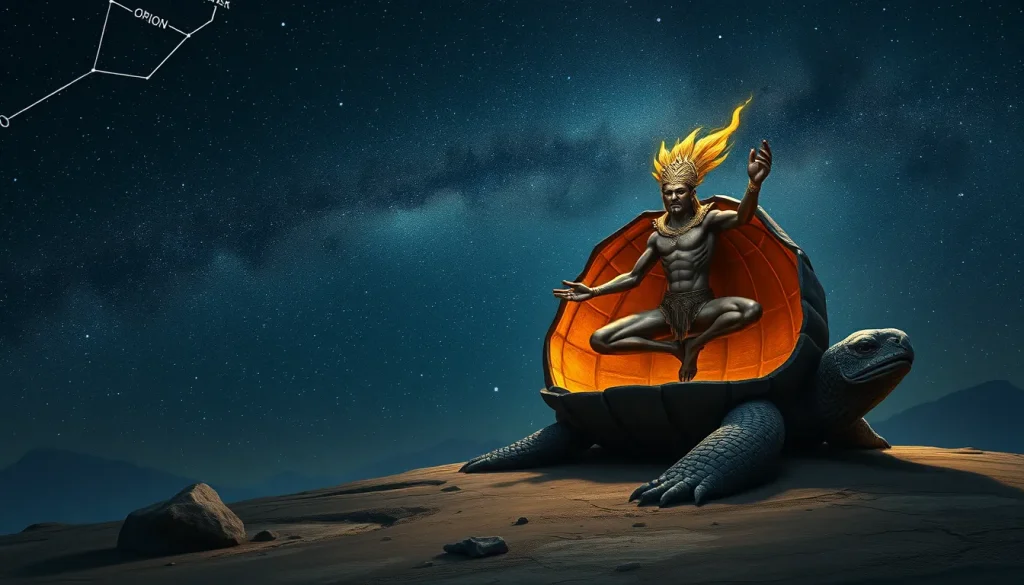
The core narrative of the Maize God involves his death, descent into the underworld (Xibalba), and subsequent resurrection, which ensures the renewal of crops and the continuity of time. In the Classic Period (200–900 CE), the Maize God is frequently depicted as a culture hero, often shown emerging from a cracked turtle shell. This iconography is not merely symbolic of planting seeds in the earth but corresponds to specific astronomical configurations. According to research regarding the celestial origin of Maya creation myths, the three hearthstones of the creation story are identified within the constellation Orion. These stars—Alnitak, Saiph, and Rigel—form a triangle that frames the Orion Nebula, interpreted as the mythical hearthfire where creation occurred.
The journey of the Maize God is inextricably linked to the creation of the world itself. On creation eve, recorded as August 12 in the correlation of the Maya Long Count calendar, the Milky Way stretches from east to west across the night sky. To the ancient Maya, this position of the galaxy represented a great canoe paddled by gods who transport the First Father, or the Maize God, to the place of creation. This astral narrative reinforces the deity’s role as a mediator between the celestial realm and the terrestrial world. The maize deity’s emergence is not an isolated event but part of a broader cosmological framework where the sky dictates the rhythm of agricultural and ritual life. The identification of the Maize God with the constellation Orion and the Milky Way provides a tangible mechanism for how the Maya visualized the divine intervention in natural cycles.
Furthermore, the mythological tradition recognizes maize as a vital force with which the Maya strongly identify. According to the 16th-century Popol Vuh, humanity was created from maize, and the Hero Twins have maize plants as alter egos. This suggests that the Maize God’s journey is also the journey of humanity. The discovery and opening of Maize Mountain, the place where corn seeds were hidden, remains one of the most popular tales, illustrating the deity’s role as a provider. However, the astronomical overlay adds a layer of precision to these myths, suggesting that the timing of rituals was calibrated to match the celestial movements associated with the god’s resurrection.
Evidence & Sources
The reconstruction of the Maize God’s astronomical journey relies on a convergence of epigraphic decipherment, iconographic analysis, and archaeoastronomy. A primary source of information regarding the creation story is found on Quirigua Stela C. The text on this monument describes the first event of creation as the “appearance or manifestation of an image” (halhi k’ohba). Here, the image that appeared was of three stone-settings (u tz’apwa tun), described as a jaguar throne stone placed by the Paddler gods. This inscription provides the most detailed information about the first moment of creation, associating the event with various constellations and their movement through the sky.
Scholarly interpretation of these texts has evolved significantly over the past few decades. At the 1992 Texas Meetings, Linda Schele presented a new interpretation of the creation myth and the imagery associated with it, as recorded in Classic Period inscriptions. This new reconstruction resulted from the decipherment of texts at Quirigua, Palenque, and elsewhere, relating the events of creation to astronomical phenomena. Researchers such as Schele, Grube, Nahm, R. Johnson, and Quenon have tested patterns in these inscriptions and found them to be productive, though debate continues about some details. The work of Karl Taube also remains foundational; he identified the ‘Tonsured Maize God’, a youthful deity whose emergence from a turtle shell has since become an icon of Classic Maya culture. Taube’s conclusion that the episode represents the bringing back to life of the Twins’ father, who had died in the Underworld, has been widely accepted.
Digital heritage initiatives have further supported these findings by allowing for the high-resolution modeling of stelae and codices. These digital archives enable researchers to analyze glyphic details that might be eroded or invisible to the naked eye, confirming the presence of specific astronomical glyphs alongside depictions of the Maize God. For instance, the glyph for star, shown three times, often accompanies depictions of the peccaries in Maya artwork. The two piglike peccaries in the eastern part of Leo are identified as a Maya constellation that figures prominently in the creation story. This integration of digital analysis with traditional archaeology ensures that the astronomical correlations are based on rigorous data rather than speculative alignment.
Deep Dive Analysis
Definition
The Maize God’s Journey is defined as the mythological narrative describing the deity’s cycle of death, descent into the underworld, and resurrection, which is cosmologically mapped onto the movement of celestial bodies. It serves as both an agricultural allegory and an astronomical calendar, marking the passage of time through the position of stars and the Milky Way.
How it works
The journey operates on a dual axis: the terrestrial cycle of planting and harvest, and the celestial cycle of stellar rising and setting. The resurrection of the Maize God coincides with the heliacal rising of specific constellations or the positioning of the Milky Way that resembles a cosmic canoe. This synchronization validates the king’s ritual actions on earth as mirroring the actions of the gods in the sky.
Key components
- The Three Hearthstones: Located in the constellation Orion (Alnitak, Saiph, Rigel), representing the creation of the hearth.
- The Orion Nebula: Interpreted as the mythical hearthfire at the center of the triangle formed by the hearthstones.
- The Turtle Shell: A Maya constellation within Orion from which the First Father is born.
- The Cosmic Canoe: The Milky Way stretched east to west, paddled by gods transporting the Maize God.
- The Peccaries: A constellation in Leo accompanying the creation event.
Example
On August 12, creation eve, the Milky Way stretches from east to west across the night sky. This specific astronomical position is recorded in myth as the moment the gods paddle the canoe to take First Father to the place of creation. This date correlates with the beginning of the current creation cycle in the Maya Long Count.
Historical evidence
Evidence is derived from Classic Period inscriptions such as Quirigua Stela C, which details the three stone-settings. Additionally, the Popol Vuh provides later textual support for the maize deity’s role as a culture hero and the connection between humanity and maize. Iconographic evidence includes depictions of the Tonsured Maize God emerging from a turtle shell, often accompanied by the Hero Twins Hunahpu and Xbalanque.
Common misconceptions
A common misconception is that the Maize God is explicitly named in the Popol Vuh; however, a maize god is not directly mentioned by that title in the text, though the Twins’ father, Hun-Hunahpu, is commonly referred to as such by scholars. Another misconception involves New Age interpretations that detach the myth from its archaeological context, attributing modern spiritual meanings to the stars without evidence. It is also important to distinguish between the 16th-century highland Quiche Maya traditions and the Classic Period lowland Maya inscriptions, as they represent different temporal and cultural contexts despite sharing core cosmological themes.
FAQ
Is the Maize God explicitly named in the Popol Vuh?
No, a maize god is not directly mentioned by that title in the Popol Vuh, though scholars commonly refer to the Twins' father, Hun-Hunahpu, as the Maize God based on iconographic evidence.
What constellation represents the Maya hearthstones?
The three hearthstones are found in the constellation Orion, specifically the stars Alnitak, Saiph, and Rigel.
When does the Maya creation eve occur?
Creation eve is associated with August 12, when the Milky Way stretches from east to west across the night sky.



Leave a Reply