
Short Answer
The visualization of the Maya cosmos represents a critical intersection between ancient cosmological belief systems and modern digital heritage technologies. For centuries, scholars have relied on two-dimensional drawings and textual descriptions to interpret the complex spatial relationships inherent in Maya mythology. However, the advent of high-resolution 3D modeling allows researchers and the public to engage with these concepts in immersive ways. By reconstructing sacred motifs such as the World Tree and the layered Underworld, digital archaeologists provide new insights into how the Maya perceived their place within the universe. This synthesis of archaeological data and computational modeling offers a dynamic method for preserving and interpreting cultural heritage without compromising the integrity of the original artifacts.
Main Explanation
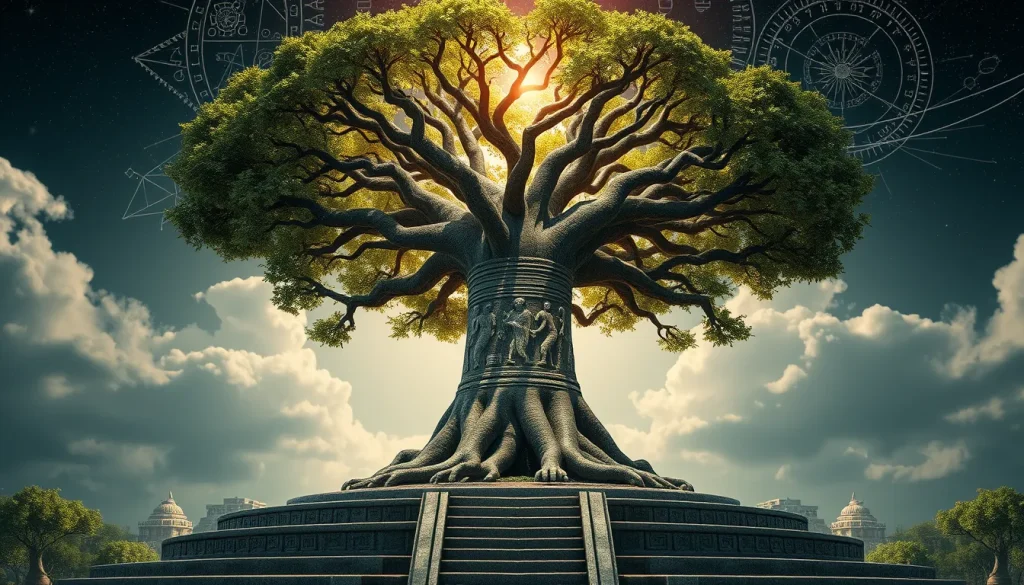
The core of Maya cosmology is the concept of the World Tree, often referred to in epigraphic records as the Wakah-Chan or raised-up sky. This motif serves as an axis mundi, a central axis that connects the three primary levels of existence: the heavens above, the earthly plane, and the underworld below. According to scholarly analysis, cosmic tree symbolism among pre-Columbian societies of Mesoamerica traces from the Preclassic period, though the underlying meaning of the motif and its symbolic permutations are poorly understood without contextual evidence. Attempts to identify the plant in a botanical context on ceramic vessels, stucco reliefs, and stone stelae of lowland Maya attribution usually favor determinations as a kapok tree (Ceiba pentandra) or maize plant (Zea mays). A botanical assessment of the morphic and ecological characteristics of these representations suggests that the tree was not merely a biological entity but a metaphysical principle of cosmogenesis and natural creation.
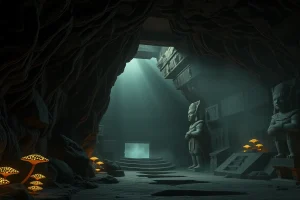
Beneath the earthly plane lies the Maya Underworld, known as Xibalba. The piecing together of ancient Maya mythology and cosmology regarding this realm involves significant difficulties, yet broad new insights often seem to manifest themselves almost overnight through interdisciplinary work. In a field of inquiry to which only social anthropologists and ethnohistorians seemed capable of making much of a contribution, we find new insights being provided by iconographers, epigraphy, linguists, archaeoastronomers, and even dirt archaeologists. The Underworld is not simply a place of death but a complementary part of the physical and cosmic space. Each level of creation has a governing deity, and the movement between these levels was often ritually enacted by kings and shamans. The World Tree stands at the center of this structure, uniting the heavens, the earth, and the underworld, ensuring cosmic stability and the recurrence of life cycles.
Rooted in the Earth and reaching toward the Sun, cosmic “world trees” are found around the globe and throughout history, symbols that unite life itself with underworlds and sky gods of disparate peoples. This “vegetative motif,” writes scholar J. Andrew McDonald, represents the “metaphysical principles of cosmogenesis, natural creation, eternal recurrence, and/or human hopes for everlasting life in the hereafter.” Known variously as kalpa vrksa to Brahmins, haoma to Parsis, yggdrasil to the Norse, arbor vitae to Christians, or more generically as the world tree, sacral tree, cosmic tree, or tree of life to historians and mythologists, the motif generally represents a primeval fount of living energy. In the Maya context, this is vividly depicted on the lid of K’inich Janaab’ Pakal’s sarcophagus, where the king is shown at the base of the tree, linking his death to the rebirth of the sun.
Evidence & Sources
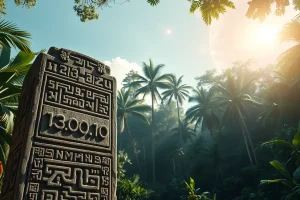
Archaeological evidence for the World Tree and Underworld is found across various media, including stone monuments, ceramics, and architectural alignments. One significant example is a monument from the ruins of Takalik Ab’Aj in Guatemala. This artifact represents the four directions, with the sacred tree (Ceiba) at the center, which united the heavens, the earth and the underworld. Each part of the physical and cosmic space is complementary, and each level of creation has a governing deity. It was probably used during rituals, serving as a physical anchor for cosmological beliefs. The digital preservation of such monuments allows for detailed analysis without risking damage to the original stone. Files associated with these models, such as those hosted on Zenodo, include various formats like .glb and .usdz, enabling widespread access for educational and research purposes.
Ceramic vessels and stone stelae provide further iconographic evidence. Scholars analyze the morphic and ecological characteristics of the depicted plants to determine whether they represent specific botanical species or symbolic composites. The sarcophagus lid of Pakal at Palenque remains one of the most famous depictions, showing the king falling into the underworld while simultaneously ascending the World Tree. This duality underscores the Maya belief in death as a transition rather than an end. The integration of epigraphic data with visual art helps confirm that these trees were not merely decorative but served as maps of the cosmos. Additionally, architectural orientations in cities like Tikal and Calakmul often align with celestial events that reinforce the vertical axis of the World Tree, connecting terrestrial structures with celestial phenomena.
The collaboration between independent researchers and institutions has also bolstered understanding. Contributions from board members of The Institute of Maya Studies and editors of specialized newsletters complement major explorations of the underworld. These efforts highlight how the field has evolved from purely anthropological study to include hard sciences and digital modeling. The availability of high-resolution scans means that details previously visible only to those visiting the sites in person can now be studied globally. This democratization of data supports the rigorous testing of hypotheses regarding Maya cosmology. However, researchers must remain cautious not to impose modern interpretations onto ancient symbols without sufficient epigraphic or contextual support.
Deep Dive Analysis
Technology Description
The visualization of the Maya cosmos relies heavily on digital archaeology technologies, specifically photogrammetry and laser scanning. These tools capture the physical geometry and texture of artifacts and sites to create accurate 3D models. In the context of cosmological modeling, this technology is used to reconstruct fragmented monuments or simulate sacred spaces that are no longer accessible. The process involves capturing hundreds of overlapping photographs or using LiDAR to map surface details. These data points are then processed into mesh models that can be viewed in virtual reality or standard 3D viewers.
How It Works
Field workflow begins with the careful documentation of the artifact or site. For a monument like the one at Takalik Ab’Aj, researchers capture images from multiple angles to ensure complete coverage. Software algorithms then align these images to generate a point cloud, which is converted into a polygonal mesh. Textures are mapped onto the mesh to replicate the color and surface wear of the original stone. For cosmological concepts that are not physical objects, such as the layers of the Underworld, artists and archaeologists collaborate to build models based on iconographic evidence from codices and murals. This hybrid approach ensures that the visualization remains grounded in archaeological data while making abstract concepts tangible.
Output/Data
The output of this workflow includes various file formats suitable for different platforms. Common formats include .glb for web viewing and .usdz for augmented reality applications. These files allow users to rotate, zoom, and inspect details of the World Tree monuments remotely. Datasets hosted on repositories like Zenodo provide open access to these models, supporting further research and education. The data often includes metadata describing the provenance, scanning conditions, and interpretive notes regarding the cosmological significance of the modeled object.
Example
A prime example is the 3D model of the monument from Takalik Ab’Aj. This model represents the four directions with the sacred Ceiba tree at the center. Users can examine the carving details that indicate the union of heavens, earth, and underworld. The model serves as a digital proxy for the physical stone, allowing scholars to measure dimensions and analyze iconography without traveling to Guatemala. This specific dataset includes multiple view renders and downloadable 3D files, facilitating both academic study and public engagement.
Strengths
The primary strength of digital visualization is accessibility. It allows global audiences to engage with Maya heritage without the environmental impact of travel. For researchers, it enables the preservation of artifacts threatened by erosion or looting. Digital models can also be manipulated to test lighting conditions or sightlines that might have been relevant to ancient rituals. Furthermore, 3D models can integrate disparate pieces of evidence, such as combining a stela from one site with a mural from another, to create a comprehensive view of cosmological beliefs.
Limitations
Despite its advantages, digital modeling has limitations. The accuracy of a model depends on the quality of the source data and the interpretive decisions made during reconstruction. There is a risk of “digital speculation,” where missing details are filled in based on assumptions rather than evidence. Additionally, 3D models cannot fully replicate the sensory experience of standing before a monumental sculpture in its original landscape. The scale and atmosphere of the sacred space are difficult to convey through a screen. Researchers must clearly distinguish between scanned data and reconstructed elements to maintain academic integrity.
Accuracy
Accuracy in cosmological modeling requires rigorous adherence to archaeological evidence. Models should be based on verified iconographic sources, such as those analyzed by iconographers and epigraphers. When depicting the World Tree, botanical assessments must consider whether the representation is a kapok tree or maize plant. Uncertainties should be documented within the model’s metadata. Peer review by Maya specialists is essential to ensure that the digital representation aligns with current scholarly consensus regarding Maya cosmology and mythology.
Cultural Heritage Considerations
Digital heritage projects must respect the cultural significance of the Maya cosmos to descendant communities. The World Tree and Underworld are not merely historical artifacts but remain part of living Maya traditions. Collaborating with indigenous groups ensures that visualizations are respectful and accurate. Open access to data should be balanced with considerations of sacred knowledge. Some aspects of cosmology may not be suitable for public gamification or casual interaction. Ethical guidelines should govern the use of 3D models to prevent the commodification of sacred symbols while promoting educational value.
FAQ
What tree represents the Maya World Tree?
Scholars usually favor determinations as a kapok tree (Ceiba pentandra) or maize plant (Zea mays) based on morphic and ecological characteristics found on vessels and stelae.
How do 3D models help study Maya cosmology?
3D models allow researchers to visualize the connection between heavens, earth, and underworld without traveling to sites, preserving details of monuments like those at Takalik Ab'Aj.
What is the significance of Pakal's sarcophagus lid?
It depicts the World Tree and the king's transition, representing metaphysical principles of cosmogenesis and human hopes for everlasting life in the hereafter.
Is the Maya Underworld only a place of death?
No, each part of the physical and cosmic space is complementary, and each level of creation has a governing deity, making it a vital part of the cosmic structure.
Leave a Reply