
Short Answer
The Maya 819-day count stands as one of the most sophisticated and enigmatic components of ancient Mesoamerican timekeeping. For decades, this specific calendrical cycle challenged modern scholars, resisting complete explanation despite extensive analysis of inscriptions across the Maya region. While earlier research identified a four-part, color-directional scheme inherent to the count, the cycle appeared too short to align meaningfully with the synodic periods of the planets visible to the naked eye. However, a paradigm-shifting study published in 2023 has fundamentally altered our understanding of this system, proposing that the Maya utilized a much larger time frame than previously suspected to harmonize ritual time with celestial mechanics.
Main Explanation
The 819-day count is a distinct period used in Maya inscriptions, often associated with ritual events and astronomical observations. Traditionally, scholars understood the count as operating in cycles of four, corresponding to the four cardinal directions and their associated colors: East (Red), North (White), West (Black), and South (Yellow). Each station in this cycle progresses in increments of 819 days. The number 819 itself is mathematically significant within Maya numerology, as it is the product of 7 and 117. The number 117 is closely approximated to the synodic period of Mercury, suggesting an early link to planetary observation. However, the traditional four-part cycle totals only 3,276 days (4 × 819), which proved insufficient to commensurate neatly with the synodic periods of other visible planets such as Mars, Jupiter, and Saturn.
The breakthrough research conducted by anthropologists John Linden and Victoria Bricker, published in the journal Ancient Mesoamerica, suggests that the calendar covers a much larger time frame. By expanding the calendar length to 20 periods of 819 days, a comprehensive pattern emerges. In this expanded model, totaling 16,380 days, the synodic periods of all the visible planets commensurate with station points in the larger 819-day calendar. This discovery implies that the 819-day count was not merely a short-term ritual marker but a component of a grand astronomical clock designed to track planetary movements over extended epochs. This resolution connects the abstract mathematics of the Maya calendar directly to the observable sky, reinforcing the civilization’s reputation as master astronomers who integrated cosmology into their temporal systems.
Evidence & Sources
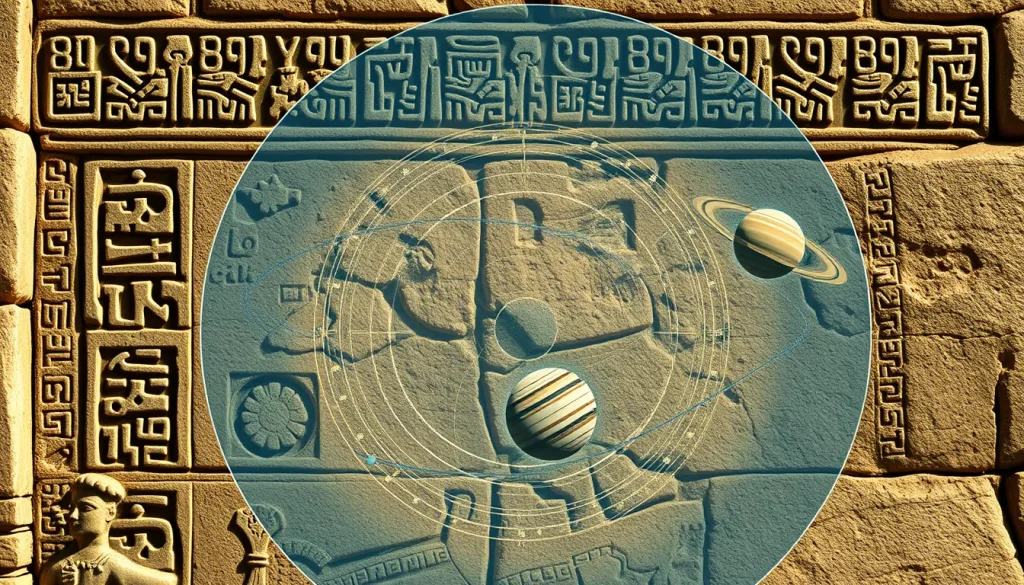
The primary evidence for the 819-day count comes from stone inscriptions found at various Maya sites, most notably Palenque in Mexico. The Tablet of the Sun from Palenque contains glyphs that refer to the 819-day count, providing crucial data for epigraphers. For years, these glyphs stumped researchers because the connections to planetary cycles were inconsistent within the short four-cycle model. The 2023 study by Linden and Bricker re-evaluated these inscriptions against known planetary synodic periods. Their analysis demonstrated that while prior research sought to show planetary connections for the 819-day count, the four-part scheme was too short to fit well with the synodic periods of the visible planets.
The study, titled The Maya 819-Day Count and Planetary Astronomy, was published in 2023 and has since been cited as a definitive solution to this ancient mystery. The researchers utilized statistical analysis and astronomical modeling to test the commensurability of the expanded 20-period cycle against planetary data. The findings indicate that the Maya intentionally structured this count to align with the retrograde motions and visibility cycles of planets. This archaeological and astronomical synthesis provides a robust framework for understanding how the Maya perceived time not as a linear progression, but as a cyclical interplay between earthly rituals and celestial events. The evidence underscores the sophistication of Maya science, where mathematical precision was employed to sacralize astronomical phenomena.
Deep Dive Analysis
Module D: Calendar System Analysis
Units and Structure: The fundamental unit of this system is the 819-day period. This unit is multiplied to create larger cycles. The traditional understanding recognized a cycle of 4 units (3,276 days), while the revised understanding proposes a grand cycle of 20 units (16,380 days). This structure allows for the integration of the 260-day Tzolk’in ritual calendar, as 819 is divisible by 13 and 7, creating complex interlocking rhythms with other calendar rounds.
Calculation Methodology: The calculation involves multiplying the base count of 819 by the number of periods. In the expanded model, 819 multiplied by 20 equals 16,380 days. This number is significant because it is a multiple of the synodic periods of Mercury, Mars, Jupiter, and Saturn. For example, the synodic period of Mercury is approximately 117 days. When multiplied by 7, it equals 819. The expanded cycle ensures that after 20 periods, the planets return to similar positions relative to the Earth and the Sun, allowing for predictive ritual timing.
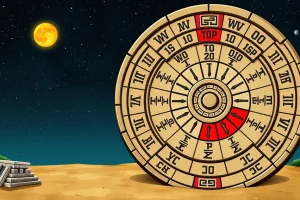
Diagram Description: Visually, the system can be imagined as a wheel with 20 stations. Each station represents 819 days. These stations are grouped into four color-directional quadrants. As time progresses, the count moves from one station to the next, changing the associated direction and color. In the expanded view, this wheel rotates 20 times before completing a grand astronomical era, aligning planetary positions with specific ritual stations.
Example Date and Inscription: Inscriptions at Palenque record dates using this count. A typical inscription might note a specific event occurring at a station within the 819-day cycle. By applying the 20-period model, historians can now correlate these dates with specific planetary configurations that would have been visible to Maya astronomers at the time. This provides a verifiable link between the recorded history and the actual sky.
Relationship to Other Calendars: The 819-day count does not operate in isolation. It intersects with the Tzolk’in (260 days) and the Haab’ (365 days). The least common multiple of these cycles creates the Calendar Round. The 819-day count adds a layer of planetary time to this system, effectively creating a “super-calendar” for long-term astronomical tracking. It complements the Long Count, which tracks linear time, by adding cyclical astronomical quality to specific dates.
Historical Use: Historically, this count was likely used by priest-astronomers to determine auspicious times for rituals, warfare, and agricultural activities. The alignment of planets was believed to influence earthly events. By tracking the 819-day count, Maya elites could anticipate celestial events and schedule ceremonies to harmonize human activity with cosmic order. This usage highlights the political power derived from astronomical knowledge in Maya society.
Current Traditions: While the ancient political structure of the Maya has collapsed, modern Maya communities continue to use aspects of the ancient calendars, particularly the 260-day count. However, the specific 819-day count with its 20-period planetary expansion is primarily a subject of academic study and archaeological reconstruction rather than active contemporary ritual practice. The 2023 discovery has revitalized interest in these ancient systems among modern cultural practitioners.
Misconceptions: A common misconception prior to 2023 was that the 819-day count was exclusively a four-cycle system limited to directional symbolism. Another error was assuming the count had no practical astronomical application beyond Mercury. The new research clarifies that the system was designed for all visible planets and operates on a much grander scale than previously thought, correcting the view that it was merely a short-term ritual device.
FAQ
What is the 819-day count?
It is a specific cycle used in the Maya calendar system, recently understood to be part of a larger 20-period cycle linking ritual time to planetary movements.
Who solved the mystery of the 819-day count?
Anthropologists John Linden and Victoria Bricker published the solution in 2023, demonstrating its connection to planetary synodic periods.
Why was the 819-day count considered enigmatic?
Prior to 2023, the traditional four-part cycle was too short to align accurately with the synodic periods of visible planets like Mars and Jupiter.
Where was evidence of the 819-day count found?
Significant inscriptions referencing the count were found at the Maya site of Palenque in Mexico, including the Tablet of the Sun.



Leave a Reply