
Short Answer
In the complex tapestry of ancient Mesoamerican temporal organization, the Lords of the Night represent a specialized ritual cycle that operated in parallel with the more widely known solar and sacred calendars. These nine deities, known in modern epigraphy as G1 through G9, were believed to govern the night hours in a repeating sequence, assigning a specific spiritual influence or ‘job description’ to each successive night. This system was not merely a method of counting days, but a divinatory tool used to determine the auspiciousness of events and the specific supernatural forces active during the dark hours of the Maya world.
Main Explanation
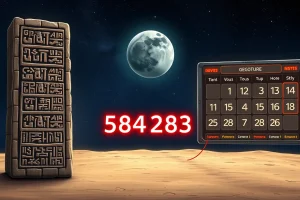
The Lords of the Night cycle is a nine-day sequence of deities that governs the ritual nature of the night. In the Classic period of Maya civilization, this cycle was meticulously recorded in Long Count inscriptions using a specific set of hieroglyphs designated by scholars as Glyph G. This glyph follows the Initial Series Long Count date on hundreds of monuments, dating roughly from 8.12.0.0.0 (CE 278) to 10.4.0.0.0 (CE 909). Each variation of Glyph G identifies one of the nine deities in the sequence.
The function of the Lords of the Night was primarily divinatory and ritualistic. By identifying which deity presided over a particular night, Maya priests and rulers could align their activities—such as bloodletting, warfare, or accession rites—with the attributes of the governing deity. This cycle operated independently of the 260-day Tzolk’in and the 365-day Haab’, creating a complex interlocking system of time where a single date was defined by multiple overlapping cycles of influence.
While the Maya records are extensive, the specific names and full mythologies of these nine deities are less clear than those of the later Aztec culture. In Central Mexico, the Yohualteuctin (Lords of the Night) were well-documented in codices. Scholars have long debated the correlation between the Maya G-series and the Aztec list. Some researchers suggest that the correlation is not necessarily one of identical deities, but rather a correlation of “spheres of influence” or roles. For example, the Aztec Fourth Lord of the Night was Centeotl, the God or Goddess of Maize; if the Maya Fourth Lord (G4) shares similar attributes, it suggests a shared Mesoamerican cosmological framework regarding the division of the night.
Evidence & Sources
The primary evidence for the Lords of the Night comes from epigraphic analysis of stone stelae and lintels. The interpretive framework for this cycle was largely established by J. Eric S. Thompson, who demonstrated that the variable forms of Glyph G cycled through a fixed period of nine. This mathematical regularity across hundreds of inscriptions confirms that the system was standardized across the Maya lowlands during the Classic period.
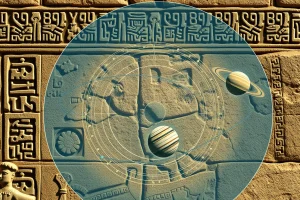
Furthermore, the presence of similar nine-day cycles in Central Mexican codices provides a comparative basis for understanding the Maya system. The radial partitioning of the night sky, as argued by some researchers, suggests that these deities may have been linked to specific sectors of the celestial sphere, turning the night sky into a giant clock or map of divine influence. This intersection of astronomy and ritual timekeeping is a hallmark of Mesoamerican intellectual tradition.
Deep Dive Analysis: The Calendar System
To fully understand the Lords of the Night, one must analyze it as a specific component of the broader Maya calendrical machinery. Unlike the solar year, the Lords of the Night is a purely ritual cycle focused on the nocturnal realm.
Units and Calculation
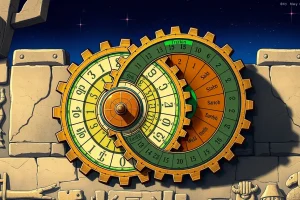
The fundamental unit of this system is the single night. The cycle consists of exactly nine units (G1, G2, G3, G4, G5, G6, G7, G8, and G9). Once G9 is reached, the cycle resets immediately to G1. This creates a simple modulo-9 mathematical progression. For any given Long Count date, the Lord of the Night can be calculated by taking the total number of days elapsed since the Maya epoch and finding the remainder when divided by nine.
Relationship to Other Calendars
The Lords of the Night did not replace other calendars but added a layer of specificity. A typical Classic Maya date might include:
- The Long Count: The absolute linear time since the creation date.
- The Tzolk’in: The 260-day ritual count (e.g., 4 Ajaw).
- The Haab’: The 365-day vague solar year (e.g., 8 Kumk’u).
- Glyph G: The specific Lord of the Night governing that date.
Because 9 is not a factor of 260 or 365, the Lord of the Night shifts relative to the other calendar positions, ensuring that a specific Tzolk’in day would be governed by a different Lord of the Night in each subsequent cycle.
Historical Use and Ritual Application
Historically, the Lords of the Night were used to determine the “quality” of a night. Certain deities were associated with positive attributes (growth, fertility, protection), while others were associated with more volatile or destructive forces. Rulers used this information to time their public appearances or private rituals to ensure they were supported by the deity of the night. This practice reflects the Maya belief that time was not an abstract vacuum but was inhabited by living, sentient forces.
Common Misconceptions
A frequent misconception is that the Lords of the Night were a “horoscope” in the modern Western sense. In reality, they were part of a state-sponsored ritual system used primarily by the elite and the priesthood to maintain cosmic order. Additionally, some modern interpretations conflate the Maya G-glyphs directly with Aztec deities without acknowledging that they may represent similar roles rather than the exact same mythological figures. The Maya G-series is a distinct epigraphic tradition that reflects a localized expression of a broader Mesoamerican concept.
FAQ
What is Glyph G?
Glyph G is the designation given by epigraphers to the hieroglyph that identifies the governing Lord of the Night in Maya Long Count inscriptions.
How does the Lords of the Night cycle differ from the Tzolk'in?
While the Tzolk'in is a 260-day cycle of spiritual influence, the Lords of the Night is a shorter, 9-day cycle specifically focused on the nocturnal hours.
Are the Maya Lords of the Night the same as the Aztec Lords of the Night?
They are closely related and share a similar structural logic (a 9-day cycle), but scholars suggest they may represent similar 'job descriptions' or spheres of influence rather than being identical deities.


Leave a Reply