
Short Answer
The Maya calendar system stands as one of the most sophisticated timekeeping methodologies in human history, rooted in deep astronomical observation and mathematical precision. At the heart of this system lies the Calendar Round, a cyclical mechanism that synchronizes two distinct calendars: the sacred 260-day Tzolk’in and the solar 365-day Haab’. Unlike modern linear dating, the Calendar Round operates on a principle of interlocking cycles, creating a unique date designation that repeats only once every 52 solar years. This complex arrangement served both practical agricultural purposes and profound ceremonial functions, anchoring the Maya understanding of time, cosmology, and ritual obligation.
Main Explanation
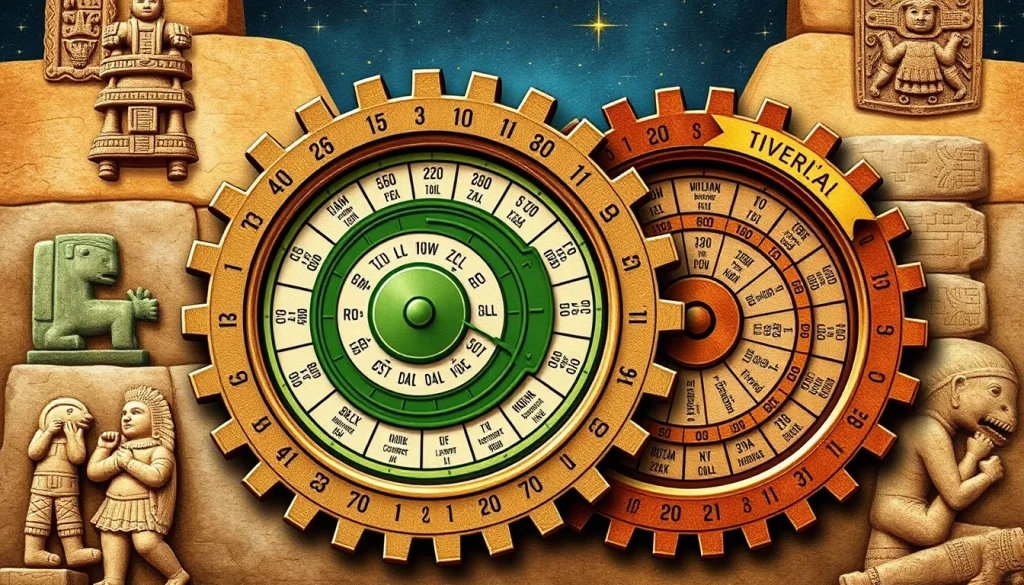
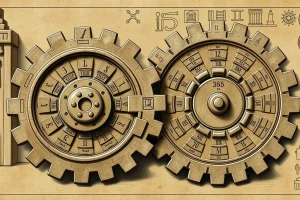
The formation of the Calendar Round is best understood through the analogy of interlocking gears. Imagine two wheels turning simultaneously at different speeds. The smaller gear represents the Tzolk’in, consisting of 260 unique positions formed by combining 13 numbers with 20 day names. The larger gear represents the Haab’, consisting of 365 positions divided into 18 months of 20 days plus a short month of 5 days known as Wayeb’. As these gears turn, a specific combination of a Tzolk’in date and a Haab’ date aligns. Because 260 and 365 share a common factor, they do not realign quickly. It takes exactly 18,980 days for both cycles to return to their starting position simultaneously. This period equates to 52 Haab’ years or 73 Tzolk’in cycles.
Within this system, a date is not recorded as a single number but as a pair, such as 4 Ahau 8 Kumk’u. The Tzolk’in component (4 Ahau) dictates the ritual energy and divinatory significance of the day, while the Haab’ component (8 Kumk’u) tracks the solar season and agricultural cycle. The interlocking nature ensures that no specific combination of sacred and solar dates repeats within a human lifetime, providing a robust framework for scheduling ceremonies, planting crops, and recording historical events within a generational context. However, because the cycle resets every 52 years, the Calendar Round alone cannot distinguish between events separated by multiples of 52 years, necessitating the use of the Long Count calendar for absolute chronology.
Evidence & Sources
Archaeological and epigraphic evidence confirms the widespread use of the Calendar Round across Mesoamerica, not limited to the Maya but also employed by the Aztec, Zapotec, and other indigenous civilizations. Stelae, altars, and ceramic vessels often bear inscriptions detailing Calendar Round dates. The mathematical consistency of these dates across centuries demonstrates a standardized understanding of the 260-day and 365-day cycles. Sources from the National Museum of the American Indian highlight that the Maya calendar system has roots in older indigenous civilizations, particularly the Olmec, indicating a long tradition of calendric development prior to the Classic Maya period.

Mathematical analysis by institutions such as the Mathematical Association of America confirms the accuracy of the Maya observations. They noted that a 365-day year precesses through all the seasons twice in 1,101,600 days, showing that the Maya were aware of the discrepancy between their vague year and the true tropical year. Despite this discrepancy, the 365-day Haab’ was sufficient for the Calendar Round’s ritual purposes. The Foundation for the Advancement of Mesoamerican Studies provides detailed lists of the day names and month names used in these cycles, such as Imix, Ik’, and Ak’bal for the Tzolk’in, and Pop, Wo, and Sip for the Haab’, validating the structural integrity of the system found in surviving codices and stone monuments.
Deep Dive Analysis
Module D: Calendar System Analysis
Units and Structure
The Calendar Round is composed of two primary units. The Tzolk’in is a sacred almanac formed by the permutation of 13 numbers and 20 day names, resulting in 260 unique days. The Haab’ is a solar calendar composed of 18 months of 20 days each, totaling 360 days, plus a final month of 5 days called Wayeb’, totaling 365 days. The day numbers in the Tzolk’in run from 1 to 13, while the day names cycle through the 20 signs independently. In the Haab’, days are numbered 0 through 19 within each month.
Calculation of the Cycle
The length of the Calendar Round is determined by the Least Common Multiple (LCM) of 260 and 365. Mathematically, 260 factors into 2×2×5×13, and 365 factors into 5×73. The LCM is calculated as 5×73×52, which equals 18,980 days. Dividing 18,980 by 365 yields exactly 52 years. Dividing 18,980 by 260 yields exactly 73 cycles. This mathematical relationship ensures that after 52 years, the day number, day name, month number, and month name all return to their original alignment.
Diagram Description
Visual representations often depict the Calendar Round as two concentric circles or interlocking wheels. The inner wheel represents the Tzolk’in with 260 teeth or positions, often colored green in contemporary representations. The outer wheel represents the Haab’ with 365 teeth or positions, often colored brown. As the wheels rotate, a pointer indicates the current date combination. This gear mechanism illustrates how the sacred and solar times mesh without ever losing synchronization within the 52-year period.
Example Date
A quintessential example of a Calendar Round date is 4 Ahau 8 Kumk’u. In Maya cosmology, this specific date is recognized as the creation date, marking the beginning of the current era. The number 4 and the name Ahau belong to the Tzolk’in cycle, while 8 and the month Kumk’u belong to the Haab’ cycle. This date appears frequently in inscriptions as a reference point for mythological events and the dedication of monuments.
Relationship to Other Calendars
The Calendar Round functions alongside the Long Count calendar. While the Calendar Round is cyclical and repeats every 52 years, the Long Count is linear and counts days from a mythical starting point. The Long Count was developed to solve the limitation of the Calendar Round, which cannot distinguish between cycles beyond 52 years. By adding a Long Count date to a Calendar Round date, Maya scribes could specify an exact moment in history unique across millennia.
Historical Use
Historically, the Calendar Round was used by all Mesoamerican civilizations to schedule religious ceremonies, determine auspicious days for warfare or marriage, and track agricultural seasons. The Haab’ approximated the solar year, guiding planting and harvesting, while the Tzolk’in guided ritual activities. The completion of a 52-year cycle was a significant event, often marked by the binding of years and the lighting of new fires, symbolizing the continuation of time and the prevention of cosmic collapse.
Current Traditions
Contemporary Maya communities in the highlands of Guatemala and parts of Mexico continue to use the 260-day Tzolk’in calendar for divination and ceremonial purposes. Daykeepers, known as Aj Q’ij, maintain the count of the sacred days, demonstrating the resilience of this ancient system. While the Haab’ is less commonly used in its traditional form due to the adoption of the Gregorian calendar, the conceptual framework of interlocking time remains vital to indigenous identity and cosmology.
Misconceptions
A common misconception is that the end of a Calendar Round or Long Count cycle signifies the end of the world. This was notably prevalent during the 2012 phenomenon. In reality, the completion of a cycle represents a renewal or reset, similar to an odometer rolling over. The Maya viewed time as cyclical and regenerative. Additionally, some believe the Calendar Round is accurate to the tropical year; however, the Haab’ is a vague year of 365 days without leap years, causing it to drift through the seasons over long periods, a discrepancy the Maya observed but did not correct within the Calendar Round structure itself.
FAQ
Why does the Calendar Round repeat every 52 years?
The Calendar Round repeats every 52 years because 18,980 days is the Least Common Multiple of the 260-day Tzolk’in and the 365-day Haab’ calendars. It takes exactly 52 solar years for both cycles to align again at their starting point.
What is the difference between the Haab and the Tzolk’in?
The Tzolk’in is a 260-day sacred calendar used for divination and ritual, based on 13 numbers and 20 day names. The Haab’ is a 365-day solar calendar used for agriculture and seasonal tracking, composed of 18 months and 5 extra days.
Did the Maya calendar predict the end of the world in 2012?
No. The 2012 date marked the end of a Long Count cycle, not the end of the world. In Maya cosmology, the end of a cycle signifies renewal and regeneration, similar to the turning of a new year.
Leave a Reply