
Short Answer
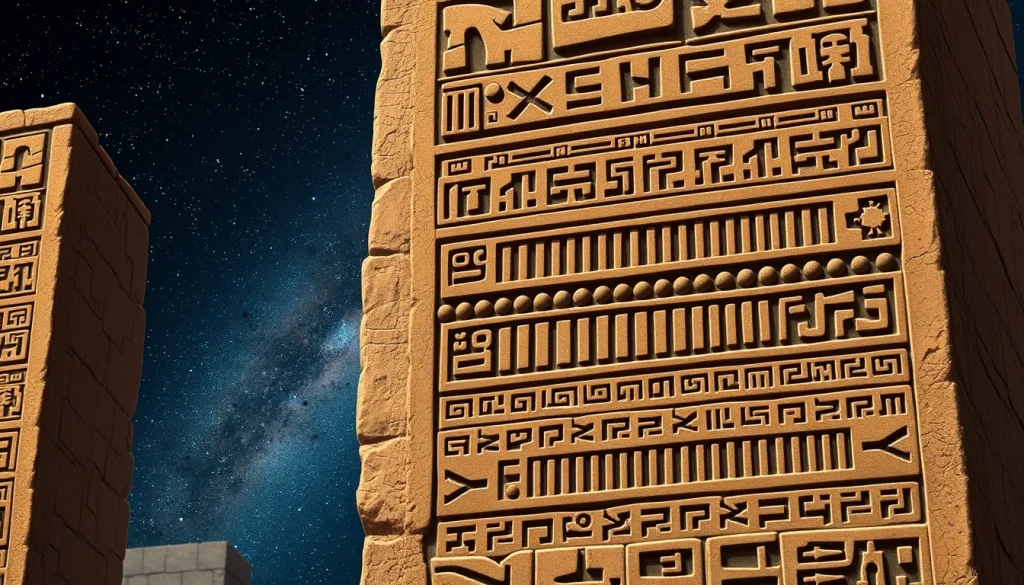
The Mesoamerican Long Count calendar is renowned for its precision and its ability to track time over vast historical spans. While popular culture often focuses on the Baktun, particularly in the context of the 2012 phenomenon, the Maya mathematical system was designed to accommodate time scales that dwarf human history. When asking what comes after a Baktun, one enters the realm of higher order units such as the Piktun, Calabtun, and Kinchiltun. These units demonstrate a sophisticated understanding of deep time, allowing ancient scribes to record dates hundreds of millions of years into the past and future.
Understanding these higher units requires an appreciation of the modified vigesimal (base-20) system used by the Maya. Unlike the Gregorian calendar, which resets annually, the Long Count is a linear count of days since a mythical creation date. This date corresponds to August 11, 3114 BCE in the proleptic Gregorian calendar. To manage the large numbers generated by this continuous count, the Maya developed a hierarchy of time periods that extended well beyond the practical needs of agricultural or civic scheduling, serving instead cosmological and dynastic purposes.
Main Explanation
The standard Long Count notation typically displays five places: Baktun, Katun, Tun, Uinal, and Kin. However, inscriptions exist that utilize higher order periods to denote exceptionally large numbers. The unit immediately following the Baktun is the Piktun. In the hierarchy established by epigraphers and mathematicians analyzing Maya glyphs, one Piktun equals 20 Baktuns. This progression continues exponentially, reflecting the Maya capacity for abstract mathematics.
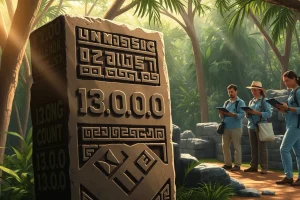
The existence of these units is not merely theoretical; they appear in monumental inscriptions where rulers sought to legitimize their power by connecting their reigns to primordial time. For example, Stela C at Quirigua contains a mythical creation date written with high-order units, anchoring the current era in a specific cosmological moment. The use of these terms indicates that the Maya conceived of time not as a repeating circle alone, but as a vast linear expanse that could be measured with the same precision as a single day.
It is crucial to distinguish between the standard five-place notation used for most historical records and the extended notation used for cosmological calculations. The former suffices for recording human history within the current creation cycle. The latter was reserved for special occasions, such as describing the distance between mythological events and contemporary dates. This dual usage highlights the flexibility of the Maya calendar system, serving both as a practical almanac and a theological statement.
Evidence & Sources
Archaeological and textual evidence supports the existence of these higher units. The primary source for the definitions of the Piktun and subsequent units comes from the analysis of Maya hieroglyphic writing. J. Eric S. Thompson, in his seminal work Maya Hieroglyphic Writing, gathered outstanding Maya calculations into the past and future to illustrate how the culture handled great distances of time. Thompson noted that the Maya calculated a date over 500,000,000 years in the past without error, a truly remarkable achievement that necessitated units larger than the Baktun.
Thompson outlined the hierarchy using terms derived from Beltran to distinguish the higher periods. According to this structure, 1 Piktun equals 20 Baktuns (8,000 Tuns), 1 Calabtun equals 20 Piktuns (160,000 Tuns), and 1 Kinchiltun equals 20 Calabtuns (3,200,000 Tuns). There is even a unit known as the Alautun, which represents an even vaster span. These definitions are corroborated by modern epigraphic studies and digital archives of Maya inscriptions.
Furthermore, the correlation between the Maya Long Count and the Gregorian calendar is well-established through the Goodman-Martinez-Thompson correlation (584,283 days). This allows modern researchers to convert these high-order units into familiar years. For instance, the completion of 13 Baktuns in 2012 was not an end, but a milestone within a larger cycle. Academic research, such as that by Erik Boot, clarifies that pseudo-scientific publications claiming an apocalypse in 2012 misinterpreted the completion of a cycle as the end of time itself, ignoring the existence of higher units that continue the count indefinitely.
Deep Dive Analysis
To fully grasp the mechanics of these higher time units, we must examine the calendar system through the lens of Module D: Calendar. This analysis breaks down the units, calculations, and historical context of the Long Count.
Units of Measurement
The Maya Long Count uses a modified vigesimal system. The base units are as follows:
- Kin: 1 day
- Uinal: 20 Kins (18 Uinals make a Tun)
- Tun: 360 days (18 Uinals)
- Katun: 20 Tuns (7,200 days)
- Baktun: 20 Katuns (144,000 days)
- Piktun: 20 Baktuns (2,880,000 days)
- Calabtun: 20 Piktuns (57,600,000 days)
- Kinchiltun: 20 Calabtuns (1,152,000,000 days)
- Alautun: 20 Kinchiltuns (23,040,000,000 days)
This hierarchy shows that the Piktun is the first order of magnitude beyond the standard historical record. While a Baktun covers approximately 394 years, a Piktun covers nearly 8,000 years. This scale allows for the measurement of geological or mythological time rather than just dynastic time.
Calculation and Notation
The calculation method involves counting the number of days passed since the mythical creation date. In standard notation, a date is written as a series of coefficients multiplied by the unit values. For example, the creation date itself is often cited as 13.0.0.0.0. When extending into higher units, additional places are added to the left of the Baktun. The system is non-repeating, meaning it does not cycle back to zero after a specific period like the Calendar Round does. Instead, it accumulates indefinitely.
The modification in the base system occurs at the Uinal level. While the system is generally base-20, the Uinal is base-18 to approximate the solar year (18 x 20 = 360). This adjustment ensures that the Tun remains close to a solar year, maintaining alignment with agricultural seasons despite the linear count.
Example Date
A prominent example of high-order calculation is found on the East side of Stela C at Quirigua. This monument records the mythical creation date of 13 Baktuns, 0 Katuns, 0 Tuns, 0 Winals, 0 Kins. In the proleptic Gregorian calendar, this corresponds to August 11, 3114 BCE. While this specific inscription stops at the Baktun level, other texts imply the capacity to go further. Modern conversions, such as those visible in digital calendar tools, show the current date in Long Count notation. For instance, in June 2026, the count had progressed to 13.0.13.12.0, indicating we are in the 14th Baktun of the current era.
Relationship to Other Calendars
The Long Count operates alongside the Tzolk’in (260-day sacred calendar) and the Haab’ (365-day solar calendar). Together, these form the Calendar Round, which repeats every 52 years. The Long Count provides the unique identifier for days within this repeating cycle. While the Calendar Round is sufficient for local scheduling, the Long Count is necessary for historical recording over centuries. The higher units like Piktun are not used in the Calendar Round but are exclusive to the Long Count’s linear framework.
Historical Use
Historically, the Long Count was widely used on monuments during the Classic Period. Rulers used these dates to assert their place in history. The use of higher units like the Piktun was rarer and typically reserved for texts discussing cosmology or the deep past. Thompson’s research highlights that the Maya did not make these tremendous calculations without occasional mistakes, but their ability to calculate dates over 500 million years in the past remains a testament to their mathematical prowess.
Current Traditions
Today, the Long Count continues to be studied and used by Maya communities and scholars. It serves as a link to ancestral knowledge. Digital heritage projects often incorporate these calculations to visualize Maya time for modern audiences. However, the use of higher units like the Piktun remains primarily academic, as contemporary Maya calendars often focus on the 260-day cycle for ritual purposes.
Misconceptions
A significant misconception involves the end of the 13th Baktun in 2012. Non-scientific and New Age publications held that the Maya Long Count ends in 2012, heralding worldwide disasters. In reality, the calendar simply rolled over to the next Baktun, much like an odometer turning from 99999 to 100000. The existence of units like the Piktun proves that the Maya envisioned time continuing far beyond 2012. The calendar does not end; it continues into the 14th, 15th, and subsequent Baktuns, eventually filling Piktuns and beyond.
FAQ
What is a Piktun in the Maya calendar?
A Piktun is a unit of time in the Maya Long Count calendar equal to 20 Baktuns, or approximately 7,885 years. It is used for measuring vast periods of time beyond standard historical records.
Did the Maya calendar end in 2012?
No, the Maya calendar did not end in 2012. That date marked the completion of the 13th Baktun. The Long Count continues into higher units like the Piktun, indicating time proceeds indefinitely.
How do you calculate a Piktun?
A Piktun is calculated as 20 Baktuns. Since one Baktun is 144,000 days, one Piktun equals 2,880,000 days. This follows the modified vigesimal system used by the Maya.
Where are higher units like the Piktun found?
Higher units are found in specific monumental inscriptions, such as Stela C at Quirigua, and in academic calculations regarding Maya cosmology and deep time rather than daily scheduling.
Leave a Reply