
Short Answer
The mathematical achievements of the Maya civilization stand as a testament to their intellectual sophistication and their profound need to track time and celestial events. Unlike the modern Hindu-Arabic numeral system which relies on a base-10 structure likely derived from counting fingers on two hands, the Maya developed a vigesimal system based on the number twenty. This base-20 framework was not merely a counting tool but a foundational element of their cosmology, architecture, and ritual life. Understanding the Maya vigesimal number system requires an examination of its symbols, its positional logic, and the specific modifications made for calendrical purposes.
Archaeological and epigraphic evidence suggests that the Maya civilization, generally dated from 1500 B.C.E to 1700 C.E., possessed one of the most advanced numerical systems of the ancient world. Their ability to perform elaborate calculations allowed for precise astronomical predictions, which were overseen by a priestly class. The system’s efficiency facilitated the recording of commodities, the construction of monumental architecture aligned with celestial bodies, and the maintenance of the Long Count calendar. This article explores the mechanics of this system, the archaeological evidence supporting its use, and the nuances that distinguish pure mathematics from calendrical applications.
Main Explanation
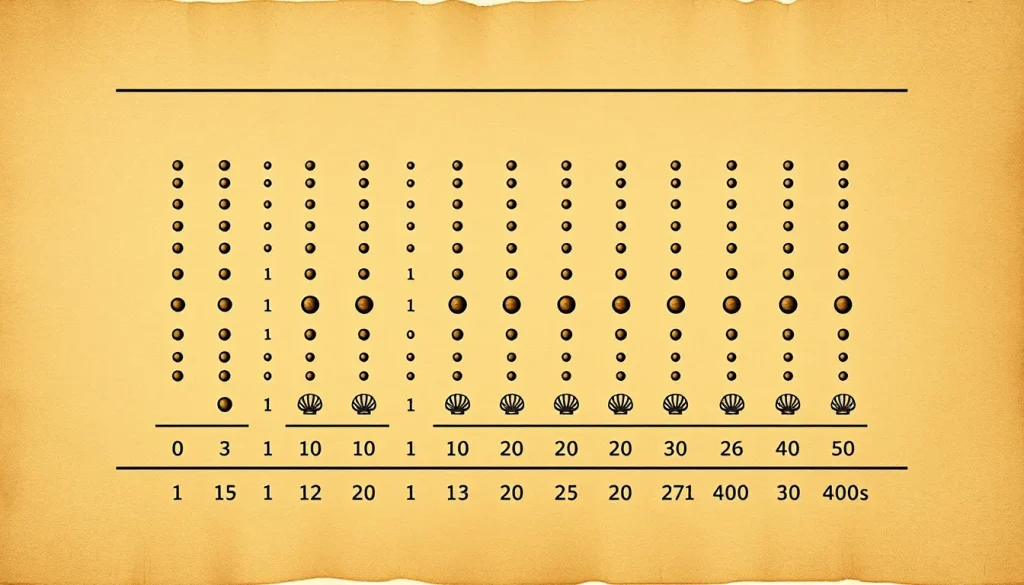
The Maya numeral system is a positional system, meaning the value of a symbol depends on its position within the number. Just as the modern decimal system uses powers of ten (1, 10, 100, 1000), the Maya system uses powers of twenty. The numerals are constructed using three primary symbols: a dot representing one, a horizontal bar representing five, and a shell shape representing zero. These symbols could be combined to represent any digit from zero to nineteen. For example, the number thirteen is written as three dots placed in a horizontal row above two horizontal bars, signifying 3 ones plus 2 fives.
Numbers greater than nineteen are written vertically, with the lowest place value at the bottom and higher place values stacked above. The first position represents units (20^0), the second position represents twenties (20^1), and the third position represents four hundreds (20^2). For instance, the number thirty-three is written as one dot in the second position (representing 1 × 20) above a combination of three dots and two bars in the first position (representing 13). The calculation is therefore (1 × 20) + 13 = 33. Upon reaching 400 (20^2), another row is started, continuing the pattern of powers of twenty. This vertical arrangement allowed the Maya to express very large numbers efficiently, which was crucial for tracking deep time in their Long Count calendar.
It is important to note terminology regarding this system. Specialists of the Maya civilization prefer the terms “Maya numerals,” “Maya number system,” and “Maya mathematics.” The adjective “Mayan” is technically reserved for reference to the languages of the region. This distinction underscores the academic rigor required when discussing their cultural achievements. The system’s sophistication is evident in the Dresden Codex and various stone stelae, where complex arithmetic operations including addition and subtraction were performed using these symbols. The concept of zero, represented by a cowry shell, served as a placeholder, ensuring the positional integrity of the numbers.
Evidence & Sources
The primary evidence for the Maya number system comes from surviving codices, stone monuments, and ceramic vessels. The Dresden Codex, one of the few surviving pre-Columbian Maya books, contains extensive tables of numerical data used for astronomical predictions. These documents demonstrate the practical application of the vigesimal system in tracking the cycles of Venus and eclipses. The precision of these observations, recorded using dot-and-bar notation, highlights the system’s utility beyond simple counting.
Archaeological findings across the Yucatan Peninsula and surrounding regions provide further corroboration. Stelae erected during the Classic Period often display Long Count dates using the vigesimal structure. These inscriptions confirm that the system was in widespread use among the elite and priestly classes who managed the ritual calendar. The Mathematical Association of America notes that while a purely base-20 system was used for simple recording of commodities, the culturally important calendar system employed a modified base-20 structure. This modification is critical for archaeologists interpreting dates, as the third positional value often represents 18 × 20 (360) rather than 20 × 20 (400) to approximate the solar year.
Historical analysis places the development of this system within the broader context of ancient counting methods. While the Babylonians used a base-sixty system and some Modern South American Tribes utilized a base-five system counting by hands, the Maya vigesimal system stands out for its inclusion of a true zero and positional notation. This development was an important step in making the counting process more efficient. The presence of the shell symbol as a placeholder indicates an abstract understanding of nothingness as a numeric value, a concept that was not universally present in ancient civilizations. The continuity of these symbols from the Preclassic through the Postclassic periods suggests a stable and standardized mathematical tradition maintained over millennia.
Deep Dive Analysis
Definition
The Maya vigesimal number system is a base-20 positional numeral system used to represent numbers and calendar dates. It is characterized by the use of three symbols and a vertical orientation for place values. The system is additive within each position (dots and bars sum to values up to 19) and multiplicative across positions (each level represents a higher power of 20).
How it works
The system operates on powers of twenty. The bottom layer represents 1s, the layer above represents 20s, the next 400s, and so on. To read a number, one sums the values of the symbols in each row and multiplies by the place value. For example, a dot in the second row equals 20. A bar in the first row equals 5. The shell symbol indicates an empty place value, preventing ambiguity in large numbers. This positional logic mirrors the Hindu-Arabic system but uses a base of 20 instead of 10.
Key components
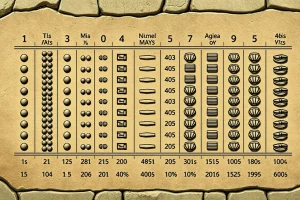
There are three essential symbols: the dot (value 1), the bar (value 5), and the shell (value 0). Numbers 1 through 4 are dots. Number 5 is a bar. Numbers 6 through 9 are dots above a bar. Number 10 is two bars. This pattern continues up to 19 (three bars and four dots). The shell acts as a placeholder, crucial for distinguishing between numbers like 20 (one dot above a shell) and 1 (one dot).
Example
Consider the number 429. In a pure vigesimal system, this is written as one dot in the third position (400s), one dot in the second position (20s), and nine in the first position (1s). Visually, this is one dot at the top, one dot in the middle, and four dots over one bar at the bottom. The calculation is (1 × 400) + (1 × 20) + 9 = 429. This vertical stacking allows for compact representation of large values used in historical chronologies.
Historical evidence
Evidence is found in the Dresden Codex and numerous stelae across the Maya region. The system was used from approximately 1500 B.C.E to 1700 C.E. Inscriptions show consistent use of the dot-bar-shell notation. The system facilitated the Long Count calendar, which required counting days over thousands of years. The mathematical precision allowed for predictions of celestial events such as the movements of Venus, which held significant ritual importance.
Common misconceptions
A common misconception is that the Maya used a pure base-20 system for all purposes. In reality, the calendar system modified the third place value to 18 × 20 (360) to align closer to the 365-day solar year. Additionally, some sources debate whether the shell symbol was considered a true numeric zero or merely a placeholder, though functionally it operated as zero in calculations. Finally, the term “Mayan” is often incorrectly applied to the numerals; “Maya” is the preferred adjective for non-linguistic contexts.
FAQ
Did the Maya invent the concept of zero?
The Maya independently developed the concept of zero, represented by a shell symbol, which functioned as a placeholder in their positional number system.
Why did the Maya use base-20 instead of base-10?
While base-10 likely arose from counting fingers, base-20 may have included counting toes, reflecting a whole-body counting method common in Mesoamerican cultures.
Is the Maya number system still used today?
While the Hindu-Arabic system is standard, some modern Maya communities retain knowledge of the traditional system, and it is studied extensively in archaeology and mathematics.



Leave a Reply