
Short Answer
The mathematical achievements of the Maya civilization stand as a testament to their intellectual sophistication, rivaling contemporary societies across the globe. Central to their advancements in astronomy, architecture, and timekeeping was a highly developed positional numeral system. Unlike the base-10 system prevalent in the modern Hindu–Arabic numeral tradition, the Maya employed a vigesimal system, counting in powers of twenty. This fundamental difference shaped how they recorded history, predicted celestial events, and structured their society. Understanding how the Maya vigesimal number system worked provides critical insight into the cognitive frameworks of one of the ancient world’s most advanced cultures.
Main Explanation
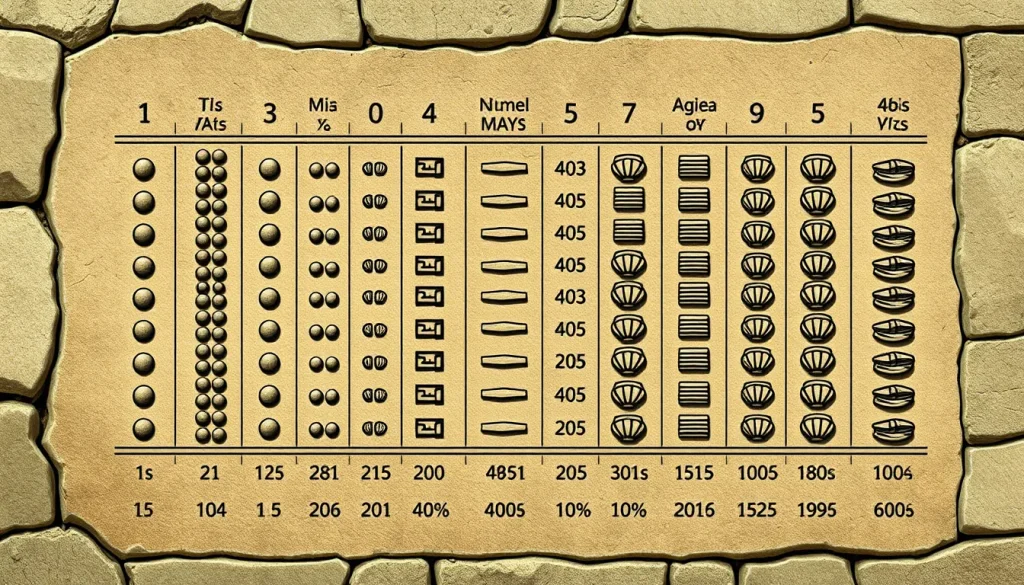
The core of Maya mathematics lies in its base-20 structure, known as vigesimal. This system likely arose from the natural counting method of using both fingers and toes, totaling twenty digits, whereas the base-10 system relies solely on fingers. The Maya numeral system is positional, meaning the value of a symbol depends on its placement within a vertical stack. Numbers were written vertically, with the lowest place value at the bottom and higher powers of twenty ascending upwards. This vertical orientation is distinct from the horizontal writing of modern numerals.
Three primary symbols constituted the building blocks of this system. A dot represented the value of one, while a horizontal bar represented the value of five. By combining these, the Maya could represent any number from one to nineteen. For instance, the number thirteen was written as three dots positioned above two horizontal bars. Crucially, the Maya incorporated the concept of zero, represented by a figure resembling a cowry shell. This inclusion of a zero placeholder was a significant mathematical innovation, appearing among the Olmec, considered the mother of all Mesoamerican civilizations, before being fully integrated into Maya arithmetic by the Late Pre-Classic period.
For numbers larger than nineteen, the system utilized powers of twenty. The first position (bottom) represented units (1s), the second position represented twenties (20s), and the third position represented four-hundreds (400s or 20 squared). As values increased, additional rows were added for higher powers, such as 20 cubed (8,000) and 20 to the fourth power (160,000). This positional allowed for the expression of vast numbers necessary for tracking long cycles of time and astronomical phenomena.
Evidence & Sources
Archaeological and textual evidence confirms the usage and sophistication of this number system across centuries. By the end of the Late Pre-Classic Maya time period, specifically between 400 BCE and 100 CE, the positional number system employing the shell, dot, and bar was in active use. This timeline indicates that the mathematical framework was established well before the Classic Period peak of Maya civilization. The Yucatan Peninsula served as a primary scene for the development of these advanced systems, overseen by a sophisticated ritual system managed by a priestly class.
Physical evidence of these numerals appears on stelae, codices, and pottery. The consistency of the symbols across different media suggests a standardized system taught and maintained by scribes and priests. The concept of zero as a placeholder, which appeared first among the Olmec, was adopted and refined by the Maya. In contrast to ancient Middle Eastern civilizations like the Babylonians, who employed a sexagesimal (base-60) system sometimes without a true zero, the Maya system consistently utilized the shell symbol to denote emptiness in a positional value. This evidence underscores the independent development of complex mathematics in the Americas.
Modern analysis of these numerals, such as those documented by the Mathematical Association of America and educational resources like LibreTexts, confirms the positional nature of the system. The transition from single digits to multi-position numbers is clearly visible in surviving inscriptions. For example, the number 33 is recorded as one dot in the second position (representing 1 times 20) above three dots and two bars in the first position (representing 13). The sum, (1 times 20) plus 13, equals 33. Such examples validate the mathematical logic preserved in the archaeological record.
Deep Dive Analysis
To fully grasp the mechanics of the Maya vigesimal number system, we must analyze its definition, components, and operational logic through a structured lens. This analysis clarifies how abstract concepts were translated into tangible symbols for practical use.
Definition
The Maya numeral system is defined as a vigesimal (base-20) positional numeral system used to represent numbers and calendar dates. It is characterized by its vertical orientation and the use of three specific glyphs to construct all numerical values.
How It Works
The system operates on additive and positional principles. Within a single position (0 to 19), values are additive: dots add one, bars add five. Once the value reaches 20, a new position is started above the previous one. Each higher position represents a multiple of the base. The first position is 20 to the power of 0 (1s), the second is 20 to the power of 1 (20s), and the third is 20 to the power of 2 (400s). Upon reaching 400, another row is started for 8,000, and so on. This allows for efficient calculation of large quantities without needing unique symbols for every number.
Key Components
- The Dot: Represents the unit value of 1.
- The Bar: Represents the unit value of 5.
- The Shell: Represents the value of 0, acting as a placeholder.
- Vertical Position: Determines the power of 20 applied to the symbol.
Example
Consider the number 429. In the Maya system, this is broken down into powers of 20. It requires three positions. The bottom position (1s) holds 9 (one bar and four dots). The middle position (20s) holds 1 (one dot), representing 20. The top position (400s) holds 1 (one dot), representing 400. Thus, 400 plus 20 plus 9 equals 429. Another example is the number 5125, which utilizes higher powers to accommodate the magnitude.
Historical Evidence
Evidence dates back to the Late Pre-Classic period (400 BCE–100 CE). The civilization itself is generally dated from 1500 BCE to 1700 CE. The usage of zero appeared first among the Olmec before being standardized by the Maya. This historical trajectory shows a evolution of mathematical thought in Mesoamerica independent of Eurasian influences.
Common Misconceptions
A common misconception is that the Maya used a base-10 system similar to modern cultures. Another error is assuming the system was purely horizontal; in reality, numbers larger than 19 were written vertically. Additionally, some believe the zero symbol was merely decorative, whereas it served a critical mathematical function as a placeholder, similar to its role in modern arithmetic.
FAQ
What symbols did the Maya use for numbers?
The Maya used three symbols: a dot for one, a horizontal bar for five, and a shell-like figure for zero.
Did the Maya have a concept of zero?
Yes, the Maya used a shell symbol to represent zero, a concept that first occurred among the Olmec civilization.
How were large numbers written?
Numbers larger than 19 were written vertically in powers of twenty, with higher values placed above lower values.

Leave a Reply