
Short Answer
The Classic Maya civilization, flourishing from the late third century to the end of the ninth century CE across the lowlands of southern Mexico, Guatemala, Belize, and western Honduras, possessed one of the most advanced intellectual traditions in the ancient Americas. Central to this tradition was the intricate relationship between mathematics, writing, and astronomy. Maya scribes were not merely record-keepers of dynastic history; they were sophisticated calculators who tracked celestial cycles with precision. The decoding of their numerical records reveals a society that valued mathematical accuracy enough to attribute specific works to individual scholars, a rarity in the ancient world.
Understanding how Maya scribes recorded astronomical calculations requires an examination of their unique numeration system, the physical media they used, and the recent archaeological evidence that has brought specific practitioners into the historical light. Unlike many contemporary civilizations, the Maya developed a positional number system that included a concept of zero, allowing for complex computations related to time and space. These calculations were not abstract exercises but were deeply embedded in the ritual and political life of Maya city-states, guiding everything from agricultural cycles to royal ceremonies.
Main Explanation
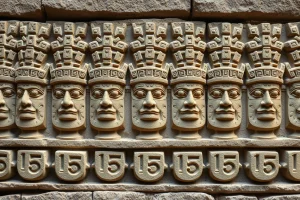
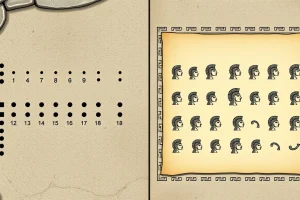
The foundation of Maya astronomical calculation was their vigesimal, or base-20, number system. This system utilized only three symbols: a dot representing one, a bar representing five, and a shell glyph representing zero. Numbers were written vertically, with the lowest position at the bottom and successive positions multiplying by twenty. This positional notation was crucial for handling the large numbers required for the Long Count calendar and astronomical tables. In the modified Long Count usage, the third position sometimes multiplied by 18 times 20 to align with the 360-day tun year, demonstrating a flexibility in their mathematical application to suit calendrical needs.
The invention and consistent use of zero were paramount to this system. The shell glyph served as a placeholder, enabling scribes to perform calculations involving large intervals of time without ambiguity. This mathematical sophistication is most explicitly preserved in sacred corpora such as the Dresden Codex, which contains astronomical tables detailing the cycles of Venus and eclipse reckoning. The scribes who compiled these texts relied on observations accumulated over generations, encoding them into numerical formulas that could predict future celestial events. These records were often painted on interior walls of ceremonial structures or inscribed on stone monuments, serving as both functional tools and sacred declarations of the ruler’s connection to the cosmos.
Recent scholarship has shifted focus from the abstract systems to the human agents behind them. For decades, Maya glyphic texts were understood primarily as chronicles of historical or divine characters. Everyday or functional records, particularly those attributing scientific work to specific individuals, were considered rare. However, new analyses of microtexts painted on interior walls have begun to uncover the identities of the scholars themselves. This shift highlights the value the Maya placed on intellectual labor, recognizing that the maintenance of cosmic order required specialized human expertise. The mathematical records were not anonymous; they were the work of trained elites who held significant status within the court.
Evidence & Sources
The primary evidence for Maya astronomical calculations comes from a combination of codices, monumental inscriptions, and wall paintings. The Dresden Codex remains the most mathematically explicit sacred corpus of the Americas, containing detailed tables for Venus and eclipse cycles. However, archaeological contexts provide the physical setting for these calculations. The site of Xultun, Guatemala, has emerged as a critical location for understanding the practical application of Maya mathematics. Structure 10K-2 at Xultun contains interior wall paintings that include numerical tables and astronomical data similar to those found in the later codices.
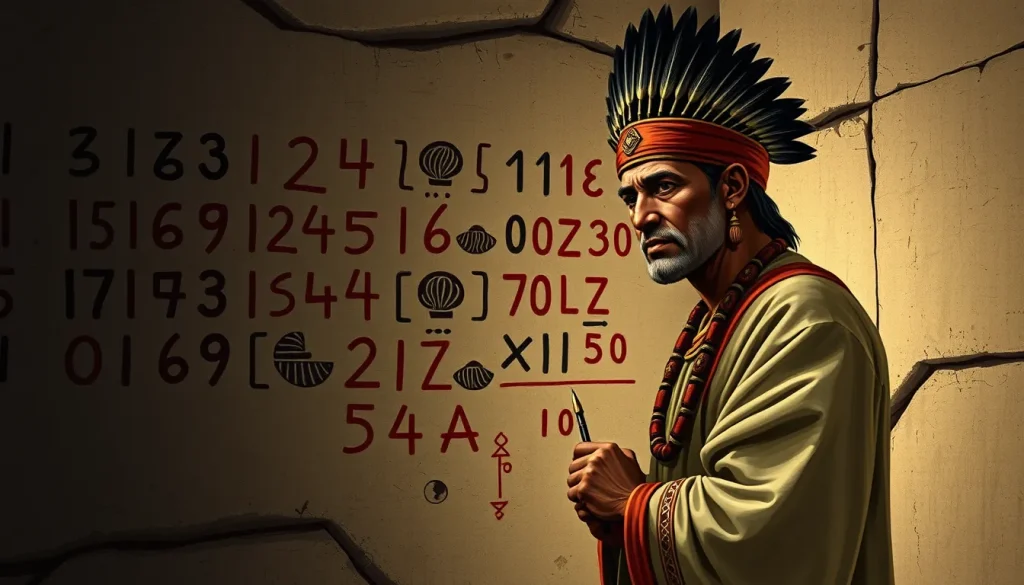
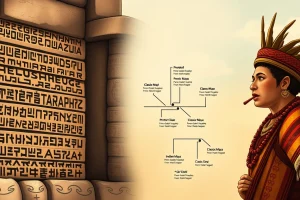
In a groundbreaking study published in 2026, researchers Franco D. Rossi, David Stuart, and Heather Hurst offered a reconstruction and transcription of a microtext painted on an interior wall of Structure 10K-2. This text records a unique astronomical formula that concludes with a name, attributing the work to an individual named Sak Tahn Waax, translated as ‘White-chested Fox’. To date, this is the only known example of a Classic Maya mathematician directly credited for their work. This discovery attests to the value of the work and provides a rare glimpse into the intellectual hierarchy of the Classic period. The text suggests that specific individuals were recognized for their ability to manipulate numerical data to serve astronomical and calendrical purposes.
Supporting literature, such as the work of Floyd G. Lounsbury on Maya numeration and computation, establishes the broader context of these findings. Lounsbury’s analysis divides Maya mathematical practice into sections including numeration and notation, calendar chronology, and eclipse reckoning. These foundational studies confirm that the numbers found at Xultun are not random decorations but functional components of a larger computational system. The convergence of epigraphic analysis and archaeological context at Xultun validates the interpretation of these walls as working spaces for scribes and astronomers. The physical preservation of these painted numbers allows modern researchers to trace the exact strokes of the ancient calculators.
Deep Dive Analysis
Definition
Maya Astronomical Computation refers to the systematic process by which Classic Maya scribes used vigesimal mathematics to track, predict, and record celestial phenomena. This concept encompasses the notation system, the computational methods, and the physical recording of data used to align human activities with cosmic cycles. It is distinct from modern astronomy in its integration with cosmology and ritual, yet it shares the fundamental goal of predictive accuracy through mathematical modeling.
How it works
The system operates on a vertical positional notation where values increase by powers of twenty moving upward. Scribes would perform additions and subtractions using these symbols to calculate intervals between celestial events. For example, to predict the return of Venus, a scribe would add the known synodic period repeatedly, adjusting for calendar rounds. The inclusion of zero allowed for the resetting of positions without losing the magnitude of the higher orders. Calculations were often checked against observed data, and corrections were noted in the margins or subsequent records.
Key components
The essential components include the dot (unit one), the bar (unit five), and the shell (zero). Additionally, the system relies on specific calendrical units such as the kin (day), uinal (20 days), and tun (360 days). The astronomical tables themselves are key components, often organized in columns representing time intervals and rows representing celestial states. The microtext identified at Xultun serves as a signature component, linking the data to a specific author.
Example
The microtext from Structure 10K-2 at Xultun serves as a prime example. It records a unique astronomical formula followed by the name Sak Tahn Waax. This text demonstrates that complex calculations were not just institutional outputs but could be associated with individual intellectual property. The formula likely related to the synchronization of lunar or planetary cycles with the ritual calendar, providing a specific date for ceremonial action.
Historical evidence
Evidence is derived from the Dresden Codex, the Madrid Codex, and archaeological sites like Xultun and Copan. The 2026 identification of Sak Tahn Waax by Rossi, Stuart, and Hurst provides the first direct epigraphic evidence of a named mathematician. Prior to this, scribes were known by their titles, but specific attribution of mathematical work was undocumented. The wall paintings at Xultun date to the ninth century, aligning with the late Classic period when such computational precision was vital for maintaining political legitimacy.
Common misconceptions
A common misconception is that Maya mathematics was purely mystical or numerological without empirical basis. While numerology played a role, the tables in the Dresden Codex and Xultun demonstrate rigorous empirical observation and correction. Another misconception is that all calculations were anonymous religious acts. The discovery of Sak Tahn Waax proves that individual authorship was recognized. Finally, some believe the system was static; however, the modified Long Count usage shows adaptability in their mathematical framework to suit astronomical realities.
FAQ
Did the Maya invent the concept of zero?
Yes, the Maya independently developed a symbol for zero (the shell glyph) within their vigesimal number system, which was crucial for their positional notation and astronomical calculations.
Who was Sak Tahn Waax?
Sak Tahn Waax, meaning 'White-chested Fox', is an eighth-century Maya mathematician identified in 2026 from a microtext at Xultun, marking the first known attribution of mathematical work to a specific individual.
Where were these calculations recorded?
Calculations were recorded on painted walls inside structures like Structure 10K-2 at Xultun, as well as in bark-paper books known as codices, such as the Dresden Codex.

Leave a Reply