
Short Answer
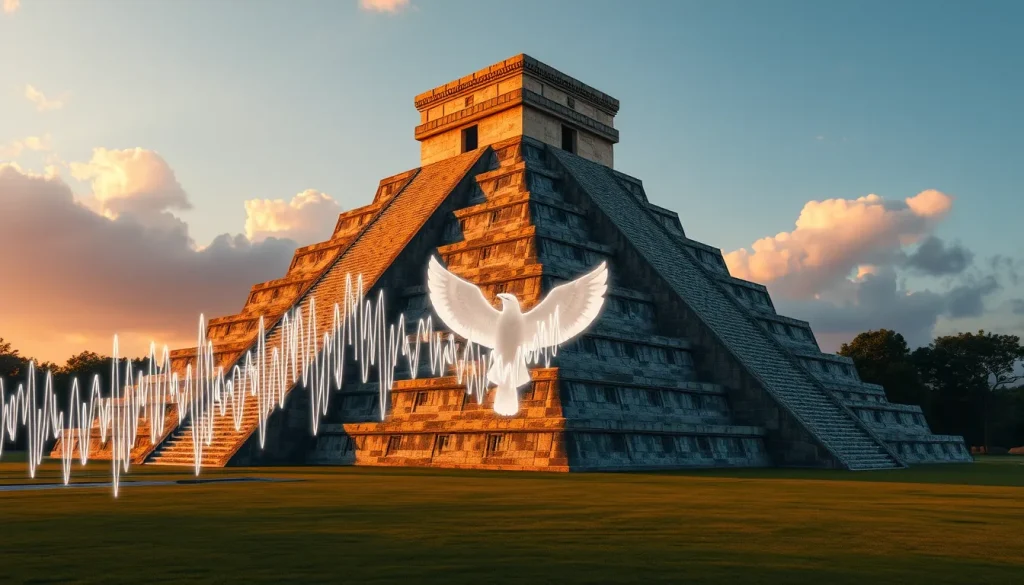
The Temple of Kukulkan, commonly known as El Castillo, at the Maya ruins of Chichén Itzá in Mexico, is renowned for a peculiar acoustic phenomenon. When a visitor claps their hands in front of the main staircase, the returning echo does not sound like a standard reflection. Instead, it produces a descending chirp that bears a strong cognitive resemblance to the call of the Resplendent Quetzal, a sacred bird in Mesoamerican culture. This effect has transitioned from a tourist curiosity to a subject of rigorous archaeoacoustic study, bridging physics, archaeology, and cultural heritage.
Understanding this acoustic mimicry requires analyzing the interaction between sound waves and the pyramid’s architecture. The phenomenon is not a recording or a supernatural event but a physical consequence of wave diffraction. Research indicates that the staircase acts as an acoustical diffraction grating, dispersing sound energy over time much like an optical grating disperses light. This article examines the physical mechanisms, the archaeological evidence, and the scholarly debate regarding whether this effect was intentionally designed by the Maya builders to enhance the spiritual experience of the site.
Main Explanation
The primary physical mechanism responsible for the quetzal-like echo is known as the “picket fence” effect, caused by periodic reflections from the temple staircases. When a sharp sound, such as a handclap, is emitted near the base of the pyramid, the sound waves strike the series of stepped terraces. Each step acts as an individual reflector. Because the steps are evenly spaced, the reflections return to the observer at slightly different time intervals. This sequence of echoes merges into a single perceived sound with a changing frequency, known as a chirp.
Advanced modeling describes the staircase as an acoustical analogue of an inclined optical Bragg diffraction grating. In physics, a Bragg grating selectively disperses wavelengths based on structure. In this acoustic context, the “wavelengths” are sound frequencies, and the “dispersion” occurs over time rather than space. Consequently, the echo is termed an “acoustical rainbow.” The high-frequency components of the handclap reflect off the nearer or upper steps differently than the low-frequency components, creating a frequency sweep that descends in pitch. This time-dispersive, pulse-stretching property converts the impulsive energy of a handclap into a tonal, bird-like warble.
Furthermore, the acoustic response is dependent on the sound source. Simulations performed using delta function-like pulses and real handclaps show strong dependence on the incident sound. Studies utilizing Gaussian pulses with different spectral distributions have found that above a frequency related to the step dimensions, the acoustic response is temporally prolonged. Depending on the spectral distribution of the pulse, the response may result in a frequency sweep with one or more harmonics. This confirms that the effect is robust but varies slightly based on how the sound is generated.
Evidence & Sources
The scientific understanding of this phenomenon relies on a combination of in situ recordings and numerical simulations. Early progress in understanding the physical and mythological elements was reported in 1999, linking the echoes to the Resplendent Quetzal, the Mayan sacred bird associated with the temple. These studies established that the echoes bear strong cognitive resemblance to the bird’s call and that the “picket fence” reflections explain the presence and trajectory of the descending chirps.
Subsequent theoretical studies published in 2004 described precise diffraction simulations to answer critical questions about what physical effects cause the formation of the chirp echo. These simulations were compared with experimental results obtained from David Lubman. The work explained not only the handclap echo but also another acoustic mystery: why an observer seated on the lowest step hears the sound of raindrops falling in a water-filled bucket when people climb the stairs higher up. The footstep sounds are transformed by the same diffraction mechanism.
Later research in 2010 analyzed the acoustic response in relation to different sound sources, proposing models based on a linear array of point sources to simulate the response. These studies compared recordings with simulations to validate the physical models. Additionally, archaeoacoustic investigations have related the chirped echo to Maya ethnohistory, noting that the Quetzal was venerated as the bird messenger of the Maya gods. The spectacular diving behavior of the quetzal at the spring equinox gives it the visage of a flying serpent, linking the acoustic effect to the visual shadow phenomenon observed at the same site.
Deep Dive Analysis
Location
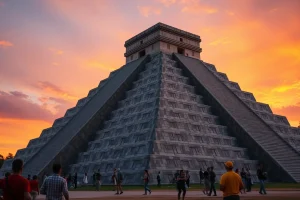
The phenomenon occurs specifically at the Temple of Kukulkan (El Castillo) within the archaeological zone of Chichén Itzá, located in the Yucatán Peninsula, Mexico. The effect is most pronounced when standing on the plaza directly in front of the northern staircase, which is the main entrance used by visitors. The geometry of the plaza and the hard limestone surface in front of the pyramid also contribute to the acoustic environment, as reflections on the ground in front of the pyramid are discussed in theoretical works as influencing the echo formation.
Construction/history
El Castillo was constructed during the Terminal Classic period, serving as a temple to the feathered serpent god Kukulkan (known as Quetzalcoatl in central Mexico). The structure stands approximately 30 meters tall with nine terraced levels. The historical context is vital because the acoustic effect aligns with the dedication of the temple to a deity associated with birds and serpents. The construction techniques utilized large limestone blocks, creating hard, reflective surfaces ideal for generating strong acoustic reflections necessary for the diffraction effect to be perceptible to the human ear.
Architecture
The architectural feature responsible for the sound is the steep northern staircase. Each side of the pyramid has 91 steps, totaling 364, plus the top platform making 365, representing the solar year. The steps are uniform in height and depth, creating the periodic structure required for the Bragg diffraction effect. The steepness of the staircase ensures that the path difference between reflections from successive steps is significant enough to create the audible frequency sweep. The precision of the masonry contributes to the clarity of the echo, as irregular surfaces would scatter the sound diffusely rather than creating a coherent chirp.
Astronomical interpretation
The acoustic effect is often discussed in conjunction with the famous equinox shadow phenomenon. At the spring equinox, a zigzag shadow creeps down the staircase balustrade, representing the plumed serpent god descending from the heavens. The chirped echo emulates the call of the quetzal, whose diving behavior at the spring equinox gives it the visage of a flying serpent. This synchronization of visual and auditory stimuli suggests a multi-sensory design intended to manifest the deity’s presence. The acoustic energy is selectively dispersed over time, much as optical gratings selectively disperse colors over space, linking the sound to the light display.
Archaeological evidence
Archaeoacoustics adds value when it solves problems that stump archaeologists. Despite compelling ethnographic ties linking the equinox display with ancient Maya culture, archaeologists initially found no evidence of intentional design for the shadow. Such evidence was found by relating the peculiar aural clue at the temple’s chirped echo to Maya ethnohistory. The echo is of cognitive interest as well; echoes are normally taken in stride, but the chirped echo seems unnatural or supernatural to many visitors. This cognitive disruption supports the argument that the effect was designed to evoke a reaction consistent with religious awe.
Alternative interpretations
While the physical mechanism is well-understood, the question of intentionality remains debated. Some researchers argue that the effect could be an accidental byproduct of the staircase’s construction requirements. The need for steep steps to accommodate the pyramid’s height might have inadvertently created the diffraction grating. However, counter-arguments suggest that the Maya were sophisticated observers of natural phenomena. The strong cognitive resemblance to the sacred bird and the alignment with the equinox ceremony suggest that if it was accidental, it was quickly recognized and incorporated into the ritual use of the temple.
Scholar consensus
The scholarly consensus confirms the physical origin of the sound as diffraction from the staircase steps. Numerical simulations show that the echo shows a strong dependence on the kind of incident sound, validating the physical model. There is growing acceptance that the Maya may have intentionally utilized acoustical properties, strengthening mythological arguments for intentional Mayan use of acoustical effects. The conversion of a handclap into a chirped echo is explained through the time-dispersive properties of these gratings, a concept now widely accepted in archaeoacoustic literature.
Visitor misconception
A common misconception among visitors is that the sound is a recording played by hidden speakers or that it sounds exactly like a biological bird to everyone. In reality, the resemblance is cognitive and subjective; some hear a bird, others hear a mechanical chirp. Another misconception is that the effect works equally from all sides of the pyramid; it is specific to the northern staircase geometry. Additionally, some believe the sound is produced by the wind or the structure itself vibrating, rather than being a reflection of the visitor’s own clap. Understanding the physics demystifies the experience without diminishing its cultural significance.
FAQ
Is the quetzal bird sound a recording?
No, it is a natural acoustic phenomenon caused by sound waves diffracting off the pyramid's staircase steps.
Does the effect work on all sides of the pyramid?
The effect is most prominent on the northern staircase due to its specific orientation and geometry relative to the plaza.
Did the Maya intentionally design this sound?
While the physical mechanism is confirmed, scholarly consensus suggests intentional design is plausible due to the cultural significance of the Quetzal bird, though definitive archaeological proof remains debated.
What other sounds can be heard at El Castillo?
Climbers ascending the stairs sound like raindrops falling into a bucket to observers seated at the base, due to the same diffraction effect.

Leave a Reply