
Short Answer
The question of how the Maya wrote zero is central to understanding one of the most sophisticated mathematical systems developed in the ancient world. Unlike many contemporary civilizations that lacked a concept for nothingness, the Maya civilization of southern Mexico, Guatemala, Belize, and Honduras utilized a true zero within a positional numeral system. This innovation was not merely philosophical but practical, enabling the precise astronomical predictions and calendar calculations for which the Maya are renowned. The symbol for zero was distinct, recognizable, and integrated seamlessly into their dot-and-bar notation.
Specialists of the Maya civilization emphasize the terminology “Maya numerals” or “Maya mathematics,” rather than “Mayan,” as the adjective “Mayan” is reserved specifically for linguistic references. This distinction underscores the academic rigor required when discussing their numerical achievements. The representation of zero was a cornerstone of this system, allowing for the expression of large numbers necessary for tracking deep time within the Long Count calendar.
Main Explanation
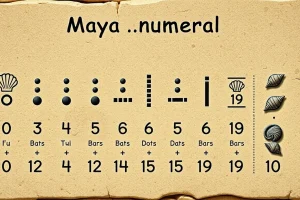
The Maya numeral system was a vigesimal (base-20) positional system. To write numbers, the Maya used three primary symbols: a dot representing one, a bar representing five, and a shell representing zero. These symbols were combined to form digits from zero to nineteen. For values exceeding nineteen, the Maya wrote numbers vertically, with each position representing a power of twenty. This vertical arrangement is analogous to the Hindu–Arabic numeral system’s use of powers of ten, but scaled to base twenty.
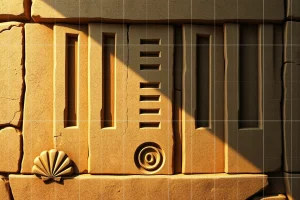
The zero symbol itself was typically depicted as a stylized conch shell, often with a cross-hatched interior. This glyph was instantly recognizable across the surviving Maya corpus, appearing on stelae, codices, and pottery. In the positional system, the shell acted as a placeholder. For example, in a vertical column, a shell in the bottom position indicated zero units, while a dot above it would indicate one twenty. This positional value meant that the same symbol could represent different magnitudes depending on its vertical placement.
Mathematically, the inclusion of zero allowed for complex arithmetic operations. The Maya could perform addition and subtraction using these symbols, carrying values between positions just as modern mathematicians carry values in base-10 arithmetic. The precision of their observations, facilitated by this numerical system, allowed them to carry out the elaborate calculations needed to make precise astronomical predictions. Without the zero placeholder, tracking cycles such as the synodic period of Venus or the solar year over centuries would have been significantly more difficult.
Evidence & Sources
Archaeological and textual evidence confirms the use of zero from at least the third century BCE through the Spanish conquest of the sixteenth century CE. The Dresden Codex, one of the few surviving pre-Columbian Maya books, contains extensive tables of numerical data utilizing the shell symbol for zero. These tables were used to predict eclipses and planetary movements. The consistency of the symbol across different media—from carved stone monuments to painted bark paper—demonstrates a standardized understanding of the concept across the Maya region.
In the modern era, the recognition of Maya numerals has extended into digital heritage. The Unicode Mayan Numerals block (U+1D2E0–U+1D2F3) provides a precomposed glyph for each of the twenty digits, including zero. This digital encoding ensures that the symbols can be rendered as live text in contemporary computing environments, preserving the visual integrity of the ancient system for educational and research purposes. The inclusion of these characters in Unicode standards highlights the global recognition of Maya mathematics as a significant human achievement.
Furthermore, historical records indicate that the Maya used powers of twenty consistently. Upon reaching 20 squared (400), another row was started in the vertical notation. For instance, the number 33 was written as one dot above three dots atop two bars. The first dot represented “one twenty” (1×20), which was added to thirteen (three dots and two bars). Therefore, (1×20) + 13 = 33. This calculation explicitly relies on the positional value established by the system, where zero serves as the critical anchor for empty positions in higher orders of magnitude.
Deep Dive Analysis
Definition of the Maya Zero
The Maya zero is defined as a numerical placeholder and a conceptual representation of nothingness within a vigesimal positional system. It is not merely the absence of a value but an active digit that holds a place in a sequence. This definition distinguishes it from earlier systems that might skip positions or use spaces ambiguously. The Maya zero was a functional tool for calculation.
How It Works
In practice, the zero symbol functioned within a vertical column. Each level of the column represented a increasing power of 20. The bottom level represented 1s, the next 20s, then 400s (20²), 8000s (20³), and so on. If a specific power of 20 was not needed in a number, the shell symbol was placed in that position to maintain the structural integrity of the number. This prevented ambiguity; without the zero, a number like 400 could be mistaken for 20 if the upper position was left blank.
Key Components
The visual vocabulary for Maya numerals is tiny but expressive. The zero is specifically a stylized shell. While variations exist in artistic depiction—some shells are more rounded, others more elongated—the core identifier remains the conch shape often filled with cross-hatching or dots. This contrasts with the dot (one) and bar (five), which are geometric. The organic shape of the zero may have cosmological significance, potentially linking to water, birth, or cycles, though mathematically it served as a null value.
Example
Consider the number 429. In the Maya system, this is written vertically. The bottom position (1s) holds nine (one bar and four dots). The middle position (20s) holds one (one dot). The top position (400s) holds one (one dot). However, if the number were 400, it would be written as one dot in the 400s position, a shell in the 20s position, and a shell in the 1s position. This explicitly shows (1×400) + (0×20) + (0×1). The presence of the shells ensures the top dot is read as 400, not 1.
Historical Evidence
Evidence for the zero appears in the Long Count calendar inscriptions. The earliest known use of zero in Mesoamerica predates the Maya, appearing in Olmec artifacts, but the Maya refined and standardized its use in a positional system. Surviving codices like the Dresden Codex provide clear textual evidence of zero used in astronomical tables. Stelae at sites like Tikal and Copán also display large numbers utilizing the shell glyph to denote completed cycles (k’atuns and b’ak’tuns) where lower units were zero.
Common Misconceptions
A common misconception is that the Maya invented the concept of zero independently without any precursor. While they developed the positional application independently of the Old World, the concept of zero as a placeholder existed in earlier Mesoamerican cultures. Another misconception involves the terminology; referring to “Mayan numerals” is linguistically incorrect according to specialists, who prefer “Maya numerals.” Additionally, some believe the shell symbol represented a specific deity exclusively, but in mathematical contexts, it functioned primarily as a numerical digit. Finally, it is sometimes assumed the system was purely base-20; however, in the calendar Long Count, the third position often modified to 18×20 (360) to approximate the solar year, showing flexibility in the system’s application.
FAQ
What symbol did the Maya use for zero?
The Maya used a stylized conch shell symbol to represent zero. It often featured a cross-hatched interior and was distinct from the dot and bar symbols used for other numbers.
Did the Maya invent zero?
The Maya developed the use of zero independently within the Americas. While the concept appeared earlier in Mesoamerica with the Olmecs, the Maya refined it into a positional system for complex calculations.
Why is the term 'Maya' preferred over 'Mayan' for numerals?
Specialists specify that 'Maya' refers to the civilization and culture, while 'Mayan' is reserved strictly for the family of languages. Therefore, 'Maya numerals' is the academically correct term.

Leave a Reply