
Short Answer
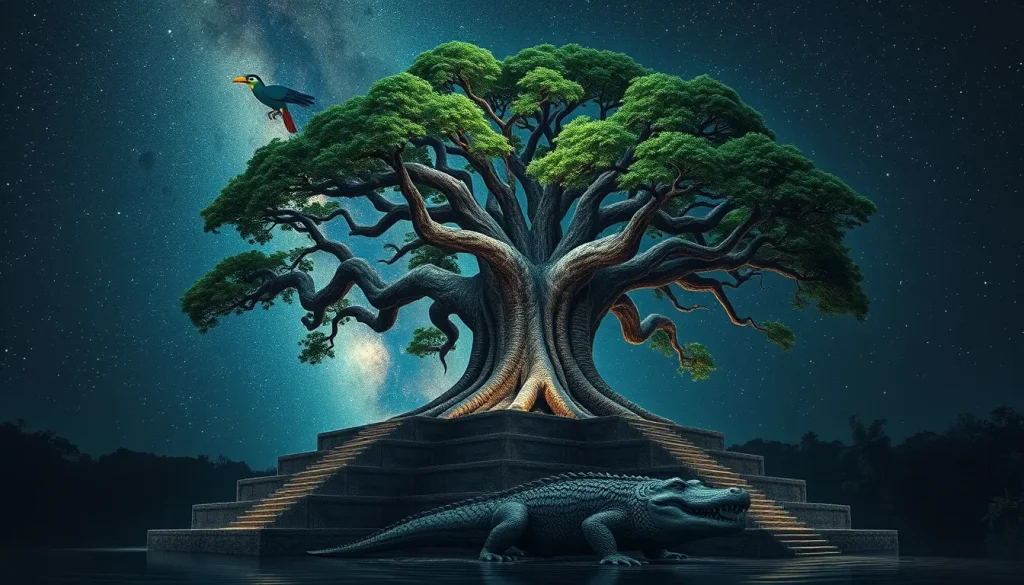
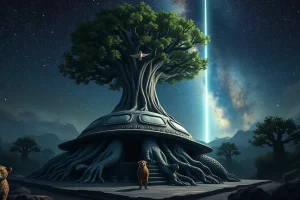
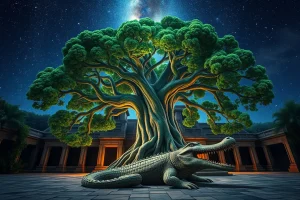
The Wakah Chan, frequently translated as the “Raised Up Sky,” stands as the central pillar of ancient Maya cosmology. More than a mere mythological motif, this concept represented a structural necessity within the Maya universe, functioning as the axis mundi that anchored the cosmos. Envisioned variously as a massive Ceiba tree, a maize plant, or a crocodilian monster, the World Tree formed the essential pathway for souls and divine energy to traverse between the three cosmic realms: the underworld (Xibalba), the earth, and the heavens. Understanding the Wakah Chan requires an interdisciplinary approach, blending archaeological iconography, epigraphic decipherment, and archaeoastronomy to reconstruct how the Classic Maya perceived their place within the celestial order.
Main Explanation
The term Wakah-Chan derives from Classic Maya glyphic texts, where it denotes the vertical axis that holds up the sky. In the Yucatan region, particularly during the Postclassic period, this concept was often referred to as the Ya’axche’, or “First Tree.” Botanically, the motif is most commonly associated with the Ceiba tree (Ceiba pentandra), a towering tropical species known for its massive trunk and buttress roots that seem to grip the earth. However, scholarly assessments indicate that the symbolism was fluid; on certain ceramic vessels and stone stelae, the World Tree displays characteristics of the maize plant (Zea mays), linking cosmological stability to agricultural sustenance and human creation.
Cosmologically, the Wakah Chan was not static. It served as a dynamic conduit. The top element of the tree was frequently crowned by the Principal Bird Deity, known as Itzam-Ye, representing the celestial realm and divine authority. Conversely, the base of the tree was rooted in the physical earth, often depicted emerging from a turtle carapace or the mouth of a crocodilian monster, symbolizing the watery underworld. This vertical structure was mirrored in the night sky; the Maya viewed the upright Milky Way as the glowing manifestation of the World Tree, linking terrestrial geography with celestial phenomena. This alignment suggests that the Wakah Chan was both a metaphysical concept and an observational reality, grounding spiritual beliefs in the visible movements of the galaxy.
Evidence & Sources
Archaeological evidence for the Wakah Chan is pervasive across the Maya lowlands and highlands. One of the most iconic representations is found on the lid of K’inich Janaab’ Pakal’s sarcophagus at Palenque. Dating to 683 C.E., this masterpiece depicts the deceased king at the base of a cosmic tree, falling into the underworld yet poised for resurrection along the tree’s axis. The iconography clearly delineates the tree’s role as a vehicle for royal apotheosis, allowing the soul to ascend from the realm of the dead to the heavens.
Further evidence appears at Izapa, a Preclassic site on the Pacific coast. Izapa Stela 5 features a complex tableau showing a multi-layered tree with birds perched in its branches. Scholars propose that these birds represent souls who have not yet descended into the underworld, while the central tree embodies the Mesoamerican world tree. This indicates that the symbolism predates the Classic period, tracing back to the Preclassic era. Epigraphic data supports these visual representations. Glyphic texts describe the “Raised Up Sky” in the context of creation accounts, reinforcing the idea that the tree was erected at the beginning of time to separate the sky from the earth. Modern digital heritage initiatives have further illuminated these sources; 3D scanning and photogrammetry allow researchers to analyze the depth and relief of these carvings without risking damage to the original stone, revealing subtle details about the tree’s morphology that were previously obscured by erosion.
Deep Dive Analysis
Definition
The Wakah Chan is defined as the cosmic axis of the Maya universe. It is the central pillar that connects the three cosmic realms: the underworld, the earth, and the heavens. It is not merely a physical tree but a metaphysical principle of cosmogenesis and natural creation.
How It Works
The World Tree functions as a pathway for souls and divine energy. It anchors the cosmos, preventing the sky from falling onto the earth. In astronomical terms, it corresponds to the Milky Way when it stands upright in the night sky, serving as a celestial reference point for timekeeping and ritual orientation.
Key Components
- Top Element: The Principal Bird Deity (Itzam-Ye), representing the heavens and divine oversight.
- Trunk: Often depicted as a Ceiba tree or maize stalk, symbolizing life and sustenance.
- Base Element: The physical earth, frequently represented as a turtle carapace or a crocodilian monster, symbolizing the underworld and primordial waters.
- Cardinal Directions: In the Mesoamerican context, world trees also embodied the four cardinal directions, representing the fourfold nature of a central world tree.
Example
The sarcophagus lid of K’inich Janaab’ Pakal at Palenque serves as the quintessential example. The imagery shows the king aligned with the tree, illustrating the belief that the ruler could traverse the axis mundi upon death. Another example is Izapa Stela 5, which shows the tree with birds, representing souls in transition.
Historical Evidence
Evidence spans from the Preclassic period through the Classic period (c. 250–900 AD). Ceramic vessels, stucco reliefs, and stone stelae across lowland Maya sites consistently feature the motif. Glyphic texts from the Classic period explicitly name the Wakah-Chan. Scholar J. Andrew McDonald notes that while cosmic tree symbolism traces from the Preclassic period, the underlying meaning and symbolic permutations are still being deciphered through botanical assessments of morphic and ecological characteristics on artifacts.
Common Misconceptions
A common misconception is that the World Tree was viewed as a single, literal biological species in all contexts. While the Ceiba is the primary model, iconography sometimes blends traits with maize or other vegetation to emphasize specific theological points, such as rebirth or sustenance. Another misconception is that it is purely spiritual; archaeological data suggests it was also an astronomical marker linked to the Milky Way. Finally, modern New Age interpretations often detach the symbol from its archaeological context, attributing unverified spiritual claims to it. Academically, it must be understood as a structural necessity of the ancient Maya universe, rooted in their specific cosmological and observational framework.
FAQ
Is the Wakah Chan a real tree?
While often modeled after the real Ceiba tree, the Wakah Chan is primarily a cosmological symbol representing the axis of the universe rather than a specific biological specimen.
What is the connection between the World Tree and the Milky Way?
The Maya viewed the upright Milky Way in the night sky as the glowing manifestation of the World Tree, linking celestial observations with terrestrial mythology.
Where can I see depictions of the Wakah Chan?
Prominent depictions include the sarcophagus lid of K’inich Janaab’ Pakal at Palenque and Izapa Stela 5, as well as various ceramic vessels from the Classic period.
Leave a Reply