Short Answer
In the complex tapestry of Maya cosmology, Xibalba (Kʼicheʼ Maya for “place of fright” or “place of fear”) represents far more than a simple destination for the deceased; it is a dynamic, subterranean kingdom that embodies the challenges of existence, the inevitability of death, and the possibility of rebirth [1][4]. Unlike the Western concept of a moralistic hell, Xibalba was a realm where nearly all souls journeyed after death, regardless of their earthly conduct [4]. It functioned as a mirror to the surface world, governed by a court of malevolent deities who sought to deceive and destroy those who entered their domain. The significance of Xibalba lies in its role as the ultimate testing ground for the human spirit and the divine, most notably illustrated in the narrative of the Hero Twins in the Popol Vuh [4].
The Structure and Governance of the Underworld
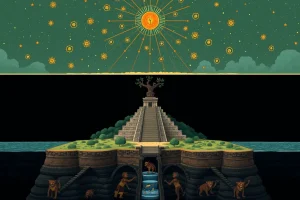
Xibalba is described as a vast subterranean world characterized by treacherous geography and a rigid, albeit cruel, hierarchy. The realm is ruled by the Lords of Xibalba, twelve powerful deities who oversee various forms of human suffering [1]. The senior-most rulers are Hun-Came (“One Death”) and Vucub-Came (“Seven Death”), who act as the primary architects of the underworld’s trials [1][2].
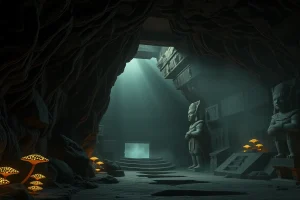
The administration of Xibalba is designed to inflict specific ailments upon humanity. The remaining ten Lords are commissioned to cause sickness, starvation, fear, destitution, and pain [1]. To enter Xibalba is to enter a bureaucratic nightmare where the visitors are subjected to a series of tests designed to prove their wit and resilience. The journey is marked by hazardous obstacles, including toxic rivers and a series of “Houses of Terror” [2][4]. These houses include:
- The Dark House: A place of absolute blindness and exhaustion.
- The Razor House: Filled with blades that shred the intruder.
- The Cold House: A realm of freezing temperatures.
- The Jaguar House: Populated by predatory beasts.
- The Bat House: Home to lethal, flying creatures.
- The Fire House: A place of scorching heat and flame [4].
The significance of these trials is not merely punitive; they represent the chaotic and dangerous forces of nature and the psyche that must be overcome to achieve transcendence or rebirth.
Archaeological and Textual Evidence
The understanding of Xibalba is derived from a synthesis of textual records and physical archaeological evidence. The primary textual source is the Popol Vuh, the sacred book of the Kʼicheʼ Maya, which provides a detailed narrative of the Hero Twins’ descent into Xibalba to avenge their father [4]. Beyond this, Classic-period ceramics often depict the action of aggressive wayob (spirit companions) and sacrificers interacting with the Underworld [1].
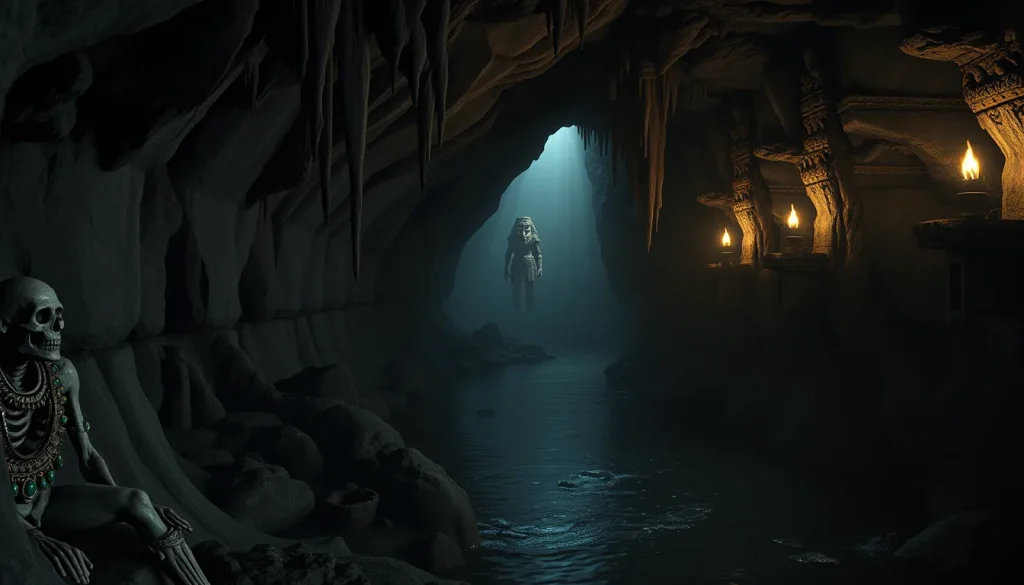
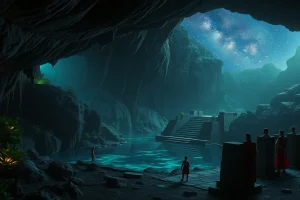
Archaeologically, the Maya identified physical entrances to Xibalba in the natural landscape. Caves were the most salient features of Maya cosmology, serving as literal and symbolic portals to the underworld [3]. In 16th-century Verapaz, a cave near Cobán, Guatemala, was traditionally viewed as the entrance [1], while similar cave systems in Belize are cited as gateways [1]. Cenotes (natural sinkholes) and ballcourts also served as liminal spaces between the earthly plane and Xibalba [4].
The artifact record confirms that these sites were used for ritual communication with the Lords of the Underworld. Excavations in caves have revealed offerings of ceramics, jewelry, incense, household items, and occasionally sacrificial victims [3]. These offerings suggest that the Maya did not merely fear Xibalba but actively engaged with its deities to ensure rain, fertility, and the maintenance of cosmic order [3].
Deep Dive Analysis: Concept of Xibalba
Definition
Xibalba is the subterranean realm of the dead in Maya mythology, specifically within the Kʼicheʼ tradition, though similar concepts exist in Yucatec (where it is known as Mitnal) [1]. It is defined as the “Place of Fear,” a realm of trial and tribulation presided over by the Lords of Death [4].
How it Works
The transition to Xibalba occurs upon death, though certain figures (like the Hero Twins) could enter while living. Once inside, the soul or visitor must navigate a series of deceptive landscapes and survive the “Houses of Terror.” Success in these trials is not based on strength, but on cunning, intelligence, and the ability to outsmart the Lords of Xibalba. This reflects a Maya philosophical emphasis on wisdom and strategy over brute force.
Key Components
- The Lords of Death: The governing body of the underworld, led by Hun-Came and Vucub-Came [1].
- The Houses of Terror: Six specialized chambers designed to kill or break the spirit of the visitor [4].
- Liminal Portals: Caves, cenotes, and ballcourts that act as the physical interfaces between the surface and the subterranean [4].
- The Milky Way: In some Maya regions, the celestial river of the Milky Way is interpreted as the road leading to Xibalba [1].
Example: The Hero Twins
The most prominent example of Xibalba’s significance is the story of the Hero Twins. They were summoned to Xibalba to play a ballgame against the Lords of Death. Through a series of tricks and supernatural abilities, they survived the Houses of Terror and eventually defeated the Lords, symbolizing the victory of life and light over death and darkness [4].
Historical Evidence
Evidence for Xibalba is found in the Popol Vuh, Classic-period pottery depicting underworld scenes, and the presence of ritual caches in cave systems throughout Guatemala and Belize [1][3]. The continued sanctity of these caves in modern Maya communities demonstrates the resilience of this cosmological framework [3].
Common Misconceptions
A frequent misconception is that Xibalba is equivalent to the Christian “Hell.” However, Xibalba was not a place of eternal punishment for “sinners.” It was a natural part of the cosmic cycle where nearly all souls traveled [4]. Furthermore, while often depicted as purely malevolent, the Lords of Xibalba were deities who could be petitioned and appeased through ritual offerings to ensure the fertility of the earth and the coming of rain [3].
FAQ
Is Xibalba the same as Hell?
No. Unlike the concept of Hell as a place of punishment for sins, Xibalba was a subterranean kingdom where nearly all souls went after death, serving as a place of trial and cosmic balance.
Who are the main rulers of Xibalba?
The underworld is ruled by twelve Lords, the most senior being Hun-Came (One Death) and Vucub-Came (Seven Death).
Where were the entrances to Xibalba located?
The Maya believed entrances were located in caves (such as those near Cobán, Guatemala), cenotes, and the ritual ballcourts.
Leave a Reply