
Short Answer
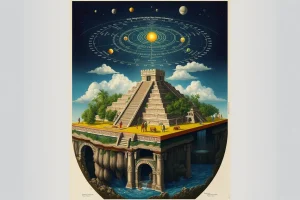
The ancient Maya perceived the universe not as a void, but as a structured, living entity defined by a rigorous vertical hierarchy. This cosmological framework was characterized by a tripartite division: the celestial realm (the heavens), the terrestrial plane (the earth), and the subterranean realm (the underworld). Central to this belief system was the conviction that the universe consisted of 13 distinct layers of heaven and 9 layers of the underworld, a numerical symmetry that mirrored the Maya’s sophisticated mathematical and calendrical systems. This vertical axis allowed for the movement of gods, ancestors, and the souls of the deceased, ensuring the continued balance of the natural world.
The Structure of the Vertical Universe
In Maya thought, the universe functioned as a cosmogram—a symbolic map of existence. The 13 layers of the heavens represented the celestial heights, where the supreme deities resided and where the movements of the sun, moon, and stars were orchestrated. These layers were not merely physical spaces but spiritual gradients of purity and power. The highest levels were associated with the most abstract and powerful forces of creation, while the lower celestial levels were closer to the human experience.
Conversely, the underworld, known as Xibalba (the ‘Place of Fear’), consisted of 9 distinct levels. Xibalba was not a place of ‘hell’ in the Western sense of eternal punishment, but rather a perilous realm of trial and transition. It was governed by the Lords of Xibalba, who tested the souls of the dead through a series of challenges and traps. The nine levels of the underworld corresponded to the depths of the earth, often associated with caves and cenotes, which the Maya viewed as natural portals to this subterranean world.
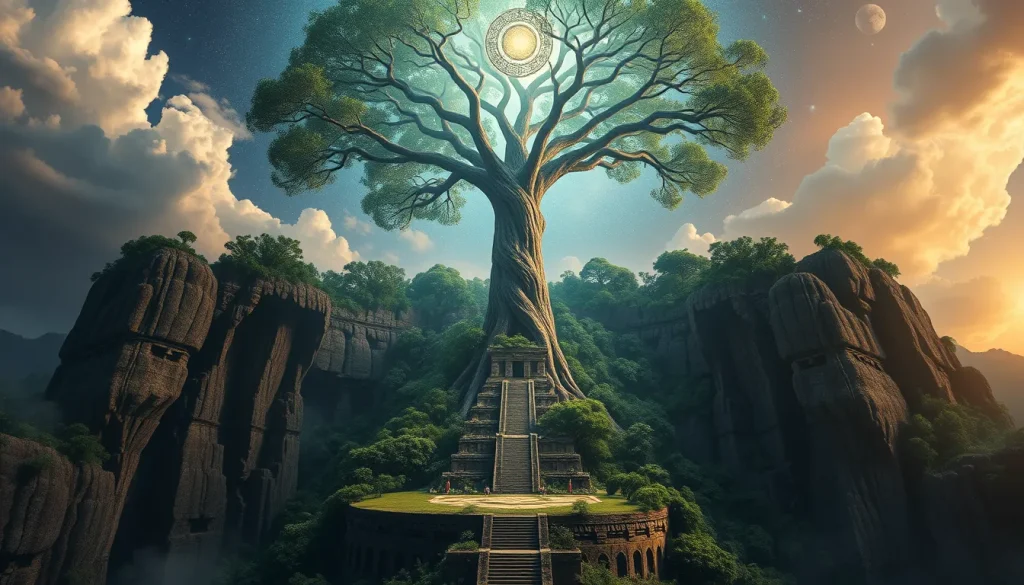
Connecting these two extremes was the Wakah-Chan, or the World Tree. This cosmic axis, often depicted as a giant Ceiba tree, rooted itself in the depths of Xibalba, grew through the terrestrial plane, and extended its branches into the 13th heaven. This axis provided the necessary conduit for communication and travel between the realms, allowing deities to descend to earth and humans to communicate with the divine through ritual and bloodletting.
Evidence and Sources
Our understanding of the 13 heavens and 9 underworlds is derived from a synthesis of archaeological findings, epigraphic analysis, and colonial-era manuscripts. The primary textual sources include the Popol Vuh (the Quiché Maya creation narrative) and the Books of Chilam Balam (Yucatec manuscripts), which detail the cyclical nature of creation and the trials faced by the Hero Twins in the nine levels of Xibalba [3, 4].
Archaeologically, this cosmology is manifested in the architecture of Maya cities. The construction of pyramids often mirrored the sacred mountain, serving as a physical link between the earth and the sky. Furthermore, the discovery of ‘E-Groups’—architectural assemblages designed for astronomical observation—demonstrates how the Maya aligned their physical structures with the celestial movements of the 13 heavens [1]. The use of mirrors and reflective surfaces in ceramics and ritual deposits further supports the belief in portals; mirrors were seen as gateways that allowed practitioners to peer into the spiritual worlds, effectively bridging the gap between the terrestrial and the subterranean [2].
Deep Dive Analysis: The Concept of the Vertical Universe
Definition
The Maya vertical universe is a cosmological model that organizes existence into a stacked hierarchy of 13 celestial levels and 9 subterranean levels, centered around a terrestrial plane. It is a system of spiritual geography where numerical values (13 and 9) define the boundaries of existence.
How it Works
The system operates on the principle of reciprocity and movement. Energy and entities flow vertically along the axis of the World Tree. Rituals performed on earth—such as bloodletting, incense burning, and pilgrimage to sacred sites like cenotes—were designed to open portals or ‘ways’ (be) to these levels. For example, the 9 levels of Xibalba functioned as a filter for the soul, while the 13 levels of heaven governed the cyclical time recorded in the Long Count calendar.
Key Components
- The 13 Heavens: The realm of the celestial deities and the cosmic hearth (associated with the Orion constellation) [4].
- The 9 Underworlds (Xibalba): The realm of death, trial, and the Lords of Xibalba [3].
- The World Tree (Wakah-Chan): The central axis connecting all levels [4].
- Portals: Natural features like caves, mountains, and cenotes that provided access to the underworld [3].
Example
The narrative of the Hero Twins in the Popol Vuh provides a clear example of this cosmology. The twins must descend into Xibalba, navigate its nine levels, and outwit the Lords of Death. Their eventual victory and ascent to the sky as the Sun and Moon illustrate the movement from the lowest depths of the 9 underworlds to the highest reaches of the 13 heavens.
Historical Evidence
Epigraphic evidence from stelae and lintels frequently references the ‘levels’ of the sky and earth. In the Dresden Codex, numerical associations with the number 13 are pervasive, linking the celestial layers to the 13-day cycle of the Tzolk’in calendar. Archaeological excavations of caves, such as those in the Yucatán Peninsula, reveal ritual offerings placed specifically to communicate with the subterranean layers of Xibalba [3].
Common Misconceptions
A frequent misconception is the interpretation of the 9 underworlds as a place of ‘evil’ or ‘damnation.’ In the Maya worldview, Xibalba was a necessary part of the cosmic cycle—a place of transformation and renewal rather than permanent punishment. Additionally, modern ‘New Age’ interpretations often project an abstract spiritualism onto these levels; however, for the ancient Maya, these were concrete, structured realities tied to specific deities and astronomical observations.
FAQ
Was Xibalba the same as Hell?
No. While Xibalba was a place of trial and fear, it was not a place of eternal punishment for 'sinners.' It was a transition realm that all souls encountered and a place where deities and ancestors resided.
How did the Maya access the 9 underworlds?
The Maya believed that certain natural features served as portals. Cenotes (collapsed sinkholes), caves, and deep ravines were seen as physical entrances to the layers of Xibalba.
What is the significance of the number 13 in the heavens?
The number 13 is sacred in Maya mathematics and astronomy, appearing in the 13-day cycle of the Tzolk'in calendar. The 13 layers of heaven reflect this numerical harmony and the complexity of the celestial order.
Leave a Reply