
Short Answer
The study of sound in ancient Maya architecture, known as archaeoacoustics, has emerged as a critical field for understanding ritual practices and cultural communication in Mesoamerica. For decades, archaeologists largely ignored acoustical science as a tool for discovery, focusing instead on visual alignment and structural integrity. However, recent investigations suggest that monuments such as the Great Ball Court at Chichen Itza and the Northern Group temples at Palenque functioned as sophisticated sound amplifiers. These structures may have been intentionally designed to project the human voice and musical instruments across vast distances, effectively serving as unplugged public-address systems for rulers and priests addressing large crowds.
This intersection of architecture and sound physics offers unique insights into how the Maya designed and used theater spaces for ceremony and ritual drama. While some acoustic features could be dismissed as irrelevant accidents of construction, acoustical advocates argue that when combined with an understanding of the Maya worldview, these features provide clues to lost civilization practices. The ability to reinforce sound or create whispering galleries would have enhanced the authority of speakers and the immersive experience of participants in the Mesoamerican ballgame, often called the sport of life and death.
Main Explanation
The science of Maya sound revolves around the physical properties of limestone architecture and the geometric precision of Maya construction. When sound waves encounter hard surfaces like stone steps and walls, they reflect, diffract, and amplify depending on the angle and distance. At Chichen Itza, the Temple of Kukulkan produces a chirping echo resembling the quetzal bird when handclaps are performed near the staircase. This phenomenon is not merely a curiosity but potentially a deliberate acoustic signature linked to the deity Kukulkan. Similarly, the Great Ball Court features whispering galleries that permit speech communication over unexpectedly large distances, allowing individuals at opposite ends of the colossal court to hear each other clearly.
At Palenque, archaeological teams led by Francisca Zalaquett of the Universidad Nacional Autónoma de México discovered that the Northern Group of public squares and temples, built around A.D. 600, is especially good at projecting sound. These complexes may have used acoustic design to broadcast and potentially disorient audiences. The architecture seems intended for ceremony, where sound reinforcement features improve the ability of rulers and priests to address large crowds. This suggests that acoustic engineering was as vital to Maya urban planning as astronomical alignment, serving both practical communication needs and cosmological symbolism.
Evidence & Sources
The primary evidence for Maya archaeoacoustics comes from modern acoustical measurements conducted at heritage sites. A seminal study published in The Journal of the Acoustical Society of America in 2002 analyzed the acoustical features of two Mayan monuments at Chichen Itza. The researchers deduced that ritual practices could be better understood through acoustical science, noting that sound reinforcement features and whispering galleries are present at the Great Ball Court and the Temple of Kukulkan. Further work by acoustical consultant David Lubman, presented at the Acoustical Society of America meetings in 2006 and 2010, proposed cultural purposes for these remarkable acoustic effects. Lubman’s study, begun in 1998, employs acoustical science to study problems that have stumped archaeologists for decades, including the relationship between sound and the serpent shadow phenomenon at Kukulkan.
National Geographic reporting in 2010 highlighted the work at Palenque, where temples might have formed a kind of unplugged public-address system. The team discovered the site projects the human voice as well as sounds like those made by musical instruments found at the site. This convergent facts from both acoustics and archaeology are needed for an investigation to be designated as acoustic archaeology. Without acoustics, archaeology is deaf, and without archaeology, acoustics is blind. These findings stir controversy but represent important news in archaeology if they have even partial validity, calling for a new archaeology of the senses as proposed by Mayanists Steven Houston and Karl Taube.
Deep Dive Analysis
Location
The primary case study for Maya acoustics is the Great Ball Court at Chichen Itza, located in the Yucatán Peninsula, Mexico. This site dominated the early postclassic Maya world, circa 900–1200 C.E. It stands as the largest and finest ballcourt found to date in Mesoamerica, where thousands of ballcourts have been discovered. The specific acoustical mechanisms found here serve as the benchmark for understanding sound design in other complexes like Palenque.
Construction and History
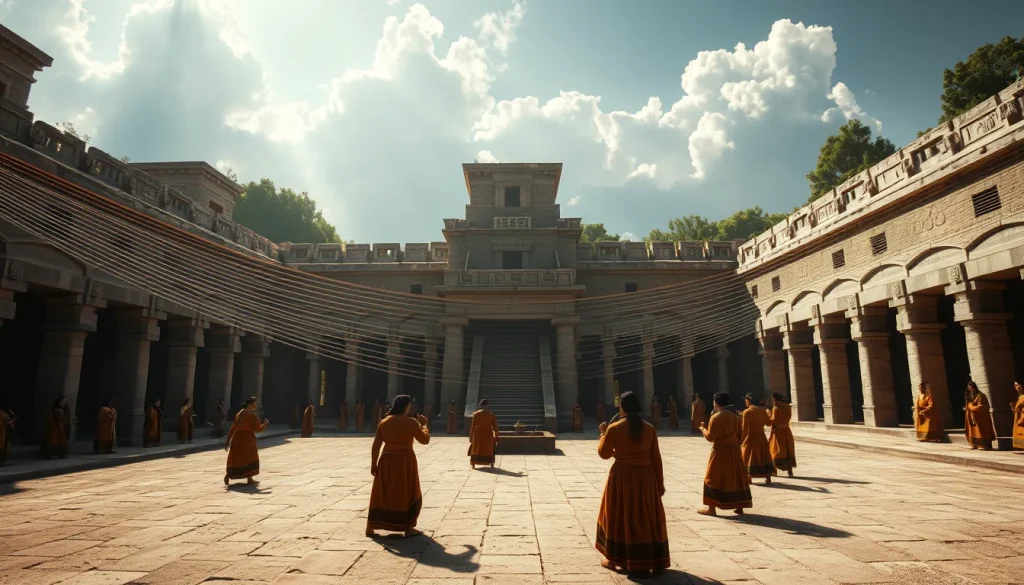
The Great Ball Court reflects the sophisticated, hybrid culture of a Mexicanized Maya civilization. Its construction involved massive limestone blocks arranged to form vertical walls and inclined playing surfaces. The architecture seems intended for ceremony and ritual drama, where what took place is largely unknown but deduced through physical evidence. The scale of the court suggests it was designed to accommodate large audiences, necessitating methods for mass communication without electronic amplification.
Architecture
The architectural layout includes long parallel walls that act as sound channels. Acoustical features at the monuments include sound reinforcement features that improve rulers and priests ability to address large crowds. The Ball Court whispering galleries permit speech communication over unexpectedly large distances. These structural elements function similarly to modern acoustic lenses, directing sound waves along specific paths to ensure clarity for listeners positioned far from the source.
Astronomical Interpretation
While primarily acoustic, the site also exhibits astronomical alignment, such as the serpent shadow that appears on the NW balustrade of the Temple of Kukulkan during the equinox. Acoustical solutions are being studied alongside these visual phenomena. The study reported employs acoustical science to study a problem that has stumped archaeologists for decades involving the serpent shadow. This suggests a multimodal sensory experience where sound and light worked in concert during ritual events.
Archaeological Evidence
Acoustical mechanisms have been found and cultural purposes proposed for two remarkable acoustic effects at the Great Ball Court. Handclaps at Kukulkan stimulate specific echo responses. The evidence relies on physical measurements of sound decay, reflection, and amplification within the stone structures. These claims are certain to stir controversy but are supported by data from the Acoustical Society of America. The findings indicate that the Maya may have been turning buildings into giant sound amplifiers and distorters to enthrall or disorient audiences.
Alternative Interpretations
Skeptics argue that unexpected and unusual acoustical features can be interpreted as irrelevant accidents rather than design. Some propose that the acoustic properties are byproducts of structural necessities rather than intentional engineering. However, acoustical advocates believe that when combined with an understanding of the Maya worldview, acoustical features can provide unique insights into how the Maya designed and used theater spaces. The debate centers on whether the precision required for these effects implies intent.
Scholar Consensus
Acoustic interpretations of sound at ancient sites are currently a hot topic. There is growing consensus that acoustical science can add value to deducing ritual practices. Leading Mayanists have called for a new archaeology of the senses. While not all archaeologists agree on the extent of intentional design, the validity of the acoustic phenomena themselves is widely accepted. It will be important news in archaeology if these findings have even partial validity, shifting how heritage sites are analyzed.
Visitor Misconception
A common misconception among visitors is that the acoustic effects are magical or spiritual in nature rather than physical. New Age interpretations often attribute the sounds to supernatural energy rather than limestone reflection. It is crucial to distinguish between historical Maya beliefs and modern interpretations. The science demonstrates that these are physical phenomena resulting from architecture, even if the Maya attributed spiritual significance to them. Understanding the physics does not diminish the cultural importance but grounds it in archaeological reality.
FAQ
Did the Maya intentionally design their buildings for acoustics?
While controversial, acoustical advocates believe that when combined with an understanding of the Maya worldview, acoustical features provide unique insights into design intent. Some features like whispering galleries suggest deliberate engineering.
What is the quetzal echo at Chichen Itza?
Handclaps at the Temple of Kukulkan stimulate an echo that resembles the call of the quetzal bird, a sacred animal in Maya culture. This is a result of the staircase geometry.
How does archaeoacoustics help archaeologists?
It adds value to deducing ritual practices by analyzing sound reinforcement features that improve rulers and priests ability to address large crowds, offering clues to how theater spaces were used.


Leave a Reply