
Short Answer
The intersection of archaeoastronomy and digital heritage has opened new avenues for understanding the sophisticated relationship between the ancient Maya and celestial cycles. Simulating sacred light involves the use of three-dimensional modeling, virtual reality, and computerized shadow analysis to reconstruct how sunlight interacted with Maya architecture during significant astronomical events, such as equinoxes and solstices. These digital reconstructions allow researchers to test long-standing hypotheses regarding the intentional design of structures like the Kukulcán Pyramid at Chichén Itzá and Stela D at Copán. By replicating the exact solar positions of the past, scholars can evaluate whether specific light and shadow effects were engineered deliberately or are merely coincidental byproducts of orientation.
Main Explanation
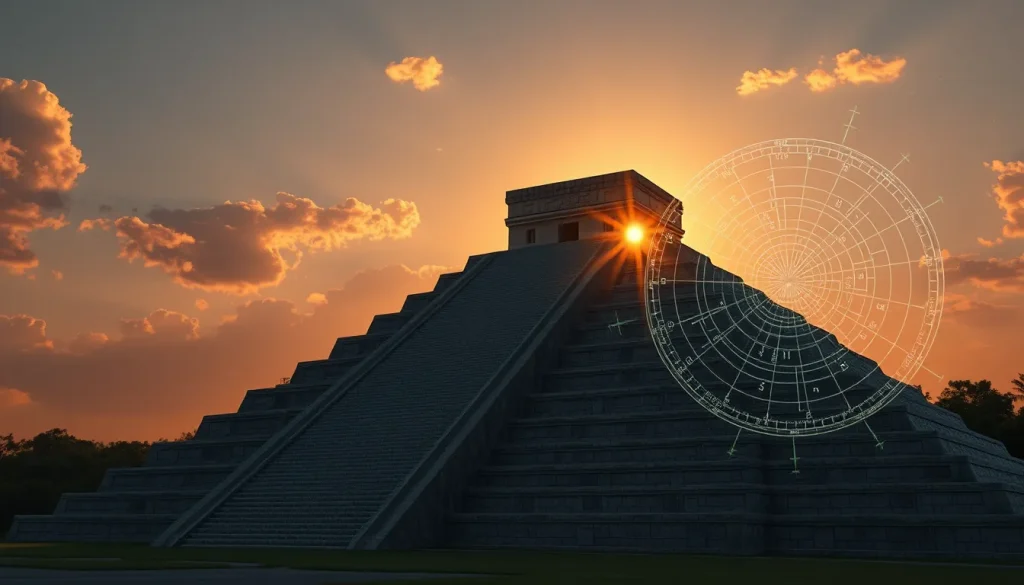
The phenomenon of sacred light refers to specific instances where sunlight creates meaningful patterns on architectural surfaces during key calendar dates. The most famous example occurs at the Kukulcán Pyramid in Chichén Itzá, where the setting sun during the equinox casts seven triangles of light and shadow along the northeast stairway, creating the illusion of a serpent descending. According to archaeological analysis, this effect can be interpreted through the lens of the Popol Vuh as the myth of the gods of the Heart of Sky coming to the Sovereign Plumed Serpent. However, neither the event nor the specific geometry used to build the pyramid is reported in the extant Mayan codices, leaving researchers to rely on physical evidence and digital simulation to determine intent.
Beyond Chichén Itzá, similar phenomena have been identified at other sites. At Copán, Honduras, investigations suggest that Stela D, its altar, and surrounding structures functioned as a sundial to record time. Archaeological evidence indicates that wooden posts and stelae were used to measure time and perform associated rites in the northern sector of the Main Plaza. Digital models constructed for Stela D study the shadows cast at different times of day and on different dates, including solstices, equinoxes, and solar zenith passages. The size and orientation of these shadows likely served as time markers for ancient residents. Furthermore, at Preclassic Cerros in Belize, virtual reality investigations explore how ancient observers noted features in the coastal landscape that marked zenith events. Over time, buildings were constructed to memorialize these observation points, eventually developing into architecture accessible only to elites, thus creating a separate privileged form of knowledge.
Evidence & Sources
The primary evidence for these phenomena comes from a combination of archaeological surveying, architectural analysis, and computational modeling. Research published in the Nexus Network Journal highlights two reliable facts regarding the Kukulcán Pyramid: first, a line across the pyramid’s base coincides with the orientation of the summer-winter solstice; second, an earlier, smaller pyramid is concealed beneath the current one. These facts ground the major question of whether the light and shadow effect was intended or occurs accidentally. Perspective as a surveying tool and digital reconstruction are now used to address this query.
At Copán, archaeological investigations support the use of stelae as time-measuring devices. Researchers constructed a digital model of Stela D to study the shadows cast at different times of day and on different dates of the year. This work, published in Ancient Mesoamerica, demonstrates how the size and orientation of shadows may have served as time markers. Similarly, work at Cerros, Belize, published in the Journal of Skyscape Archaeology, uses three-dimensional reconstructions based on recorded archaeological data. This research focuses on how the Maya at Cerros developed an astronomically influenced cosmological system where architecture itself became a form of landscape that helped mould ceremonial activities. Computer modeling has also been applied to the cultural context of the Mesoamerican calendar and polar star precession, revealing complex ancient computations involving Maya math, time, and astronomy.
Deep Dive Analysis
Technology Description
The simulation of sacred light relies on digital archaeology technologies, specifically three-dimensional modeling and virtual reality (VR) environments. These tools allow researchers to recreate ancient landscapes and structures with high precision. By integrating astronomical data regarding solar declination and azimuth into these models, scholars can simulate the exact position of the sun on any given date in history. This technology bridges the gap between static ruins and the dynamic celestial events they were designed to commemorate.
How It Works
Digital reconstruction workflows begin with the collection of spatial data through laser scanning or photogrammetry. This data forms the basis of a mesh model representing the architecture. Astronomical algorithms are then applied to calculate solar positions for specific historical dates, accounting for precession and atmospheric refraction. The software renders light rays from the simulated sun position onto the 3D model, generating shadow maps that reveal how light would have fallen on the structures during equinoxes or solstices.
Field Workflow
The process typically involves onsite surveying to capture the current state of the ruins, followed by laboratory-based modeling. Researchers must account for structural changes over time, such as the earlier pyramid concealed beneath the current Kukulcán Pyramid. Field data ensures that the digital model reflects the actual orientation and dimensions of the site. At sites like Cerros, recorded archaeological data informs the reconstruction of promontories and buildings that may no longer exist in their original form.
Output/Data
The primary output is a visual simulation of light and shadow patterns over time. This includes video renderings of shadow creep along stairways, such as the seven triangles at Chichén Itzá, or static maps of shadow lengths at specific times, as seen in the Stela D models. Data outputs also include precise measurements of shadow angles and durations, which can be compared against calendrical cycles.
Example
A prominent example is the digital model of Stela D at Copán, used to study shadows cast during solstices and equinoxes. Another is the VR reconstruction of Cerros, Belize, which demonstrated how early astronomical systems emerged through landscape observation before being codified in architecture. These examples show how digital tools validate hypotheses about architectural alignment.
Strengths
Digital simulations allow for non-invasive testing of hypotheses. Researchers can manipulate variables, such as the height of a structure or the date of observation, without disturbing the archaeological site. This is crucial for preserving heritage while conducting rigorous scientific analysis. It also allows for the visualization of phenomena that may be obscured by modern vegetation or structural decay.
Limitations
One limitation is the accuracy of the reconstruction. If the original height or orientation of a building is unknown, the simulation may produce inaccurate results. For instance, the presence of an earlier pyramid beneath the Kukulcán Pyramid complicates the analysis of the current structure’s original intent. Additionally, atmospheric conditions in the past may have differed from modern models, affecting light transmission.
Accuracy
Accuracy depends on the quality of the archaeological data input. When based on precise surveying, as seen in the Copán and Cerros studies, digital models can provide reliable insights into astronomical alignments. However, claims about specific mythological interpretations, such as the Popol Vuh connection to the Kukulcán light effect, remain theoretical unless supported by textual evidence, which is currently extant only in later codices.
Cultural Heritage Considerations
Digital reconstructions must respect the cultural significance of these sites to modern descendant communities. While simulations can distinguish between historical fact and modern interpretation, they should not be used to validate New Age misconceptions. The goal is to understand the ancient cosmological system, such as the privileged knowledge created by elite architecture at Cerros, rather than to promote unsupported spiritual claims.
FAQ
Was the serpent shadow effect at Chichén Itzá intentional?
While the effect is precise, extant Mayan codices do not report it. Researchers use digital modeling to determine if the geometry was intended for this effect or if it is accidental.
How do digital models help archaeologists study Maya astronomy?
Models allow researchers to simulate solar positions and shadow casts for historical dates without disturbing the site, testing hypotheses about architectural alignment.
Did all Maya sites use architecture for astronomical observation?
Not all sites. Evidence suggests places like Cerros developed observation systems over time, eventually restricting access to elites, while Copán used stelae as sundials.

Leave a Reply