
Short Answer
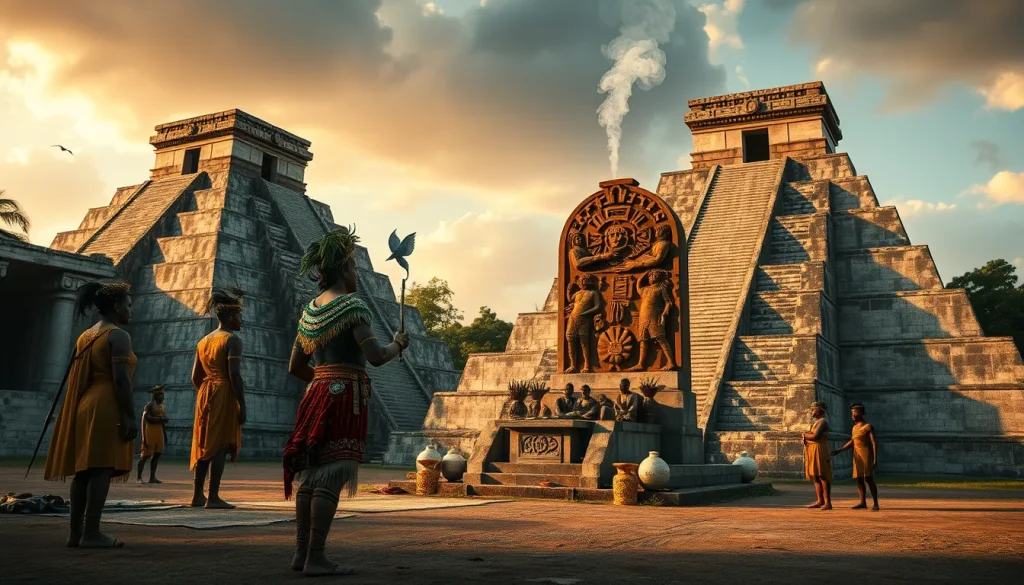
The conclusion of a Katun, a twenty-year period within the Maya Long Count calendar, represented one of the most significant temporal milestones in Classic Maya civilization. These period endings were not merely chronological markers but were understood as moments of cosmic vulnerability and renewal requiring specific ritual interventions. Archaeological and epigraphic evidence demonstrates that Katun endings were celebrated through the dedication of stone monuments, the performance of bloodletting rites, and the construction of specialized architectural complexes designed to host these commemorative ceremonies. The rituals served to legitimize dynastic rule, anchor historical narrative, and maintain alignment between human activity and celestial cycles.
Main Explanation
In the Maya conception of time, periods were not abstract measurements but lived experiences imbued with spiritual weight. The Katun, consisting of approximately 7,200 days, was a primary unit of historical reckoning during the Classic Period (c. 250–900 CE). The ending of a Katun was believed to be a time when the burden of time shifted, requiring rulers to perform specific duties to ensure the continuity of the world. These rituals often involved the erection of stelae—carved stone shafts—and altars that recorded the date and the name of the ruling lord. The act of raising these monuments was itself a ritual performance, transforming the calendar date into a permanent physical presence within the sacred landscape.
The significance of these events extended beyond the immediate ruling family. Evidence suggests that Katun endings were public spectacles involving the broader community. The rituals reinforced the connection between the king, who acted as the intermediary between the human and supernatural realms, and the populace. By successfully navigating the transition of the Katun, the ruler demonstrated their capacity to sustain cosmic order. Failure to perform these rites could be interpreted as a sign of weakness or divine displeasure, potentially destabilizing the political structure. Therefore, the archaeological record of Katun endings provides crucial insight into the intersection of politics, religion, and timekeeping in Maya society.
Evidence & Sources
The primary evidence for Katun ending rituals comes from monumental inscriptions and architectural assemblages across the Maya Lowlands. A key source of data is the analysis of stelae and altars at Tikal, where researchers have focused on how the Maya celebrated ends of the Katun cycles during the Classic period. Academic analysis of Tikal’s Katun period-ending stelae and altars highlights the accent placed on Katun period-ending rituals, specifically noting the development of twin-pyramid complexes at Tikal designed to host Katun-ending commemoration. These architectural groups appear in sets corresponding to specific Katuns, providing a physical map of temporal progression through the city’s urban layout.
Further evidence is found in the dynastic narratives of Palenque. Recordings of “Period-Endings” by members of the dynastic genealogy show that incidents and exploits associated with period-ending dates and ritual practice of time were recorded in longer inscriptions. For instance, the dynastic narrative on the three panels from The Temple of the Cross, The Temple of the Foliated Cross, and The Temple of the Sun in Palenque utilizes period-ending dates as base dates for actions performed or incidents that happened on a former and a later date. Scholars have noted that several rituals of time of the past, present, and future were proclaimed on the central panel of The Tablet of the Temple of the Inscriptions. This phenomenon, described as “k’atun history,” compares with the Katun prophecies of the colonial Yucatec Books of Chilam Balam, indicating a long-standing tradition of linking historical narrative to calendar cycles.
Architectural evidence also includes E-group assemblages, constructed and used for more than a millennium in the Maya Lowlands. While traditionally thought to mark solstices and equinoxes, recent investigations suggest these alignments were rarely accurate. Instead, accurate solar alignment was probably only a minor element of a larger set of metaphorically linked design considerations that included concepts of sacred geography and ritual performance in reference to yearly solar and agricultural cycles. This suggests that Katun rituals were part of a broader framework of astronomical observation and ritual performance that prioritized symbolic accuracy over precise mechanical alignment.
Deep Dive Analysis
Module A: Definition of Katun Ending Ritual Complex
Definition
The Katun Ending Ritual Complex refers to the standardized set of ceremonial activities, architectural constructions, and epigraphic recordings performed by the Maya at the conclusion of every twenty-year cycle in the Long Count calendar. This complex functioned as a mechanism for historical recording, political legitimization, and cosmic maintenance.
How It Works
The ritual process was triggered by the approaching conclusion of a Katun. Priests and astronomers calculated the date using the Long Count system. As the date approached, the ruling lord would prepare for the ceremony. On the specific day of the period ending, rituals were performed at dawn or during significant astronomical alignments. The core action involved the dedication of a monument, often accompanied by bloodletting where the ruler or elite members drew blood to offer to the ancestors and gods. This offering was believed to nourish the deities responsible for carrying the burden of the upcoming time period.
Key Components
The ritual complex consisted of several material and performative elements. First, the Stela and Altar pair served as the focal point, recording the Long Count date and the ruler’s name. Second, caching rituals involved burying valuable objects such as jade, shell, or ceramics beneath the monuments to sanctify the ground. Third, architectural settings were crucial; at Tikal, twin-pyramid complexes were developed specifically to host Katun-ending commemoration. These complexes typically featured two pyramids facing each other across a plaza, with a northern enclosure and a western stela-altar pair, creating a standardized stage for the ritual drama.
Example
A definitive example is found at Tikal, where multiple twin-pyramid complexes were built sequentially. Each complex corresponds to a specific Katun ending during the Late Classic period. The analysis of all Tikal’s Katun period-ending stelae and altars reveals a consistent pattern where the accent is put on Katun period-ending rituals. These structures were not merely tombs but active ritual spaces used to commemorate the cycle’s end. Similarly, at Palenque, the Temple of the Inscriptions records rituals of time of the past, present, and future, anchoring the dynasty’s history within the flow of Katuns.
Historical Evidence
The historical evidence is primarily epigraphic and architectural. Inscriptions explicitly state the completion of the Katun (e.g., “It ended the Katun”). The dynastic genealogy recordings show that incidents and exploits associated with period-ending dates were recorded in longer inscriptions. This creates a “k’atun history” where time itself is the protagonist. Additionally, the existence of the Prehispanic Maya Katun Wheel suggests a conceptual model for how these cycles were visualized and understood conceptually beyond simple linear counting. The colonial Books of Chilam Balam preserve echoes of this tradition through Katun prophecies, linking the ancient Classic period practices to later Postclassic and Colonial traditions.
Common Misconceptions
A common misconception is that Katun endings were primarily prophetic events predicting doom or apocalypse, similar to modern interpretations of the 2012 cycle ending. However, archaeological evidence indicates they were commemorative and stabilizing rather than apocalyptic. The focus was on renewal and the reaffirmation of order. Another misconception is that E-group architectures associated with these times were precise astronomical observatories for solstices. Recent investigations have shown that these alignments were rarely accurate, arguing that accurate solar alignment was probably only a minor element of a larger set of metaphorically linked design considerations. The rituals were about sacred geography and performance rather than precise astronomical data collection.
FAQ
What is a Katun in the Maya calendar?
A Katun is a period of approximately 20 years (7,200 days) within the Maya Long Count calendar system, used for historical reckoning.
Why did the Maya build twin-pyramid complexes?
At Tikal, twin-pyramid complexes were developed specifically to host Katun-ending commemoration rituals during the Classic period.
Were Katun endings considered apocalyptic?
No, archaeological evidence suggests they were times of renewal and commemoration rather than doom, focused on maintaining cosmic order.
Leave a Reply