
Short Answer
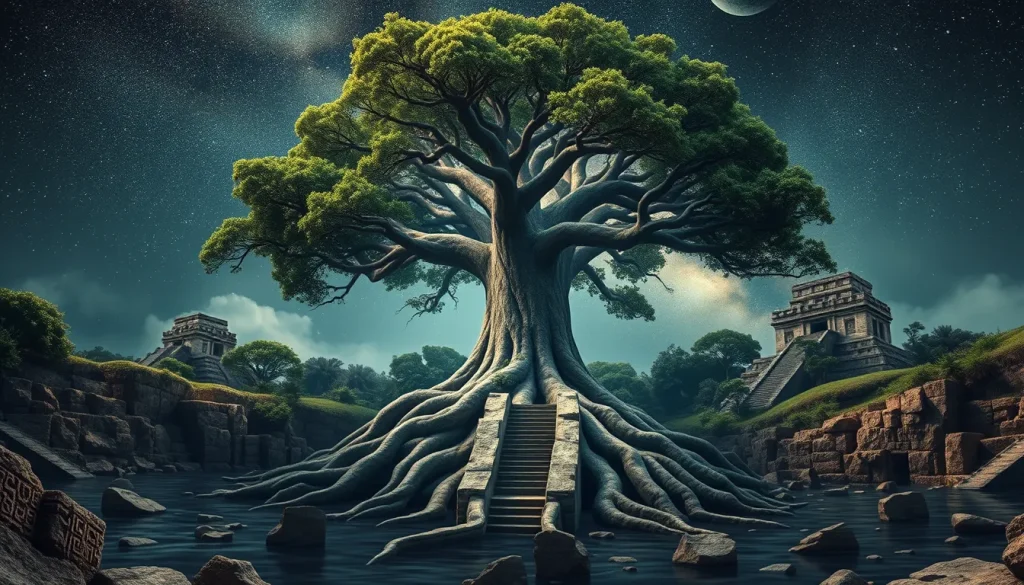
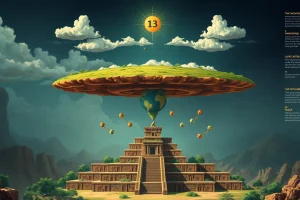
In the complex intellectual landscape of ancient Mesoamerica, the Maya World Tree represents one of the most profound syntheses of observation and belief. Far from being a mere botanical symbol, the World Tree functioned as a cosmological anchor—an axis mundi—that organized the Maya perception of space and time. By linking the subterranean depths of the underworld (Xibalba), the terrestrial surface of human existence, and the thirteen levels of the celestial heavens, the World Tree provided a structural framework through which the Maya interpreted astronomical cycles and the movement of deities.
The World Tree as a Cosmological Conduit
The World Tree is a recurring motif in Maya art, architecture, and hieroglyphic texts, symbolizing the power of life to emerge from the realm of the dead [2]. Cosmologically, it represents the center of the universe, around which all other spatial coordinates are organized. This vertical axis allowed for the flow of energy and communication between different planes of existence. In its fruit-laden form, the tree was often personified as the god of creation, serving as the progenitor of royal dynasties and the source of life [2].
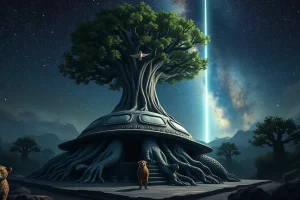
From a structural perspective, the tree is often depicted as a cruciform or a central pillar. Its roots penetrate the watery depths of the underworld, its trunk occupies the middle world of humans, and its branches support the sky. This verticality is not merely symbolic but reflects a metaphysical principle of cosmogenesis and eternal recurrence, representing human hopes for everlasting life and the cyclical nature of existence [3]. Scholars such as J. Andrew McDonald note that this vegetative motif represents the fundamental principles of natural creation and the metaphysical architecture of the Maya world [3].
Evidence and Sources
The evidence for the World Tree’s role in Maya cosmology is found across multiple archaeological and textual mediums. One of the most iconic depictions is found on the lid of the sarcophagus of K’inich Janaab’ Pakal at Palenque. In this relief, the World Tree emerges from the depths of the underworld, with Pakal positioned at the center, illustrating the king’s transition and his role as the axis of the cosmos [3].
Botanically, the Maya identified the World Tree with specific species. While interpretations vary, the Ceiba pentandra (Kapok tree) is the most frequently cited candidate due to its massive size, towering height, and extensive root system, which mirrors the cosmological structure of the universe [1]. Other scholars have suggested the maize plant (Zea mays) as a symbolic representation, linking the World Tree to the Maize God, who is central to creation myths [1].
Textual evidence from the sixteenth-century highland Maya texts and hieroglyphic inscriptions describes the erection of a great world tree at the dawn of the present age [2]. This textual record confirms that the tree was not just an artistic convention but a foundational element of their creation narrative, acting as the point of origin for the current era of time.
Deep Dive Analysis: The World Tree as a Cosmological Concept
Definition
The Maya World Tree is a cosmological construct acting as the axis mundi, a central pillar that connects the three primary realms of the Maya universe: the Upper World (heavens), the Middle World (earth), and the Underworld (Xibalba). It is a symbol of stability, creation, and the cyclical nature of life and death.
How it Works
The tree operates as a spiritual and astronomical bridge. In Maya cosmology, the universe was not static but dynamic. The World Tree provided the fixed point around which celestial bodies revolved. By aligning their architecture and cities with the coordinates suggested by the World Tree, the Maya sought to harmonize their terrestrial existence with the divine order of the stars. The tree facilitated the ascent of souls and the descent of gods, acting as a portal for ritual communication.
Key Components
- The Roots: Anchored in the underworld, often associated with water, crocodiles, and the lords of Xibalba.
- The Trunk: The terrestrial plane, representing the current age and the physical presence of the Maya people and their rulers.
- The Canopy: The celestial realm, often associated with the Solar deity, the Moon, and the thirteen levels of heaven.
- The Fruit/Flowers: Symbols of abundance, creation, and the divine lineage of the Maya royalty [2].
Example: The Palenque Sarcophagus
The sarcophagus of Pakal the Great provides a definitive example of the World Tree in action. The image depicts the king falling (or rising) through the center of the World Tree. This imagery suggests that the ruler, by identifying himself with the axis mundi, transcends the boundary between life and death, ensuring the continuity of the cosmos and the legitimacy of his dynasty.
Historical Evidence
Archaeological findings of stucco reliefs and stone stelae throughout the lowlands consistently feature the vegetative motif. Furthermore, the alignment of Maya temples often reflects a desire to recreate this cosmic center on earth, with the temple acting as a man-made ‘World Tree’ that connects the priest or ruler to the heavens during astronomical events.
Common Misconceptions
A frequent misconception is that the World Tree was a single, physical tree that existed in history. In reality, it was a conceptual and symbolic framework. While the Ceiba tree served as a physical analog, the “World Tree” was a metaphysical map used to explain the structure of the universe. Additionally, modern interpretations sometimes conflate the World Tree with New Age “energy grids,” whereas for the ancient Maya, it was strictly tied to lineage, royal authority, and specific astronomical observations of the Milky Way and the solar cycle.
FAQ
Is the Maya World Tree the same as the Tree of Life?
While similar in the sense that both represent a source of life and a connection between realms, the Maya World Tree is specifically tied to Maya astronomy, royal lineage, and the structure of the three-tiered universe (Underworld, Earth, Heaven).
What plant did the Maya actually use to represent the World Tree?
The Ceiba (Kapok) tree is the most widely accepted botanical representative due to its physical characteristics, though the maize plant is also used symbolically to represent creation and the Maize God.
How does the World Tree relate to Maya astronomy?
The World Tree served as the central axis around which the cosmos revolved. It aligned the terrestrial world with celestial movements, such as the Milky Way, which was sometimes viewed as a cosmic canoe or a celestial path linked to the tree's verticality.
Leave a Reply