
Short Answer
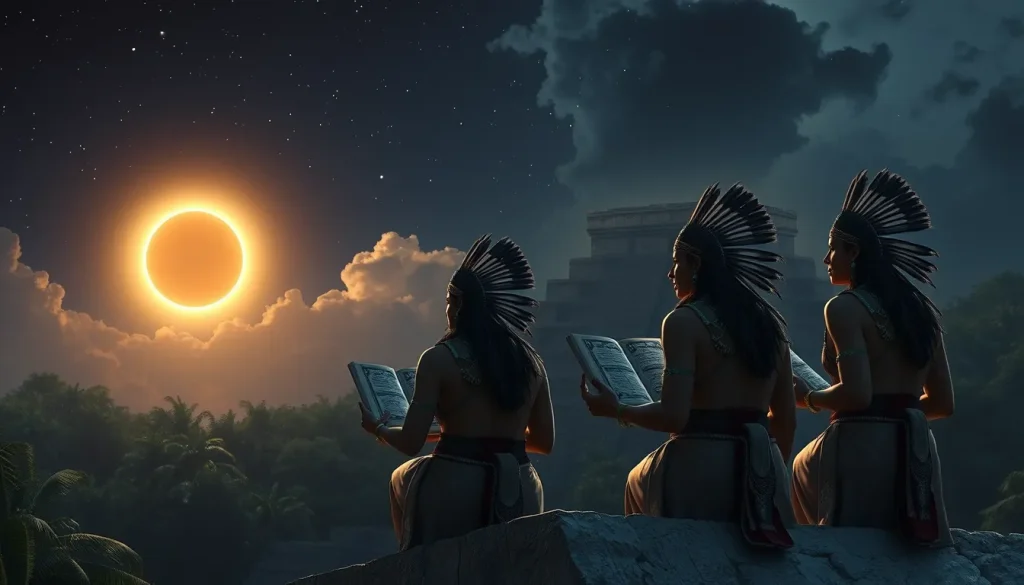
For the ancient Maya, the cosmos was not a distant void but a living landscape intimately connected to earthly affairs. Among the celestial phenomena they observed, the solar eclipse held a position of profound significance and fear. Unlike modern astronomical events viewed primarily through scientific lenses, Maya eclipses were interpreted through a complex framework of cosmology, theology, and ritual practice. These events were not merely optical occurrences but were understood as moments of cosmic instability, often signifying clashing gods or a “broken sun” that threatened the order of the world. Understanding the rituals performed during these events requires an examination of archaeological evidence, surviving codices, and the continuity of oral traditions within modern Maya communities.
Main Explanation
The Maya conceptualization of a solar eclipse was deeply rooted in their cosmovision, which emphasized the balance between opposing forces such as day and night, light and dark, or good and bad. According to contemporary Maya Yucatec community leaders, the solar eclipse was historically interpreted as the Sun God expressing fury or demanding specific rituals to restore balance. This phenomenon was known as Chi’bal K’iin, or “When the Sun is Eaten.” It was considered one of the most feared phenomena because it was related to negative events and viewed as a bad omen. However, this fear was coupled with the understanding that an eclipse also represented a closure and a sign of renewal. The event was seen as a struggle between the Sun and the Moon, reflecting the broader cosmic struggle inherent in Maya theology.
Ritual responses were designed to mitigate the perceived danger of the “broken sun.” While specific liturgical texts were largely destroyed during the Spanish Inquisition, archaeological and ethnohistorical data suggest that rituals involved community gathering, noise-making to frighten away the entity consuming the sun, and fasting. The objective was to assist the sun in its struggle against the obscuring force, ensuring its return and the continuation of the agricultural cycle. These actions were not superstitious panic but structured religious responses grounded in a sophisticated understanding of celestial mechanics. The Maya recognized the periodicity of these events, allowing priests and astronomers to prepare the populace spiritually and physically for the occurrence.
Evidence & Sources
The primary sources for understanding Maya eclipse rituals come from a combination of surviving codices, monumental inscriptions, and architectural alignments. The Dresden Codex, dating to the 11th or 12th century, is one of only four hieroglyphic Maya codices to survive European colonization. This bark paper codex is a 78-page accordion-style tome that details advanced methods for celestial prediction. Recent research has clarified how medieval Maya texts within the codex were used to predict solar eclipses for centuries, confusing Western readers until recent decipherments. The codex contains tables specifically designed to track the movements of the moon and sun to anticipate eclipses, demonstrating that the rituals were preceded by rigorous mathematical calculation.
Archaeological evidence further supports the importance of astronomy in ritual scheduling. Studies of civic and ceremonial buildings disclose that structures were largely oriented on astronomical grounds, mostly to sunrises and sunsets on certain dates. These alignments allowed the use of observational calendars that facilitated a proper scheduling of agricultural and associated ritual activities in the yearly cycle. Furthermore, modern perspectives from Maya community leaders, such as Felicita Cantun of Belize, provide a living link to these ancient beliefs. Cantun notes that while the culture gave different interpretations to eclipses long ago, the view of the eclipse as a struggle between celestial bodies persists in oral history. This continuity helps archaeologists distinguish between ancient recorded beliefs and modern interpretations, ensuring a nuanced understanding of the ritual landscape.
Deep Dive Analysis
Definition
Maya eclipse rituals constitute a set of ceremonial practices performed in response to the obscuration of the sun by the moon. These rituals were not isolated events but were part of a broader cosmological framework where celestial events dictated terrestrial outcomes. The rituals were intended to address the cosmic imbalance caused by the eclipse, viewed as a moment where the sun’s life-giving power was threatened.
How it works
The ritual process began with prediction. Maya astronomers used calendrical systems to anticipate eclipses, allowing priests to prepare the community. Once an eclipse was imminent or occurring, the community would engage in acts of supplication. This involved recognizing the event as a sign of possible destruction or a demand from the Sun God. The rituals functioned as a mechanism to renew the cosmic contract between humanity and the divine, ensuring the sun’s return.
Key components
Key components of the ritual complex included observation, noise-making, and fasting. Observation was critical, as evidenced by architectural alignments designed to track celestial bodies. Noise-making was a common pan-Mesoamerican response intended to scare away the entity devouring the sun. Fasting and bloodletting may have been employed to demonstrate piety and offer energy to the weakened sun god. The rituals were communal, reinforcing social cohesion during times of perceived cosmic crisis.
Example
A prime example of the predictive capability underpinning these rituals is found in the Dresden Codex. This text contains eclipse tables that allowed Maya priests to forecast events with extraordinary accuracy. By tracking the lunar nodes and the solar year, they could identify danger periods. When these periods arrived, the prescribed rituals would be enacted to safeguard the kingdom and the harvest from the potential destruction signified by the clashing gods.
Historical evidence
Historical evidence is derived from the Dresden Codex, monumental hieroglyphic inscriptions, and architectural alignments. The codex provides direct textual evidence of eclipse prediction. Inscriptions on stelae often record celestial events alongside historical milestones, linking the sky to royal legitimacy. Additionally, the orientation of buildings like El Castillo at Chichen Itza reflects the importance of solar phenomena in ceremonial life. Unfortunately, much knowledge was destroyed during the Spanish Inquisition, leaving only fragments from which to reconstruct these advanced methods.
Common misconceptions
A common misconception is that the Maya believed an eclipse meant the permanent end of the world. While viewed as a sign of possible destruction, it was also seen as a sign of renewal and closure. Another misconception is that these rituals were purely superstitious without scientific basis. In reality, they were grounded in sophisticated astronomical knowledge and accurate calendrical systems. Finally, some modern interpretations conflate ancient Maya beliefs with New Age spirituality; however, archaeological evidence points to a structured state religion focused on cosmic balance rather than individual spiritual enlightenment.
FAQ
Did the Maya fear solar eclipses?
Yes, solar eclipses were considered the most feared phenomena because they were related to negative events and viewed as a bad omen signaling possible destruction.
How did the Maya predict eclipses?
They used sophisticated calendrical systems and astronomical data contained in codices like the Dresden Codex to predict the timing of celestial events with extraordinary accuracy.
What does Chi’bal K’iin mean?
It is a Maya Yucatec term meaning “When the Sun is Eaten,” referring to the solar eclipse as a struggle between the Sun and the Moon.
Are there any surviving Maya texts on eclipses?
Yes, the Dresden Codex is one of only four hieroglyphic Maya codices to survive European colonization and contains tables for predicting eclipses.



Leave a Reply