
Short Answer
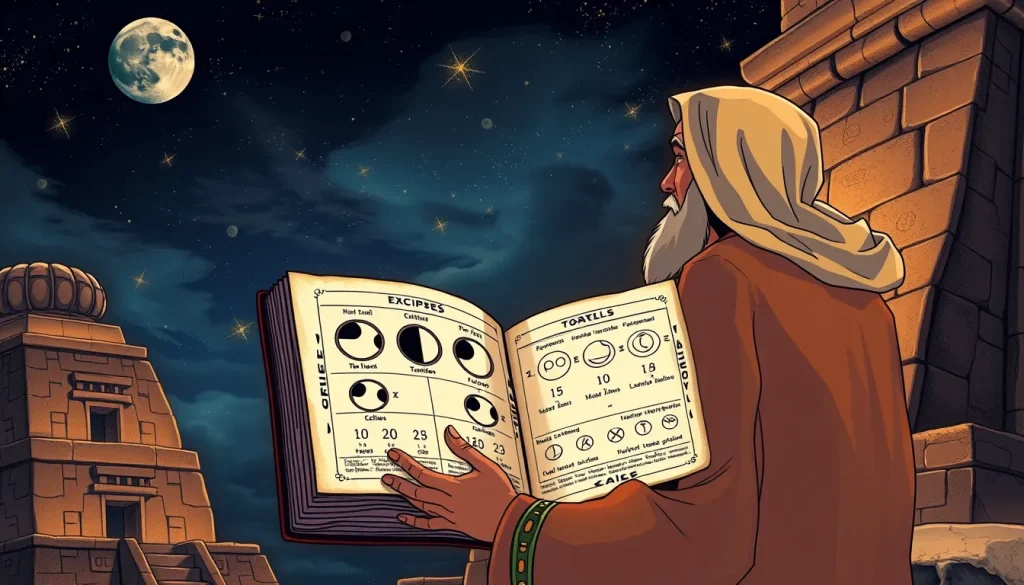
The ancient Maya possessed one of the most advanced astronomical traditions in the pre-Columbian world, characterized by a profound ability to track celestial cycles over centuries. Among their most significant achievements was the precise tracking of the Moon, not merely for timekeeping but for the critical prediction of eclipses. This capability required a deep understanding of the discrepancies between the lunar synodic month and the eclipse half-year, leading to the creation of complex corrective tables. These astronomical computations were recorded in bark-paper codices and painted on the walls of ritual spaces, serving as functional tools for calendar specialists to anticipate celestial events that held deep cosmological significance.
Main Explanation
Maya lunar astronomy was not a singular practice but a multifaceted system integrating observation, mathematics, and ritual. At the heart of this system was the recognition that the lunar cycle does not fit perfectly into the solar year or the standard 260-day sacred calendar. To manage this, Maya astronomers devised the Lunar Series, a supplementary set of glyphs attached to Long Count dates on monuments, which recorded the age of the moon and the length of the current lunation. However, for long-term prediction, specifically of eclipses, they utilized schematic tables. The most famous of these is the Eclipse Table found in the Dresden Codex, which covers a period of 405 schematic lunar months. Recent research indicates that this table was not static; it was designed with a reconstructible history, evolving from general lunar calendar tables into specific predictive tools for eclipse stations.
The mechanics of these tables relied on the accumulation of days. The Dresden Codex Eclipse Table spans 11,960 days, a period chosen because it is a multiple of both the eclipse half-year and the synodic month, allowing for the realignment of lunar phases with eclipse possibilities. The table is divided into 69 groups of alternating 5 and 6 months, creating a rhythm that approximates the true lunar intervals. This structure allowed calendar specialists to identify ‘stations’ or specific dates where eclipses were likely to occur. Unlike modern astronomy which calculates precise moments, the Maya system identified windows of danger or opportunity, aligning celestial mechanics with ritual action. The accuracy of these tables was maintained through correction mechanisms, acknowledging that a schematic month of 29.5 days drifts from the true synodic month of approximately 29.53059 days over time.
Evidence & Sources
The archaeological record provides robust evidence for these sophisticated computations, primarily through codices and monumental inscriptions. The Dresden Codex, pages 51 through 58, contains the definitive Eclipse Table. Scholarly analysis by Justeson and Lowry (2025) suggests that the table’s design of 405 months was originally implemented as a general lunar calendar before being refined for eclipse prediction. This evolution implies a dynamic scientific process where observed intervals among eclipses stimulated approximations that were later compiled into the stationary table we see today. The table is preceded by a section of multiples of 11,960 days, establishing the temporal scope of the prediction cycle.

Beyond the codices, the murals at Xultun, Guatemala, offer crucial archaeological evidence pushing the baseline of these computations back to the Classic period. Discovered in Structure 10K-2, these early ninth-century texts include a 162-lunar synodic month semester table. These numerically related texts, painted in fine black line over colorful murals, demonstrate that the sophisticated astronomical computations found in the Postclassic codices had roots centuries earlier. Additionally, the Lunar Series glyphs found on monuments at sites like Yaxchilan utilize rules of three to compute lunar ages, attaching lunar data to the chronological statements of rulers. Iwaniszewski (2023) notes that while the Maya did not use a formal lunar calendar like those in the ancient Near East, their Lunar Series attached to the Long Count served a similar function of tracking the moon’s phase and visibility within the broader calendrical system.
Deep Dive Analysis
Module C: Astronomy – The Moon and Eclipse Cycles
Celestial Object: The primary focus of this astronomical system is the Moon, specifically its nodes where its orbit intersects the ecliptic plane. Eclipses can only occur when the sun and moon are near these nodes during a new or full moon. The Maya tracked the ‘Dragon’ or the nodal cycle, which is distinct from the phases of the moon.
Observational Cycle: The Maya monitored two key cycles: the synodic month (new moon to new moon, approx. 29.53 days) and the eclipse half-year (approx. 173.3 days). The challenge lay in the fact that 12 synodic months (354 days) fall short of a solar year, and the eclipse year is even shorter. The 405-month table in the Dresden Codex represents a commensuration of these cycles, totaling 11,960 days. This period allows the lunar phases and eclipse nodes to realign closely enough for prediction.
How Maya Observed It: Observations were conducted with the naked eye, likely using horizon markers or architectural sightlines, though specific lunar observatories are less defined than solar ones. The data was recorded by calendar specialists, or ‘keepers of the days,’ who noted the intervals between observed eclipses. As noted by Justeson and Lowry, intervals among observed eclipses could have stimulated the approximation to the series of lunar intervals compiled as stations. This suggests a method of empirical data collection over generations, refined into mathematical models.
Archaeological/Textual Evidence: The primary textual evidence is the Dresden Codex (pages 51-58), which exhibits three units with 23 eclipse possibilities each. Archaeological evidence includes the Xultun murals (Structure 10K-2), which contain day tallies ranging between 935 and 6704 tropical years used to calculate commensurations among calendrical and astronomical cycles. These murals confirm that the mathematical rigor seen in the codices was already present in the Classic period.
Calendar Connection: The lunar astronomy was inextricably linked to the calendar. The Lunar Series glyphs (E, D, C, X, B, A) were attached to Long Count dates. The ‘C’ glyph, for instance, indicated the position of the moon in a cycle of six lunations. The Eclipse Table itself was a calendar device, allowing priests to know when to perform rituals to ward off the perceived dangers of an eclipse. The 405-month cycle was integrated into the broader 52-year Calendar Round and the Long Count, ensuring that celestial time was synchronized with civil and ritual time.
Architecture Connection: While the Dresden Codex is a book, the architecture of sites like Chichén Itzá (El Caracol) is often associated with Venus and solar observations. However, the Xultun room (10K-2) itself serves as an architectural container for astronomical data, suggesting that some rooms functioned as calculation chambers or archives for astronomical data rather than just observational platforms. The placement of these texts within residential or ritual structures indicates that astronomy was a house-based or court-based knowledge system.
Cultural Meaning: Eclipses were viewed as moments of cosmic instability. The ability to predict them was a source of political power, allowing rulers to demonstrate their connection to the cosmos. The precision of the tables, such as the 11,960-day period, was not merely scientific but served to maintain cosmic order. The ‘danger’ of an eclipse required ritual intervention, and the tables provided the schedule for these interventions.
Uncertainty/Debate: Debates persist regarding the exact origin of the 405-month interval. Justeson and Lowry argue it evolved from a general lunar calendar, whereas earlier interpretations might have viewed it as a purely eclipse-specific construct from the start. Additionally, the exact method of initial observation—whether purely naked-eye or aided by water mirrors or other devices—remains a topic of archaeological inference. The drift between the schematic 29.5-day month and the true 29.53059-day month meant that without correction, the calendar would differ by one day after roughly 964 days, necessitating the complex correction mechanisms found in the codices.
FAQ
How accurate were the Maya eclipse predictions?
The Maya Eclipse Table covered 405 months and allowed for the prediction of eclipse 'stations' or windows. While not precise to the minute like modern astronomy, it was accurate enough to anticipate the occurrence of eclipses within a specific timeframe, which was sufficient for ritual preparation.
What is the Lunar Series?
The Lunar Series is a set of glyphs found in Maya inscriptions that supplement the Long Count date. It records the current lunation number, the length of the current lunar month (29 or 30 days), and the moon's age, providing a precise lunar context for historical events.
Where was the Xultun Lunar Table found?
The Xultun Lunar Table was discovered painted on the walls of Structure 10K-2, a residential house in the Classic Maya city of Xultun, Guatemala, dating to the early ninth century A.D.





Leave a Reply