
Short Answer
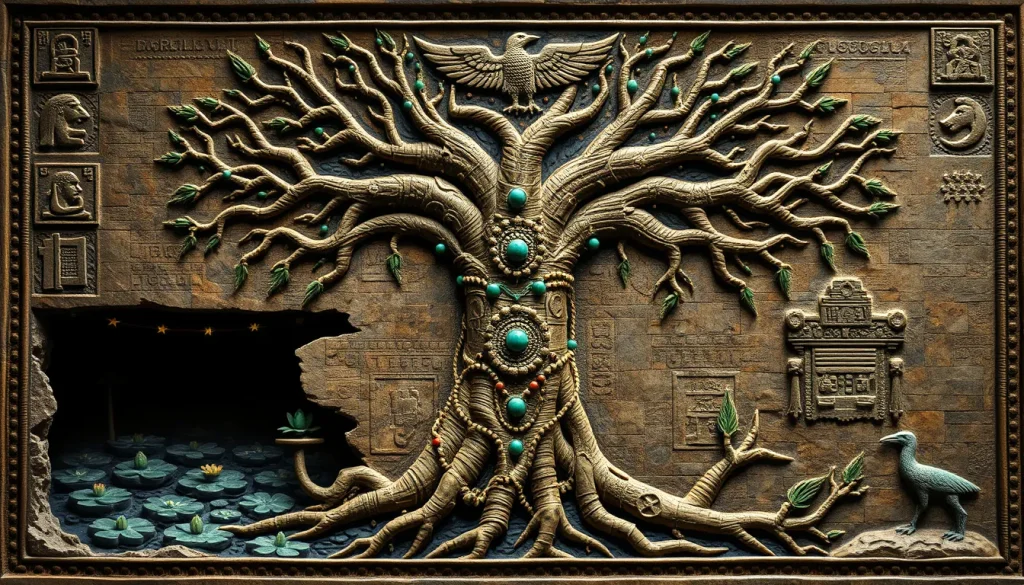
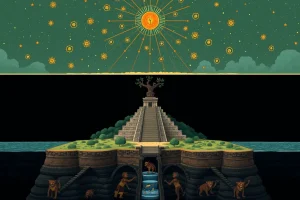
The concept of the Wacah Chan, often translated as the World Tree, stands as one of the most profound and pervasive symbols in ancient Maya cosmology. Serving as the axis mundi, this sacred vegetative motif connected the disparate realms of existence: the watery underworld (Xibalba), the terrestrial plane of human activity, and the celestial domain of the gods. Far from being a mere decorative element, the World Tree functioned as a metaphysical conduit for power, legitimacy, and cosmic order. Recent archaeological findings and iconographic analyses have refined our understanding of this symbol, challenging earlier assumptions about its botanical identity and highlighting its role in kingship and creation mythology.
Main Explanation
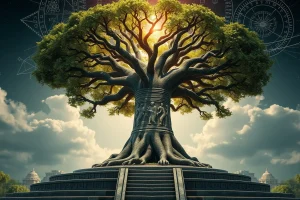
In Maya cosmological thought, the universe was not a void but a structured space organized around a central pivot. The Wacah Chan provided this structural integrity, rooting itself in the underworld and extending its branches into the heavens. This vertical axis was complemented by a horizontal plane, often represented by a quadripartite arrangement of trees marking the cardinal directions, each associated with specific colors and deities. The central tree, however, held primacy as the point of creation and the channel through which divine energy flowed to sustain the world.
The symbolism of the World Tree was intrinsically linked to the concept of cosmogenesis, or the creation of the world. Hieroglyphic inscriptions and sixteenth-century highland Maya texts describe a great world tree that was erected at the dawn of the present age to stand as the axis point of the cosmos. In its fruit-laden form, it personified the god of creation who fathered the progenitors of the Maya royal dynasty. This connection legitimized the rule of living kings, who were often depicted interacting with the tree or even personifying it themselves. By aligning themselves with the Wacah Chan, rulers asserted their ability to mediate between the human and supernatural realms, ensuring agricultural fertility and cosmic stability.
Scholar J. Andrew McDonald outlines that the motif generally represents a primeval fount of living energy, embodying metaphysical principles of natural creation, eternal recurrence, and human hopes for everlasting life in the hereafter. This vegetative motif is not unique to the Maya; cosmic trees are found around the globe and throughout history, known variously as kalpa vrksa to Brahmins, haoma to Parsis, yggdrasil to the Norse, or arbor vitae to Christians. However, the Maya iteration possesses distinct iconographic characteristics that reflect their specific environmental and theological context. The tree was not static; it was a dynamic entity involved in the cycles of death and rebirth, mirroring the agricultural cycles of maize and the celestial movements of the sun and Venus.
Evidence & Sources
Archaeological evidence for the Wacah Chan spans over a millennium, from the Preclassic period through the Postclassic conquest era. One of the earliest indications of these iconographic practices comes from San Bartolo in the Petén region. Archaeological remains at San Bartolo indicate that these iconographic practices were established and codified to a certain extent by the first century B.C. This early codification suggests that the cosmological significance of the tree was foundational to Maya civilization long before the Classic period florescence.
Perhaps the most famous depiction of the World Tree is found on the lid of K’inich Janaab’ Pakal’s sarcophagus at Palenque. The Mayan king of Palenque died in 683 C.E., and his sarcophagus lid depicts the World Tree rooted in the earth and reaching toward the sun. This imagery underscores the king’s transformation after death, ascending the tree to join the ancestors and gods. Such depictions reinforce the idea that the tree was a pathway for the soul, facilitating the transition from mortality to divinity.
Botanical identification of the World Tree has been a subject of scholarly debate. Attempts to identify the plant in a botanical context on ceramic vessels, stucco reliefs, and stone stelae of lowland Maya attribution usually favor determinations as a kapok tree (Ceiba pentandra) or maize plant (Zea mays). However, a botanical assessment of the morphic and ecological characteristics of these motifs suggests a white-flowered water lily of lowland swamps, Nymphaea ampla. The frequent identification of various gods and dynastic rulers as personifications of a water lily world tree underscores the crucial symbolic and ritualistic roles this plant once played in the practice of religion and kingship among Mayan civilizations. This shift in understanding from the terrestrial ceiba to the aquatic water lily highlights the importance of swamp ecology in Maya creation myths.
Later historical records introduce complexities regarding terminology. During his visit to Nojpeten in 1696, Fray Andrés de Avendaño reported observing the Itzá Maya worshipping a stone column called yax cheel cab (the first tree of the world). Though claiming to recognize the yax cheel cab from depictions in pre-Hispanic Maya codices, Avendaño notes that the Itzá “want it to be under stood that they give homage to it because this is the tree of whose fruit our first father Adam ate.” As no known pre-Hispanic source uses the term yax cheel cab, scholars interpret this as a hybrid cosmology resulting from Spanish contact, blending indigenous tree worship with Christian Genesis narratives.
Deep Dive Analysis
Module A: Definition and Conceptual Framework
Definition: The Wacah Chan is defined as the cosmic axis or World Tree in Maya belief systems, serving as the central connector between the thirteen layers of heaven and the nine levels of the underworld. It is not merely a physical plant but a supernatural construct that organizes space and time.
How it Works: The tree functions as a conduit for ch’ulel (soul force) and divine authority. Rituals performed at the base of stelae representing the tree allowed rulers to communicate with ancestors. The tree’s roots drink from the underworld waters, while its branches support the sky burden, preventing cosmic collapse.
Key Components: Iconographically, the tree consists of three main sections. The roots often terminate in Cauac monster mouths or water lily rhizomes, symbolizing the underworld. The trunk is frequently marked with jade beads or maize signs, representing value and sustenance. The branches terminate in sky bands or celestial birds, such as the Principal Bird Deity, indicating the heavenly realm.
Example: The sarcophagus lid of Pakal the Great at Palenque serves as the quintessential example. Here, the king is shown at the base of the cross-shaped tree, falling backward into the underworld while simultaneously ascending toward the celestial bird at the top. This dual motion illustrates the tree’s function as a vehicle for resurrection.
Historical Evidence: Evidence ranges from the Preclassic murals of San Bartolo (c. 100 B.C.) to Postclassic codices. The San Bartolo murals show early maize god mythology intertwined with tree imagery. Classic period stelae at sites like Tikal and Copan frequently depict rulers standing before or emerging from the tree. Postclassic records, such as those noted by Avendaño, show the persistence of tree worship into the colonial period, albeit syncretized with Christian theology.
Common Misconceptions: A prevalent misconception is that the World Tree was always identified as the Ceiba tree. While the Ceiba is significant in modern Maya culture, archaeological iconography from the Classic period often points to the water lily (Nymphaea ampla) or maize. Another misconception is that the term yax cheel cab is ancient; textual analysis reveals it likely emerged during the colonial contact period as a hybrid term blending Maya and Christian concepts of the Tree of Life.
FAQ
Is the Maya World Tree the same as the Ceiba tree?
While the Ceiba is often associated with the World Tree in modern interpretations, archaeological evidence suggests the ancient Maya also identified it with the water lily (Nymphaea ampla) and maize plants depending on the context and period.
What is the significance of the Wacah Chan in kingship?
The World Tree legitimized royal authority by positioning the king as the central axis of the cosmos, capable of mediating between the gods and humans to ensure cosmic order and fertility.
When did the concept of the World Tree first appear in Maya culture?
Archaeological remains at San Bartolo indicate that iconographic practices related to the World Tree were established and codified by the first century B.C. during the Preclassic period.


Leave a Reply