
Short Answer
The history of mathematics is often told through the lens of Old World civilizations, yet the independent development of sophisticated numerical systems in the Americas stands as a testament to human intellectual universality. Among the most significant of these achievements is the Maya concept of zero. Unlike many contemporary cultures that lacked a symbol for nothingness, the Maya integrated zero into a complex positional number system. This innovation was not merely a philosophical abstraction but a practical tool that enabled the precise tracking of time, celestial cycles, and historical records. The revolutionary nature of the Maya zero lies in its dual function as both a placeholder within a positional system and a number in its own right, facilitating calculations that underpinned their renowned calendar systems and astronomical observations.
When Spanish conquistadors arrived in the early 16th century, they encountered a civilization whose mathematical capabilities often surpassed their own in specific domains. Hernán Cortés, for instance, sailed for the coast of Yucatán on 18 February 1519 with a force intended for conquest, landing at Tabasco on the northern coast of the Yucatán peninsular. While the political structures of the Maya were in decline from about 900 AD, the mathematical achievements of this civilization remained embedded in their monuments and codices. The people of the Yucatán peninsular were descendants of the ancient Mayan civilisation, and it is the mathematical achievements of this civilisation which remain a primary focus of historical analysis. The existence of a zero symbol allowed for the representation of large numbers necessary for the Long Count calendar, a system capable of tracking time over millennia without resetting.
Main Explanation
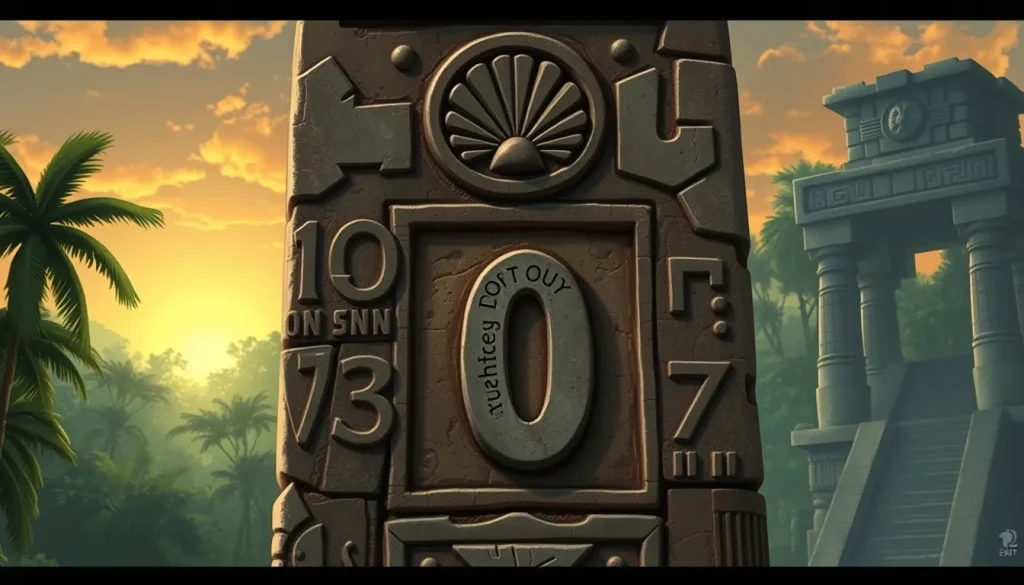
The revolutionary aspect of the Maya concept of zero is best understood through its application in a vigesimal (base-20) positional number system. In most ancient number systems, such as those used by the Romans or Egyptians, numbers were additive. To write a large number, one simply repeated symbols. However, in a positional system, the value of a symbol depends on its position. For such a system to function effectively, a marker is required to indicate an empty position, much like the zero in the modern decimal system indicates the difference between 1, 10, and 100. The Maya developed this marker independently, represented typically by a shell glyph, though variations including a hand or a face exist in different contexts and periods.
This system allowed the Maya to perform complex arithmetic operations necessary for their astronomical models. The integration of zero meant that they could represent dates far into the past and future with precision. Recent academic analysis suggests that the Maya system can be classified under non-power positional number representation systems, which distinguishes it from standard bijective numeration. According to research published in Heliyon in 2021, the Mesoamerican discovery of zero involved unique structural properties that facilitated their specific calendrical needs. The authors, including Berenice Rojo-Garibaldi and Julyan H. E. Cartwright, highlight that this system was not merely a copy of Old World ideas but a distinct intellectual development arising from the specific cosmological and administrative requirements of Mesoamerican societies.
Furthermore, the zero was not just a placeholder; it held numerical value. This is evident in calculations found in the Dresden Codex and on stelae across the Maya region. The ability to treat zero as a number allowed for subtraction and more complex algebraic manipulations required to predict eclipses and the cycles of Venus. This mathematical sophistication supported a cosmology where time was cyclical yet measurable with linear precision. The use of zero as a placeholder by the Maya ensured that the positional values of bars (representing five) and dots (representing one) remained unambiguous, even when a specific position in the number held no value.
Evidence & Sources
Archaeological evidence for the Maya zero is robust, appearing on stone monuments, ceramic vessels, and in the few surviving bark-paper codices. One of the earliest known uses of the zero in the Long Count calendar appears on Stela C at Tres Zapotes, dating back to the 1st century BCE, although some debates persist regarding the exact chronology of its inception versus its widespread adoption. The MacTutor History of Mathematics archive notes that while Cortés captured Tenochtitlán before the end of 1519, the mathematical systems he encountered were already ancient. The city was rebuilt as Mexico City in 1521, yet the underlying mathematical logic of the region remained rooted in pre-Hispanic traditions.
Digital heritage projects and epigraphic studies continue to analyze these inscriptions to understand the nuances of the numeral system. The Heliyon article from 2021 provides a modern scientific grounding for these historical observations, categorizing the system alongside bijective numeration studies. This research underscores that the Maya discovery of zero was part of a broader context of non-power positional systems. The physical artifacts, such as the stelae erected during the Classic Period (250–900 AD), frequently display Long Count dates that require the zero glyph to be read correctly. For example, a date ending in a period of zero days requires the shell glyph to denote that no additional days are added to the higher order unit.
Educational resources, such as those provided by Mexicolore, emphasize the pedagogical importance of understanding this concept. They note that the use of zero as a placeholder is a critical component of teaching Maya mathematics today. The survival of these concepts through the colonial period, despite the destruction of many codices by Spanish clergy, speaks to the resilience of the knowledge system. The mathematical achievements were not lost entirely but were preserved in oral traditions and community practices, such as the continuation of the 260-day calendar in contemporary Maya communities. The intersection of archaeology and mathematics reveals that the zero was integral to the identity of the Maya scribe, the aj tzʼib, who was responsible for maintaining the cosmic order through numerical precision.
Deep Dive Analysis
Module A: Definition and Mechanics of the Maya Zero
Definition
The Maya zero is a glyph and numerical concept representing the absence of quantity within a specific position of a vigesimal (base-20) number system. It functions simultaneously as a placeholder to maintain positional integrity and as a number that can participate in arithmetic operations.
How it Works
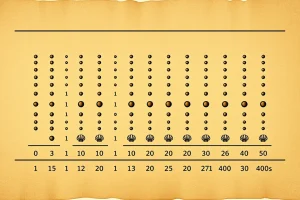
In the Maya numeral system, numbers are written vertically. The lowest position represents units (1s), the next position up represents 20s, the next 400s (20×20), and so on. If a specific position has no value, the zero glyph is inserted. For instance, the number 20 is written as a dot in the second position and a zero in the first position. Without the zero, the dot in the second position might be misinterpreted as a one in the first position.
Key Components
The system relies on three primary symbols: the dot (value 1), the bar (value 5), and the shell (value 0). These symbols are combined additively within a position but positionally multiplicatively across levels. The shell glyph is the most common representation of zero in the Long Count calendar, while other variants appear in ritual contexts.
Example
Consider the Long Count date 13.0.0.0.0. This date signifies the completion of a major cycle. The zeros indicate that there are no additional tuns, uinals, or kins beyond the 13 baktuns. Without the zero glyphs, the date would be mathematically ambiguous and computationally useless for tracking deep time.
Historical Evidence
Evidence spans from the Preclassic to the Postclassic periods. Inscriptions on stelae in sites like Tikal, Copán, and Quiriguá demonstrate consistent usage. The 2021 study by Rojo-Garibaldi et al. confirms the structural uniqueness of this system compared to Old World counterparts, noting its classification within non-power positional number representation systems.
Common Misconceptions
A frequent misconception is that the Maya zero was purely symbolic or religious without mathematical utility. In reality, it was essential for calculation. Another error is assuming the Maya invented zero before all other cultures; while independent, similar concepts arose in India and Babylon. However, the Maya application within a vigesimal calendar system remains unique in the archaeological record of the Americas.
FAQ
Did the Maya invent zero before India?
The Maya developed the concept independently. While Indian mathematics also developed zero, the Maya system arose in isolation in the Americas, serving specific calendrical needs.
What does the Maya zero glyph look like?
It is most commonly depicted as a shell, though variations include a hand or a face depending on the context and time period.
Why was zero necessary for the Maya calendar?
Zero acted as a placeholder in their positional number system, allowing them to write large numbers and track long cycles of time accurately.
Is the Maya zero still used today?
While the Long Count is not in daily use, contemporary Maya communities maintain calendar traditions that rely on the underlying mathematical concepts.



Leave a Reply