
Short Answer
The cosmological framework of the ancient Maya represents one of the most sophisticated vertical conceptions of the universe in pre-Columbian Mesoamerica. Far from a flat expanse, the Maya universe was envisioned as a layered structure consisting of the underworld, the terrestrial plane, and the celestial heavens. These distinct realms were not isolated but were interconnected by a central axis known as the World Tree, or Wakah-Chan. This cosmic pillar served as the structural necessity of the universe, allowing for the transit of souls, the flow of divine energy, and the maintenance of cosmic order. Understanding this tripartite division is essential for interpreting Maya art, architecture, and religious texts, as it permeates nearly every aspect of their cultural expression from the Classic period through the Postclassic era.
Main Explanation
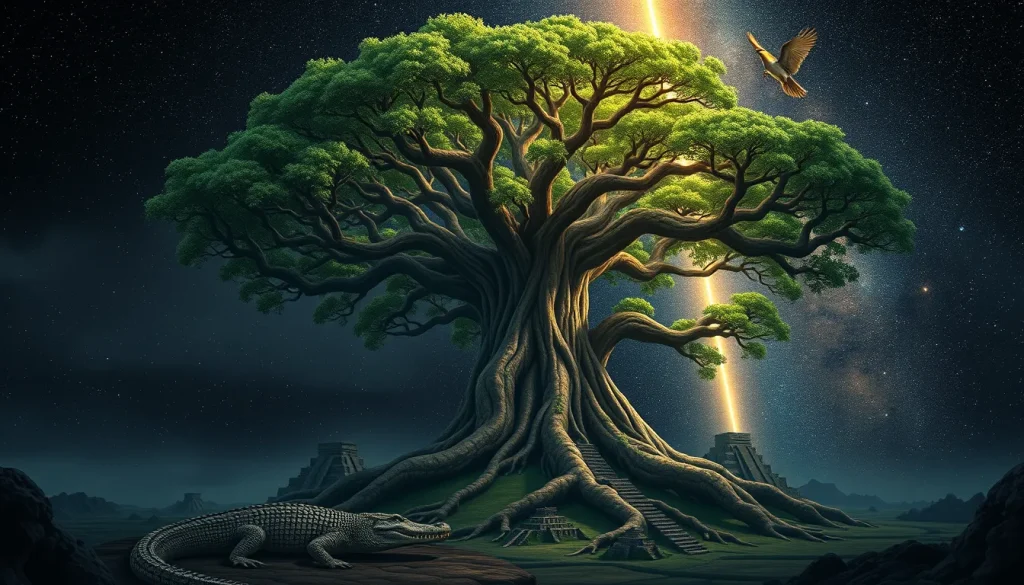
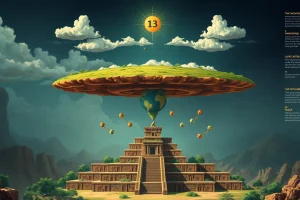
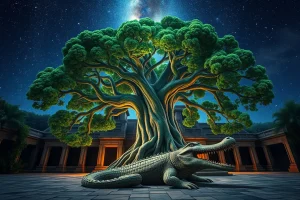
At the absolute center of the ancient Maya universe stood the World Tree, known in the Classic period as Wakah-Chan, meaning “Raised Up Sky.” In the Yucatan region, it was often referred to as Ya’axche’. This concept was not merely mythological but was considered a structural necessity for the stability of the cosmos. The Maya conceived of the universe in three primary vertical layers. The lower part consisted of the underworld, often associated with the realm of the dead and known in K’iche’ Maya tradition as Xibalba. This realm was frequently depicted as being supported by a physical earth represented as a turtle carapace or a crocodilian monster floating in a primordial sea.
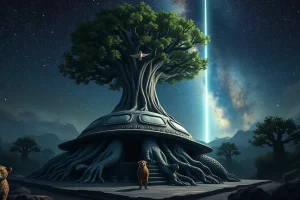
Above the earthly plane lay the heavens, which were divided into multiple layers, often thirteen in number, corresponding to the levels of the sky. The World Tree acted as the axis mundi, piercing through these layers to connect the underworld, the earth, and the heavens. In its botanical form, the World Tree is most commonly associated with the Ceiba tree (Ceiba pentandra), a massive tropical tree native to the region. The tree’s roots were believed to extend into the underworld, while its branches supported the sky. At the top of the tree sat the Principal Bird Deity, known as Itzam-Ye, representing the highest celestial authority. This vertical conception is described in accordance with a cosmogram where the underworld occupies the lower part, then the Earth, and finally the heavens above.
The function of this cosmological structure was deeply tied to the cycle of life, death, and regeneration. Sacred trees represented the power of life to grow from the underworld realm of the dead. In its fruit-laden form, the tree personified the god of creation who fathered the progenitors of the Maya royal dynasty. This connection legitimized the rule of kings, who were seen as intermediaries capable of traversing these realms through ritual bloodletting and trance. The Milky Way was also linked to this structure; the Maya viewed the upright Milky Way in the night sky as the glowing World Tree, further integrating astronomical observation with mythological belief. Thus, the cosmos was a living entity, sustained by ritual action and anchored by the central pillar of the World Tree.
Evidence & Sources
Our knowledge of Maya religion and cosmology results mostly from a combination of archaeological evidence and surviving textual records. The primary written sources include the codices, the books of Chilam Balam (a collection of Yucatec manuscripts), and the Popol Vuh, which is a Quiché document detailing the creation myth and the adventures of the Hero Twins in Xibalba. These texts support the ubiquity of religious practices, including the offering of blood, which was frequent in Mesoamerica before the arrival of the Spanish. Archaeological and historical texts confirm that the Maya made pilgrimages at all times of the year to multiple locations considered naturally sacred.
Certain places were considered naturally sacred and served as portals to the other realms. This was the case for caves, mountains, islands, ruins, and cenotes, which are collapsed dolines in karst environments. Cenotes, in particular, were viewed as direct entrances to the underworld, evidenced by the vast quantities of ritual offerings recovered from sites like the Sacred Cenote at Chichén Itzá. Hieroglyphic inscriptions and sixteenth-century highland Maya texts describe a great world tree that was erected at the dawn of the present age to stand as the axis point of the cosmos. These inscriptions provide direct historical evidence of the cosmological beliefs held by the elite and the priesthood.
Iconographic evidence further solidifies this model. Depictions of sacred trees in the art of ancient America have fascinated generations of scholars because of their consistent symbolism across different regions and time periods. A paramount example is the lid of K’inich Janaab’ Pakal’s sarcophagus at Palenque. The Maya king of Palenque died in 683 C.E., and his sarcophagus lid depicts the World Tree rooted in the earth and reaching toward the Sun. This imagery aligns with the scholarly understanding that cosmic “world trees” are found around the globe and throughout history, symbols that unite life itself with underworlds and sky gods of disparate peoples. This “vegetative motif” represents the metaphysical principles of cosmogenesis, natural creation, eternal recurrence, and human hopes for everlasting life in the hereafter.
Deep Dive Analysis
Definition
The Maya World Tree, or Wakah-Chan, is defined as the cosmic axis that connects the three realms of existence. It is the central pillar of Maya cosmology, often envisioned as a massive Ceiba tree or a crocodilian monster. It formed the pathway for souls and divine energy, ensuring the continuity of the cosmic cycle. Without this axis, the heavens would fall, and the underworld would overwhelm the earth.
How It Works
The cosmological system functioned through vertical connectivity. Souls of the deceased would travel down the roots of the tree into Xibalba, while divine energy and celestial bodies traveled down the branches to the earth. Rituals performed by kings at the base of physical Ceiba trees or atop temples designed to mimic the mountain-tree complex allowed them to communicate with ancestors and deities. The Milky Way served as the celestial manifestation of this tree, visible at night as a glowing pillar across the sky.
Key Components
The structure consists of specific iconographic elements. The Top Element is the Principal Bird Deity (Itzam-Ye), representing the heavens. The Botanical Model is the Ceiba tree (Ceiba pentandra). The Base Element is the physical earth, often depicted as a turtle carapace or a crocodilian monster. These components appear consistently in murals, ceramics, and stone carvings across the Maya region.
Example
The most famous archaeological example is the sarcophagus lid of K’inich Janaab’ Pakal. The carving shows the king at the base of the World Tree, falling into the underworld yet simultaneously being reborn as the Maize God. This illustrates the tree’s role in resurrection and the cyclical nature of life and death within the cosmological framework.
Historical Evidence
Evidence is derived from Classic period hieroglyphic inscriptions and Postclassic manuscripts. The books of Chilam Balam and the Popol Vuh provide narrative context to the iconography found on stelae and temples. Sixteenth-century highland Maya texts describe the erection of the world tree at the dawn of the present age, confirming the longevity of this belief system.
Common Misconceptions
A common misconception is that the World Tree was purely a metaphorical concept. However, archaeological evidence suggests it was a structural necessity in the Maya mind. Another misconception involves conflating ancient beliefs with modern New Age interpretations. While sacred trees are similar in concept to the tree of life described in other traditions, such as the Book of Mormon or Norse Yggdrasil, the Maya Wakah-Chan is distinct in its specific association with the Ceiba, the Principal Bird Deity, and the Maya royal dynasty’s lineage.
FAQ
What is the World Tree called in Maya cosmology?
In the Classic period, it was known as Wakah-Chan (“Raised Up Sky”). In the Yucatan, it was often called Ya’axche’.
How did the Maya view the Milky Way?
The Maya viewed the upright Milky Way in the night sky as the glowing World Tree, linking astronomical observation with mythology.
What archaeological evidence supports the World Tree concept?
Evidence includes hieroglyphic inscriptions, the lid of K'inich Janaab' Pakal's sarcophagus, and descriptions in the Popol Vuh and Chilam Balam.
Leave a Reply