
Short Answer
The Maya Lunar Series stands as one of the most intricate achievements of pre-Columbian astronomy and mathematics. Inscribed primarily during the Classic Period (c. 250–900 CE) on stelae and altars, this sequence of glyphs provided a precise record of the moon’s phase and its position relative to the ecliptic nodes. Unlike simple observational logs, recent research indicates the Lunar Series was often generated through complex backward calculations from known monument erection dates. This system allowed Maya calendar specialists to integrate lunar data into the broader Long Count calendar, facilitating long-term eclipse prediction and ritual scheduling.
Main Explanation
The Lunar Series typically consists of a specific sequence of glyphs appended to the Initial Series (Long Count) date on Maya monuments. The core function of this series was to record two distinct astronomical parameters: the age of the moon (how many days had passed since the last new moon) and the position of the moon relative to the lunar nodes (the points where the moon’s orbit crosses the ecliptic, critical for eclipse prediction).
The sequence generally includes Glyphs G, F, X, A, B, C, E, and D, though not all appear on every monument. Glyphs A, B, and C are primarily concerned with the lunar age. Glyph A indicates whether the preceding lunar month was 29 or 30 days long. Glyph B records the number of days elapsed in the current lunar month, while Glyph C places this within a larger cycle of six lunar months, often referred to as a lunar semester. These semesters alternated between 177 and 178 days to maintain synchronization with the actual synodic month.
Crucially, Glyphs G and F track the lunar nodes. Recent analysis suggests these glyphs relate to the draconic month and the cycle of nine nights, linking lunar positions to broader cosmological cycles. Glyph X, historically enigmatic, has been identified in recent studies as part of an eighteen-month lunar synodic calendar, further refining the Maya ability to model lunar behavior over extended periods. This integration of synodic and draconic cycles demonstrates a high level of mathematical sophistication, moving beyond simple observation to predictive modeling.

Evidence & Sources
Archaeological evidence for the Lunar Series is found across the Maya lowlands, with significant concentrations at sites like Palenque, Tikal, and Coba. The inscriptions provide raw data that modern archaeologists and archaeoastronomers analyze to reconstruct Maya computational methods. A pivotal study published in Ancient Mesoamerica confirms that Lunar Series dates on Classic monuments were often calculated backward. Using a specific adjustment technique known as the “Palenque formula,” scribes determined the lunar age based on the date the monument was erected, rather than solely relying on direct observation at the time of the recorded event.
Further evidence comes from the Dresden Codex, a Postclassic manuscript containing eclipse tables. Research published in Science Advances in 2025 revised the understanding of the codex’s 405-month eclipse table. It suggests this table was originally implemented as a general lunar calendar table of 405 successive months. The design required specific overlaps in successive tables to maintain prediction correctness, indicating a continuous tradition of lunar monitoring that evolved from the Classic Period Lunar Series into Postclassic eclipse warnings.
Additionally, academic work on Glyphs G and F has clarified their connection to the lunar nodes and the draconic month. This supports the hypothesis that the Maya understood the conditions necessary for eclipses—that the moon must be near a node during a full or new phase. The convergence of epigraphic data from monuments and mathematical analysis of codical tables provides a robust framework for understanding how the Maya tracked celestial mechanics without telescopic aid.
Deep Dive Analysis
Module D: Calendar System Analysis
Units of Measurement
The Maya Lunar Series operated using specific time units distinct from the solar haab or the sacred tzolk’in. The primary unit was the lunar month, alternating between 29 and 30 days. These were grouped into lunar semesters of six months, alternating between 177 and 178 days. This alternation was necessary because the average synodic month is approximately 29.53 days. Over six months, this fraction accumulates, requiring the addition of a day periodically to keep the calendar aligned with the moon’s phases.
Calculation Methods
Contrary to earlier assumptions that all dates were observed directly, evidence shows that many Lunar Series dates were calculated. The “Palenque formula” allowed scribes to backward calculate the lunar series from the monument’s erection date. For example, at Tikal, this formula was used on date 9.16.15.0.0 to backward calculate the Lunar Series of 5.0.0.0.0 12 Ahaw 3 Sak. This implies a standardized mathematical model was shared across city-states, allowing for consistency in historical records even when referring to mythological or distant past dates.
Diagram Description
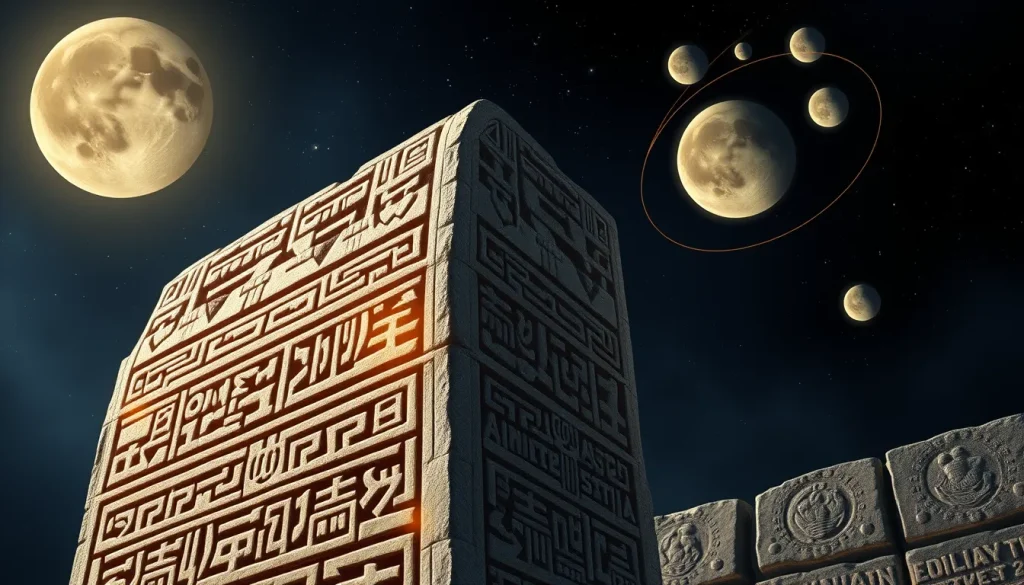
In a typical inscription, the Lunar Series follows the Long Count date. It begins with the Introducer Glyph, followed by Glyph G (node position), Glyph F (node cycle), and Glyph X (18-month cycle). Then follow Glyphs A (month length), B (moon age), and C (semester position). The sequence concludes with Glyphs E and D, which often relate to the lunar deity or patron. This fixed order ensured that any trained scribe could decode the astronomical data regardless of regional stylistic variations in glyph art.
Example Date
A concrete example of this system in action is found at Coba. Here, backward calculation was employed to assign lunar data to distant calendar rounds. By anchoring the calculation to a known contemporary date, the Maya could project lunar conditions onto mythological timeframes. This practice reinforced the legitimacy of ruling dynasties by connecting them to celestial events established at the dawn of the current creation cycle.
Relationship to Other Calendars
The Lunar Series did not exist in isolation. It was interlocked with the Long Count, which provided the absolute timeline, and the Eclipse Table of the Dresden Codex, which provided the predictive framework. The 405-month cycle in the Dresden Codex is a multiple of the lunar semesters tracked in the Classic Lunar Series. This continuity suggests that the Classic Period inscriptions were the empirical foundation for the Postclassic predictive tables. The overlap procedures identified in recent 2025 research show how these tables were adjusted to maintain accuracy over centuries.
Historical Use
Historically, the Lunar Series was used to schedule rituals that required specific lunar conditions, such as agricultural ceremonies or warfare initiations. It also served a political function. By demonstrating control over time and celestial prediction, Maya rulers asserted their divine authority. The precision of the Lunar Series, particularly the tracking of nodes via Glyphs G and F, indicates that eclipse prediction was a state secret or a specialized knowledge held by the court astronomer-priests.
Current Traditions
While the Classic Lunar Series inscriptions ceased with the collapse of the Classic courts, lunar tracking persists in modern Maya communities. Contemporary daykeepers often monitor lunar phases for agricultural planting and ritual timing. However, the complex node tracking and backward calculation formulas of the Classic Period are not directly practiced today, surviving instead as archaeological data reconstructed by modern epigraphers and astronomers.
Misconceptions
A common misconception is that the Maya Lunar Series was purely observational. Recent high-precision adjustment techniques confirm that calculation played a dominant role. Another error is assuming the system was static; the identification of Glyph X as part of an eighteen-month cycle shows evolutionary changes in the calendar’s design. Finally, some New Age interpretations suggest spiritual energy tracking unrelated to astronomy; archaeological evidence firmly grounds the series in physical celestial mechanics, specifically synodic and draconic months.
FAQ
Did the Maya observe the moon directly for every Lunar Series date?
No. Recent evidence shows that many Lunar Series dates were calculated backward from the monument erection date using specific formulas like the Palenque formula.
What is the purpose of Glyphs G and F?
Glyphs G and F track the lunar nodes and the draconic month, which are essential for predicting eclipses.
How does the Lunar Series relate to the Dresden Codex?
The Lunar Series provided the empirical data and calendar structure that evolved into the 405-month eclipse table found in the Dresden Codex.
What is Glyph X in the Lunar Series?
Glyph X is part of an eighteen-month lunar synodic calendar, helping to refine long-term lunar tracking.






Leave a Reply