
Short Answer
In the worldview of the ancient Maya, space was never empty or neutral. Unlike modern navigational concepts where cardinal points are arbitrary coordinates on a compass, the Maya perceived the universe as a deeply structured, sacred geography. This cosmological framework organized all physical and spiritual existence around four cardinal directions and a central axis, each encoded with specific colors, deities, trees, and birds. Understanding this system is essential for interpreting Maya architecture, art, and ritual practices, as it reveals how they mapped the divine onto the physical world.
Main Explanation
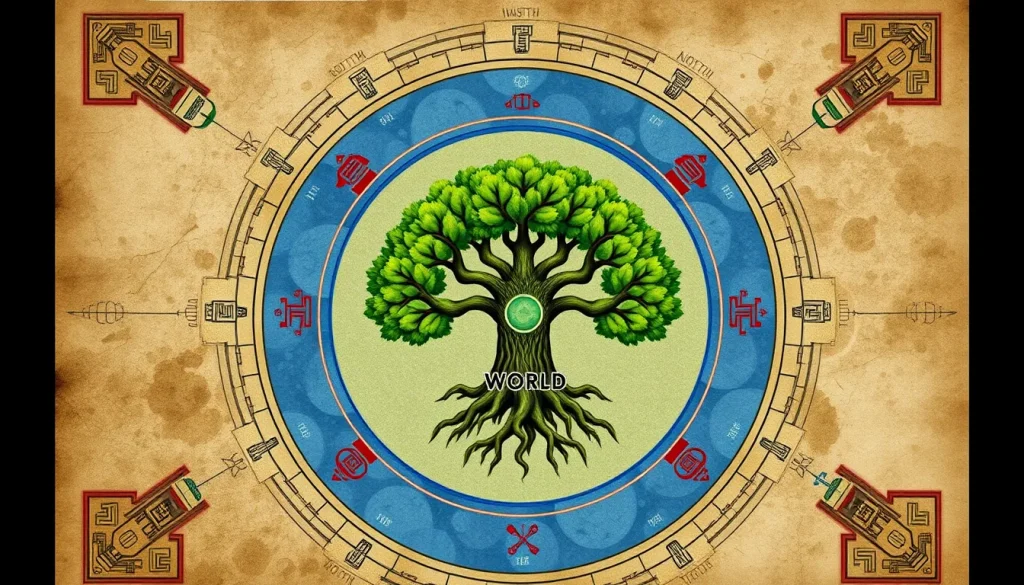
The Maya directional system is a foundational element of their cosmology, serving as the framework for the universe itself. The four directions—East, North, West, and South—were not merely locations but potent spiritual forces. Each direction was associated with a specific color, creating a color-coded map of the cosmos that guided everything from temple orientation to ritual offerings. According to archaeological and ethnohistoric research, the primary associations are Red for the East, White for the North, Black for the West, and Yellow for the South. The center, representing the axis mundi or World Tree, was associated with Blue-Green.
The East, known as lik’in or lak’in in Yucatec Maya, is associated with the color Red (Chak). This direction holds profound significance as the place of the rising sun, symbolizing birth, renewal, and life. The association with blood further underscores its connection to vitality and sacrifice. Conversely, the West (chik’in) is linked to Black (Ek). As the domain of the setting sun, the West represents death, the underworld, and the end of cycles. This duality between East and West mirrors the daily journey of the sun, a central narrative in Maya mythology.
The North (xaman) is associated with White (Sak). This direction is often linked to the ancestors, the Milky Way, and cold winds. In many Maya communities, the North is considered the direction of authority and stability. The South (nohol) is associated with Yellow (K’an). This direction is connected to the right hand of the sun’s path and is often associated with warmth and growth. Finally, the Center (Yax) is Blue-Green, representing the World Tree that connects the underworld, the earthly realm, and the heavens. This central axis was the pivot point around which the cosmos rotated, grounding the sacred geography in the physical landscape.

These associations were not static; they formed a dynamic system where space was intensely sacred. The Maya did not just possess a map of the world; they possessed a sacred geography that organized all physical and spiritual space. This structure influenced the placement of cities, the orientation of temples, and the layout of ceremonial caches. By aligning structures with these directional colors and forces, Maya architects and priests ensured that human activities resonated with the cosmic order.
Evidence & Sources
The understanding of Maya directional colors and terms relies on a convergence of epigraphic, colonial, and ethnographic evidence. Epigraphic research in the nineteenth century initially identified the hieroglyphs used to represent the directions, but it took considerable time for scholars to correlate these glyphs with phonetic readings and modern Maya terms. Sixteenth-century sources provided crucial data on the words used by the Yucatec Maya for the directions. The terms East (lik’in), North (xaman), West (chik’in), and South (nohol) were recorded early on and are still used by Mayas of the Yucatecan branch of the Mayan family today.
Linguistic analysis by scholars such as Nicholas A. Hopkins and J. Kathryn Josserand has been instrumental in connecting Classic Period hieroglyphs with these colonial and modern terms. Their research highlights that while the glyphs were identified early, putting the lines of evidence together revealed unresolved questions that continue to drive research. The phonetic reading of the Classic Period hieroglyphs representing the “four directions” remains a focus of much research, ensuring that our understanding evolves with new decipherments.
Furthermore, cognitive and mythological belief systems form the context in which stories were written and illustrated. As noted in studies of Maya narrative arts, the belief systems that form the context in which stories were written include the structured space of the cosmos. The directional colors are not merely decorative; they are integral to the narrative structure of texts and art forms. This is evident in codices and murals where deities are often depicted with color attributes corresponding to their directional affiliation. The integration of language, art, and cosmology demonstrates that the directional system was a pervasive element of Maya culture, spanning from the Classic Period through to modern traditions.
It is crucial to distinguish between these historical records and modern interpretations. To modern people, cardinal directions are navigational tools devoid of inherent emotional meaning. However, archaeological evidence confirms that to the ancient Maya, space was not empty. It was deeply structured. Resources dedicated to Maya teaching and heritage emphasize that these colors formed the framework of the universe, associated with specific trees, birds, and deities. This sacred geography organized all physical and spiritual space, a concept supported by both ancient inscriptions and continuing indigenous knowledge.
Deep Dive Analysis
Definition
The Sacred Directions and Colors system is a cosmological model used by the Maya to organize space, time, and spiritual forces. It defines the universe as a quadrapartite structure centered around an axis mundi, with each quadrant possessing unique attributes defined by color and direction.
How it works
The system functions as a symbolic map where every location holds specific spiritual weight. Rituals, architecture, and even daily activities were aligned with these directions to maintain cosmic balance. For instance, offerings placed in the four corners of a temple would correspond to the specific color and deity of that direction, ensuring comprehensive spiritual coverage.
Key components
The core components include the four cardinal directions plus the center. Each has a color: East (Red), North (White), West (Black), South (Yellow), and Center (Blue-Green). Additionally, each direction is associated with specific trees, birds, and deities, creating a complex web of symbolism. For example, the East is associated with the rising sun and blood, while the West is linked to the setting sun and the underworld.
Example
A practical example is found in Maya architecture. Temples were often oriented to face East, towards the rising sun, aligning with the Red direction of birth and renewal. Ceremonial caches found beneath floors often contain items colored or made of materials corresponding to the directional associations, such as red shell for the East or black obsidian for the West.
Historical evidence
Evidence comes from multiple sources: Classic Period hieroglyphs on monuments, Colonial-era dictionaries and texts recording Yucatec Maya terms, and modern ethnographic studies of Maya communities. The continuity of terms like lik’in and xaman from the sixteenth century to the present day underscores the durability of this cosmological framework.
Common misconceptions
A common misconception is that these colors are arbitrary or purely aesthetic. Another is the New Age interpretation that applies generic spiritual meanings without archaeological backing. Academic research clarifies that these associations were specific, structured, and integral to the Maya belief system, organizing all physical and spiritual space rather than serving as vague metaphors.
FAQ
Why did the Maya associate colors with directions?
For the Maya, space was not neutral. Colors coded the sacred geography of the cosmos, linking physical directions to spiritual forces, deities, and natural cycles like the sun's path.
Are these directional terms still used today?
Yes, terms like lik’in (East), xaman (North), chik’in (West), and nohol (South) are still used by Mayas of the Yucatecan branch of the Mayan family.
What is the significance of the Center direction?
The Center is associated with Blue-Green (Yax) and represents the axis mundi or World Tree, serving as the pivot point that connects the underworld, earth, and heavens.

Leave a Reply