
Short Answer
Introduction to Maya Numeration and Civilization
The mathematical achievements of the Maya civilization stand as a testament to the intellectual sophistication of pre-Columbian Mesoamerica. Dating from approximately 1500 B.C.E to 1700 C.E, the Maya developed a complex numeration system that facilitated advanced astronomical observations and calendar tracking. The Yucatan Peninsula served as the primary scene for the development of one of the most advanced civilizations of the ancient world, where a sophisticated ritual system overseen by a priestly class required precise calculation methods. Unlike many contemporary cultures that relied on base-ten systems likely derived from counting fingers, the Maya adopted a vigesimal, or base-20, system. This fundamental choice influenced every aspect of their record-keeping, from commodity tracking to the intricate cycles of the Long Count calendar.
The historical context of Maya mathematics is intertwined with the broader narrative of Mesoamerican history. While the civilization had been in decline from about 900 AD in certain regions, the mathematical traditions persisted until the Spanish conquest. Hernán Cortés, excited by stories of the lands which Columbus had recently discovered, sailed from Spain in 1505, eventually leading to the encounter with these systems in the early 16th century. The preservation of this knowledge, despite the destruction of many codices, allows modern archaeologists and digital heritage specialists to reconstruct the logical frameworks that underpinned Maya society.
The Vigesimal Base-20 System
At the core of Maya mathematics lies the vigesimal system, which operates on powers of twenty rather than the powers of ten found in the Hindu–Arabic numeral system used globally today. This base-20 structure is believed to have originated from counting both fingers and toes, providing a natural physiological basis for the numeration. In a purely base-20 system, each position represents a increasing power of twenty: 1, 20, 400, 8000, and so on. This positional notation allowed the Maya to represent large numbers efficiently, which was essential for tracking long periods of time in their cosmology.
The efficiency of this system enabled the Maya to perform complex calculations necessary for their agricultural and ritual cycles. For example, the number thirty-three would be written as one dot above three dots atop two bars. The first dot represents “one twenty” or “1×20”, which is added to three dots and two bars, or thirteen. Therefore, (1×20) + 13 = 33. This additive positional system meant that numbers after 19 were written vertically in powers of twenty, allowing for scalability that matched their astronomical needs.
Comparison of Numeral Systems
| Feature | Maya System | Hindu-Arabic System |
|---|---|---|
| Base | 20 (Vigesimal) | 10 (Decimal) |
| Orientation | Vertical (Bottom to Top) | Horizontal (Left to Right) |
| Zero Symbol | Shell | 0 (Circle) |
| Primary Symbols | Dot, Bar, Shell | 0-9 Digits |
| Calendar Application | Modified Base-20 | Standard Base-10 |
Symbols: Dot, Bar, and Shell
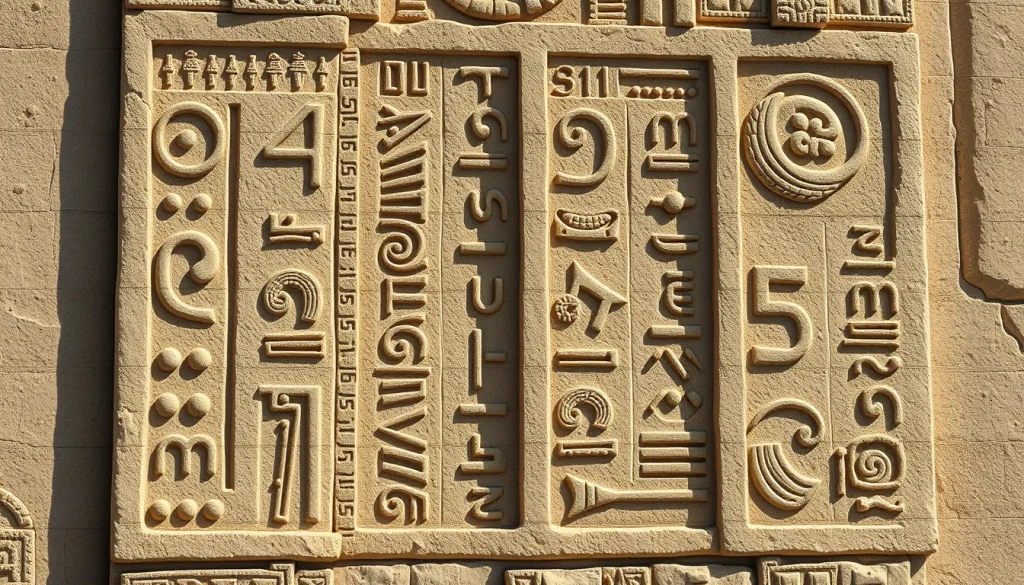
The Maya numeral system is remarkably economical, utilizing only three primary symbols to represent all numbers within the vigesimal framework. These symbols are the dot, representing one; the bar, representing five; and the shell, representing zero. With these three symbols, each of the twenty vigesimal digits could be written. For instance, the number thirteen is written as three dots in a horizontal row above two horizontal bars. Sometimes it is also written as three vertical dots to the left of two vertical bars, demonstrating flexibility in glyph arrangement while maintaining numerical value.
The bar symbol likely originated from a counting stick or finger representation, while the dot represented a unit count. The shell symbol, often depicted as a cowry shell, served as a placeholder. It is unclear whether they also considered it a true numeric “zero” in the abstract philosophical sense, but functionally it operated as a zero within their positional system. This triad of symbols allowed for clear visual distinction between values, reducing errors in transcription on stelae and codices.
Positional Notation and Vertical Writing
One of the most distinctive features of Maya mathematics is the vertical orientation of their numerals. Numbers were written vertically with the most significant digit at the top. This contrasts with the horizontal writing of modern numerals. Upon reaching 20^2 or 400, another row is started (20^3 or 8000, then 20^4 or 160,000, and so on). The number 429 would be written as one dot in the 400s place, one dot in the 20s place, and nine (one bar and four dots) in the 1s place.
This vertical stacking aligns with the Maya cosmological view of layers or levels of existence, often reflected in their architecture and temple structures. The positional nature means that the value of a symbol depends entirely on its vertical placement. A single dot at the bottom level represents one, but the same dot at the second level represents twenty. This requires careful alignment in inscription, which archaeologists observe on stone monuments where grid lines were often carved to ensure numerical accuracy.
The Concept of Zero in Mesoamerica
The Maya are credited with one of the earliest independent inventions of the concept of zero in human history. In their system, the cowry shell served as a place holder. This innovation was crucial for the functioning of their positional numeral system. Without a zero, distinguishing between numbers like 20 (one dot in the second position, shell in the first) and 1 (one dot in the first position) would be ambiguous in a positional context.
While the Hindu–Arabic numeral system uses powers of ten, the Mayan used powers of twenty. The inclusion of zero allowed for the representation of empty place values, enabling the calculation of vast time spans required for the Long Count calendar. This mathematical abstraction indicates a high level of intellectual development, as the concept of nothingness as a number is not intuitive in early counting systems. The use of the shell glyph suggests a connection to trade or natural resources, grounding abstract mathematics in tangible cultural symbols.
Calendar Modifications: Long Count vs. Pure Base-20
While the Maya used a purely base-20 system for simple recording of commodities, their much more prevalent and culturally important calendar system used a modified base-20 system. The place values employed in this number system are tied to the Calendar Round and Long Count calendars. In the standard vigesimal system, the third position represents 400 (20 × 20). However, in the calendar system, the third position represents 360 (18 × 20). This modification was made to approximate the solar year of 365 days.
This irregularity demonstrates the pragmatic adaptation of mathematics to astronomical reality. The Maya prioritized the alignment of their numerical system with the solar cycle over strict mathematical consistency. Each place represents the next order of numbers of days, facilitating the tracking of celestial events. This modification is a key example of how Maya mathematics was not merely theoretical but deeply integrated into the ritual and agricultural life of the civilization. The priestly class managed these calculations, ensuring that rituals occurred at auspicious times determined by these complex cycles.
Mathematical Applications in Astronomy and Architecture
The application of Maya mathematics extended far beyond simple counting; it was the engine behind their astronomical predictions and architectural alignments. The Maya had a sophisticated ritual system that was overseen by a priestly class, who utilized these numbers to predict eclipses, planetary movements, and seasonal changes. The precision of their calculations is evident in structures like the Caracol at Chichén Itzá, which aligns with the movements of Venus.
Architecture often embodied mathematical ratios. Temples were built with dimensions reflecting sacred numbers derived from their calendar systems. The integration of math and architecture served to reinforce the cosmological order, where the built environment mirrored the celestial mechanics. This synthesis of disciplines highlights the holistic nature of Maya knowledge, where mathematics, astronomy, and religion were inseparable. The ability to model these structures digitally today allows researchers to verify these alignments with high precision.
Archaeological Evidence and Codices
Our understanding of Maya mathematics relies heavily on archaeological evidence, including stelae, pottery, and the few surviving codices. The people of the Yucatán peninsular were descendants of the ancient Mayan civilisation which had been in decline from about 900 AD. Despite this decline, the mathematical knowledge persisted in the Postclassic period. The destruction of many texts during the Spanish conquest, such as when Cortés captured Tenochtitlán before the end of 1519, limits our primary sources.
However, surviving inscriptions on stone monuments provide robust data. These stelae often record dates using the Long Count system, requiring the full range of Maya numerals. Digital heritage initiatives now use 3D modeling to preserve these inscriptions, protecting them from erosion and allowing global access to the data. These digital replicas enable mathematicians and archaeologists to analyze the glyph structures without risking damage to the original artifacts.
Digital Heritage and Modern Analysis
In the modern era, digital heritage specialists play a crucial role in interpreting and preserving Maya mathematical records. LiDAR scans and 3D modeling technologies allow for the discovery of hidden structures and the detailed recording of numerical glyphs. These tools help reconstruct the context in which these numbers were used, revealing patterns that might be invisible to the naked eye. For example, digital analysis can highlight wear patterns on stelae that indicate which numbers were most frequently used or revered.
Furthermore, computational modeling allows researchers to test hypotheses about Maya calculations. By simulating the calendar systems using the modified base-20 rules, scholars can verify the accuracy of Maya astronomical predictions against modern ephemeris data. This intersection of ancient wisdom and modern technology ensures that the legacy of Maya mathematics continues to be understood and appreciated. It also provides educational opportunities, allowing students to interact with Maya numerals in virtual environments.
Legacy and Decline of the System
The decline of the Maya civilization impacted the transmission of their mathematical knowledge. Hernán Cortés sailed for the coast of Yucatán with a force of 11 ships, 508 soldiers, 100 sailors, and 16 horses on 18 February 1519. The subsequent conquest and conversion efforts led to the suppression of indigenous knowledge systems, including their mathematics. The city was rebuilt as Mexico City in 1521, marking a shift in the dominant cultural and numerical systems of the region.
Despite this, the Maya numeral system remains a subject of fascination and study. It challenges the notion that mathematical progress follows a single linear path toward the Hindu-Arabic system. The Maya developed a fully functional, sophisticated system independently, proving that intellectual innovation is a universal human capacity. Today, the study of Maya mathematics contributes to a broader understanding of the history of science, highlighting the diversity of human thought and the various ways cultures have solved the problem of quantification.
“The Mayan culture used a base 20 number system. It was an additive positional system that used two symbols, a dot for one, a horizontal bar for five, and a cowry shell for a place holder.” — Mathematical Association of America
- Base: Vigesimal (Base-20)
- Symbols: Dot (1), Bar (5), Shell (0)
- Orientation: Vertical
- Zero: Independent invention
- Calendar: Modified Base-20 (18×20 for 3rd position)
- Period: 1500 B.C.E to 1700 C.E
- Region: Yucatan Peninsula and surrounding areas
- Primary Use: Calendar, Astronomy, Trade
FAQ
Did the Maya invent zero?
Yes, the Maya independently developed the concept of zero, represented by a shell symbol, which functioned as a placeholder in their positional system.
Why did the Maya use base-20 instead of base-10?
The base-20 system likely arose from counting both fingers and toes, which was a natural development for their civilization compared to the finger-only base-10 system.
How was the Maya calendar different from their standard math?
While standard math used pure base-20, the calendar system modified the third position to 18x20 (360) to better approximate the solar year of 365 days.


Leave a Reply