
Short Answer
The question of how Classic Maya mathematicians calculated solar declination without modern optical tools stands as a testament to the sophistication of pre-Columbian science. Operating primarily between 250 and 900 CE, Maya priest-astronomers developed some of the most accurate pre-telescope astronomy in the world. Their ability to track the sun’s seasonal movement was not merely academic; it was essential for regulating the agricultural schedule and legitimizing royal power through cosmological alignment. Unlike European contemporaries who relied on the Julian calendar’s fixed 365.25-day year, Maya calculations of the tropical solar year were more accurate than those of the Spanish upon their arrival in the 16th century [4]. This article explores the mathematical and observational methodologies employed by these ancient scientists, grounded in recent archaeological evidence.
Main Explanation
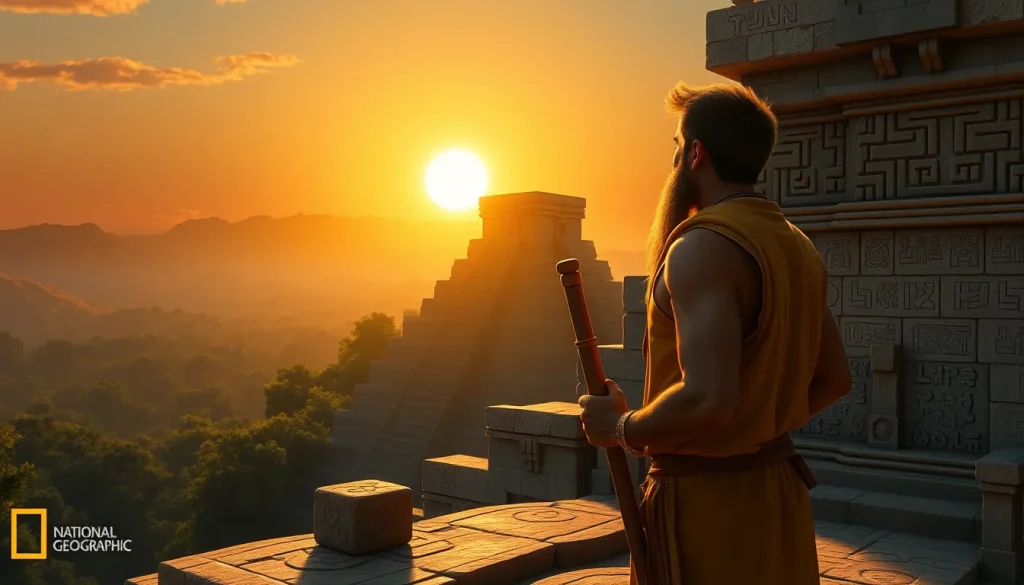
The calculation of solar declination—the angle between the rays of the sun and the plane of the earth’s equator—required a synthesis of precise observation and complex mathematics. The Maya did not possess telescopes or trigonometric functions in the modern sense. Instead, they utilized a system of horizon astronomy combined with their fully developed positional numeral system. This vigesimal (base-20) system allowed for the handling of large numbers necessary for long-term astronomical cycles. By observing the sunrise and sunset points along the horizon over the course of a year, Maya astronomers could mark the extremes of the sun’s movement, known as the solstices.
The process involved fixed observation points, often within temple architecture, looking toward specific horizon markers such as mountain peaks or constructed towers. As the sun moved north and south throughout the year, its rising position shifted along the horizon. By counting the days between these extreme positions, mathematicians could determine the length of the solar year. The Classic Maya understood many astronomical phenomena, aided by their writing system which allowed them to record data over generations. Their estimate of the length of the synodic month was more accurate than Ptolemy’s, demonstrating a rigorous approach to data collection and refinement over centuries [4]. The mathematical achievements of this civilization were rooted in a culture that viewed time and space as interconnected, where celestial events dictated terrestrial activities.
Evidence & Sources
Archaeological and textual evidence provides the foundation for understanding these calculations. For decades, Maya glyphic texts from the Classic period typically chronicled the exploits of historical or divine characters, with everyday functional records being rare. However, a breakthrough study published in 2026 identified the work of an eighth-century Maya mathematician named Sak Tahn Waax (‘White-chested Fox’) [3]. Researchers reconstructed a ‘microtext’ painted on an interior wall of Structure 10K-2 at the site of Xultun, Guatemala. This text records a unique astronomical formula that concludes with a name, attributing the work to an individual. To date, this is the only known example of a Classic Maya mathematician directly credited for their work, attesting to the value of their intellectual contributions [3].

Furthermore, architectural evidence supports the use of solar observation. Many temples from the Maya architecture have features oriented to celestial events [4]. These structures often functioned as observational instruments themselves, with windows and doorways framing the sun at specific declinations. The decline of the ancient Mayan civilisation from about 900 AD did not erase this knowledge immediately, though the political collapse impacted the institutional support for such large-scale scientific endeavors [1]. Modern digital heritage specialists now use 3D modeling to simulate these sightlines, confirming that the alignments were statistically significant and not accidental. This intersection of archaeology and digital technology allows researchers to verify the accuracy of ancient sightlines without disturbing the fragile sites.
Deep Dive Analysis
Module A: Definition and Process of Solar Declination Calculation
Definition: In the Maya context, calculating solar declination refers to the method of determining the sun’s seasonal latitude relative to the celestial equator using horizon markers and calendar counts. It was a functional process used to predict solstices and equinoxes for agricultural and ritual purposes.
How it works: The method relied on “horizon scanning.” An observer would stand at a fixed location and note the position of the sunrise against a distant backdrop. Over the year, the sunrise point migrates along the horizon. The northernmost point marks the summer solstice, and the southernmost marks the winter solstice. By counting the days between these extremes using their calendar system, mathematicians could derive the solar year length. They utilized their positional numeral system to record these counts over long periods, allowing for corrections and averaging to increase accuracy.
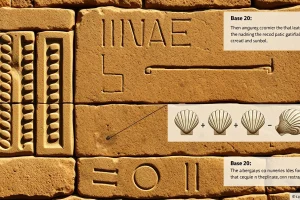
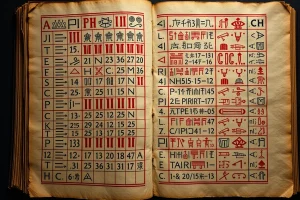
Key components: The primary components included the vigesimal numeral system (using dots, bars, and a shell for zero), the Ha’b’ calendar (365 days), and the Tzolk’in (260 days). Together, these formed the Calendar Round. Architectural features served as the “instruments,” such as the windows of El Caracol or specific temple orientations. The human observer acted as the lens, trained to recognize minute shifts in solar position.
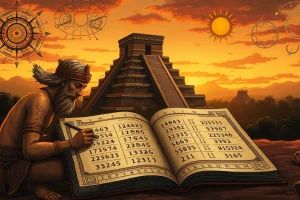
Example: If a mathematician at Xultun observed the sun rising over a specific mountain peak on the summer solstice, they would record the date using the Long Count system. They would wait until the sun returned to that same peak the following year. By calculating the days elapsed, they refined the value of the tropical year. The work of Sak Tahn Waax suggests such formulas were written down and preserved [3].
Historical evidence: The identification of Sak Tahn Waax at Xultun provides direct textual evidence of individual mathematicians [3]. Additionally, the general accuracy of Maya astronomy, noted to be superior to early European calculations upon contact, supports the efficacy of their methods [4]. The MacTutor History of Mathematics notes that the people of the Yucatán peninsular were descendants of this ancient civilisation which had been in decline from about 900 AD, yet their mathematical legacy persisted [1].
Common misconceptions: A frequent misconception is that the Maya possessed lost high-tech technology or extraterrestrial aid. In reality, their accuracy resulted from generations of meticulous record-keeping and observation. Another misconception is that their calendar predicted the “end of the world.” Their calculations were cyclical, focused on continuity rather than apocalypse. Modern spiritual interpretations often conflate historical Maya beliefs with New Age concepts, but archaeological evidence points to a pragmatic scientific tradition integrated with state religion.
FAQ
Did the Maya use telescopes for their calculations?
No, the Maya developed accurate astronomy without telescopes, relying on naked-eye observation and horizon markers.
Who was Sak Tahn Waax?
Sak Tahn Waax is an eighth-century Maya mathematician identified from a glyphic text at Xultun, credited with an astronomical formula.
How accurate was the Maya calendar compared to Europe?
Their calculation of the tropical solar year was more accurate than that of the Spanish when they first arrived in the Americas.

Leave a Reply