
Short Answer
The production of Maya codices represents one of the most sophisticated achievements of pre-Hispanic Mesoamerican civilization. These screen-fold books, known as codices in Mesoamerican studies, were not merely records but sacred objects imbued with ritual significance and astronomical knowledge. Created by elite scribes known as aj tz’ib, the manufacturing process involved complex botanical processing, chemical engineering of pigments, and mastery of a logo-syllabic writing system. While the tropical climate and Spanish colonial book burnings destroyed the vast majority of these texts, the four surviving codices provide invaluable evidence of Maya material culture and intellectual history.
Main Explanation
The creation of a Maya codex began with the preparation of the writing surface, which was distinct from the stone stelae or ceramic vessels also used by Maya scribes. The primary material was paper made from the inner bark of fig trees, specifically the amate tree (Ficus species). This bark was harvested, soaked, and beaten into thin sheets using stone beaters, a technique shared with other Mesoamerican cultures but refined by the Maya for high-status manuscript production. Once the paper sheets were formed, they were coated with a sizing agent, often a starchy paste or gypsum-based primer, to create a smooth, white writing surface that could absorb ink without bleeding.
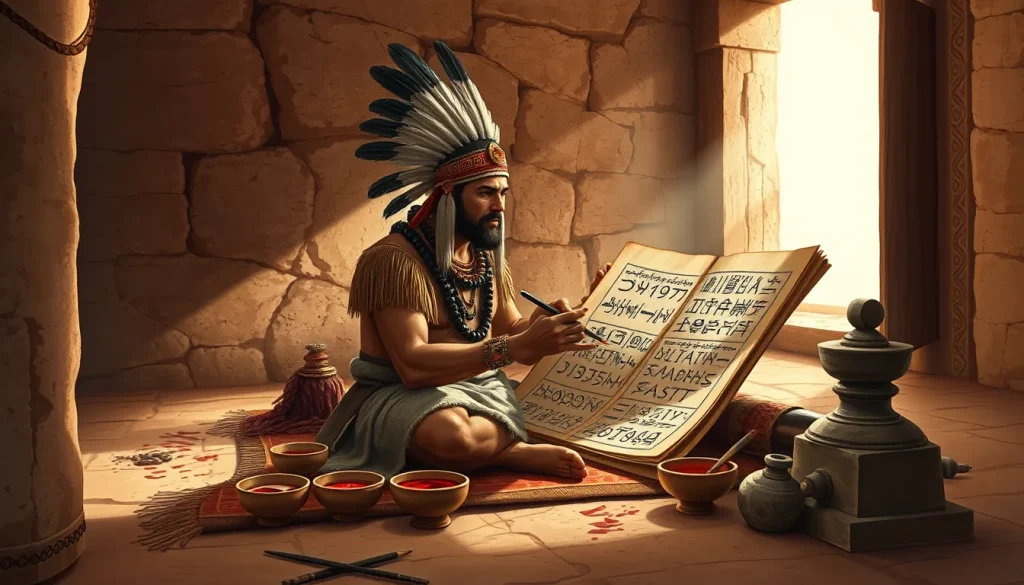
Following the preparation of the paper, the scribe, or aj tz’ib, would engage in the act of writing and painting, which were considered the same art form in the Maya world. The Classic Maya word tz’ib encompasses both writing and painting, reflecting the understanding that composing hieroglyphic text was inherently a visual and artistic act. Scribes used fine brushes made from animal hair or plant fibers to apply pigments derived from minerals and organic sources. Black ink was typically carbon-based, while red pigments often came from hematite or cinnabar. The famous Maya Blue, a durable pigment used in murals and potentially codices, was a complex compound of indigo and palygorskite clay.
The social status of the scribe was paramount in the production of these documents. Scribes were often members of the royalty or high nobility, trained from a young age in hieroglyphic writing, calendar mathematics, and iconography. Their patron deity was Itzamná, the inventor of writing, underscoring the sacred nature of their work. The resulting codex was folded into a screen-fold format, allowing it to be expanded for reading or ritual consultation and compacted for storage. These books contained almanacs, astronomical tables, and ritual procedures, serving as essential tools for priests and rulers to maintain cosmic order.
Evidence & Sources
Our understanding of codex production relies on a combination of surviving physical manuscripts, archaeological evidence, and epigraphic analysis. Only four pre-Hispanic Maya codices are known to survive: the Dresden, Madrid, Paris, and Grolier Codices. All date to the Late Postclassic period (twelfth to fifteenth centuries CE), though they reflect traditions stretching back into the Classic period (300-800 CE). The Dresden Codex, housed in the Saxon State Library in Dresden, is considered the most important manuscript of the pre-Hispanic Maya culture. Historical records indicate it was acquired in 1734 by Johann Christian Götze, who recognized it as a ‘priceless Mexican book written in hieroglyphs’.
Archaeological evidence further illuminates the lost libraries of the Classic period. While organic materials rarely survive in the humid Maya lowlands, depictions of scribes and books appear frequently in murals and ceramic paintings. The murals at Bonampak, for instance, show scribes at work, providing visual confirmation of their tools and attire. Epigraphic evidence from stone monuments also references the act of writing and the titles of scribes, confirming their high social standing. Recent research over the past decade has significantly advanced our understanding of these documents through linguistic and textual analyses, as well as novel methodologies for interpreting calendrical structure.
Modern digital heritage technologies have also become crucial in studying these fragile artifacts. Multispectral imaging and high-resolution photography allow researchers to read faded glyphs and analyze pigment composition without physically touching the documents. This intersection of archaeology and digital technology ensures that the content of these rare books is preserved and accessible for future study, mitigating the risk of further physical degradation. Such technologies help distinguish between original paint layers and later restorations, providing a clearer picture of the original manufacturing process.
Deep Dive Analysis
Definition
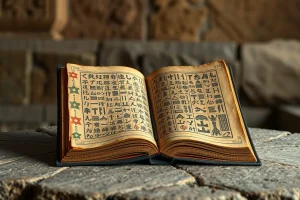
A Maya codex is a manuscript book formed of long strips of paper folded accordion-style. Unlike European bound books, the screen-fold format allowed for continuous reading across panels, often designed to align with calendrical cycles. These documents served as repositories of esoteric knowledge, including astronomy, agriculture, and ritual timing.
How it works
The production process involved harvesting bark, beating it into paper, sizing the surface, and painting glyphs with mineral pigments. Scribes worked in workshops, often within palace complexes, using prepared pigments and brushes. The text was laid out according to strict grid systems based on the Maya calendar, ensuring astronomical data aligned correctly across the folds.
Key components
- Support: Amate bark paper (fig tree inner bark).
- Coating: Gypsum or starch-based sizing for whiteness and smoothness.
- Pigments: Carbon black, hematite red, Maya Blue, and other mineral colors.
- Tools: Fine brushes, stone beaters, and pigment grinding stones.
- Content: Hieroglyphic text, iconography, and calendrical structures.
Example
The Dresden Codex consists of two strips of paper made from amate, painted on both sides. It contains detailed astronomical tables, particularly regarding the cycles of Venus, and ritual almanacs. Its survival is attributed to its removal from the tropics to Europe in the 18th century, sparing it from the humidity that destroyed others.
Historical evidence
Research indicates that while only four codices survive, the ancient Maya produced countless books over the two millennia their writing system was in use. Texts rendered on non-perishable materials like stone often endure, but the broader manuscript tradition of the Classic period is largely lost. Epigraphic and archaeological evidence suggests a vibrant culture of literacy and book production among the elite.
Common misconceptions
A common misconception is that the Maya only wrote on stone. In reality, books were the primary medium for daily ritual and administrative record-keeping, while stone was reserved for permanent public monuments. Another myth is that all books were burned by the Spanish; while many were destroyed, some survived due to their removal from the region or concealment. Additionally, writing and painting were not separate disciplines; to the Maya, every brushstroke carried both visual and linguistic meaning.
FAQ
How many Maya codices survive today?
Only four pre-Hispanic Maya codices are known to survive: the Dresden, Madrid, Paris, and Grolier Codices.
What material were Maya codices made from?
They were made from paper created from the inner bark of the amate fig tree, coated with a sizing agent for writing.
Who were the Maya scribes?
Scribes, or aj tz'ib, were elite members of royalty or high nobility trained in writing, painting, and calendar mathematics.
Why were most Maya books destroyed?
Most were destroyed due to the tropical climate's humidity and the burning of books undertaken by Spanish priests during colonization.
Leave a Reply