
Short Answer
The economic landscape of the ancient Maya civilization was defined by intricate trade networks that facilitated the movement of essential resources and prestige goods across Mesoamerica. For decades, scholarly understanding relied heavily on elite-centric models, suggesting that luxury items like jade and obsidian were controlled exclusively by ruling strata through tribute and gifting. However, contemporary archaeological research has generated sufficient data to redefine these systems, revealing a dynamic interplay of markets, trade routes, and collective action that involved both elite and commoner spheres. Evidence from lithic analysis, ceramic stylistics, and geochemical sourcing now illustrates how political powers, such as Tikal and Caracol, vied for control over critical arteries like the Pasión River to dominate the flow of goods during the Classic period.
Main Explanation
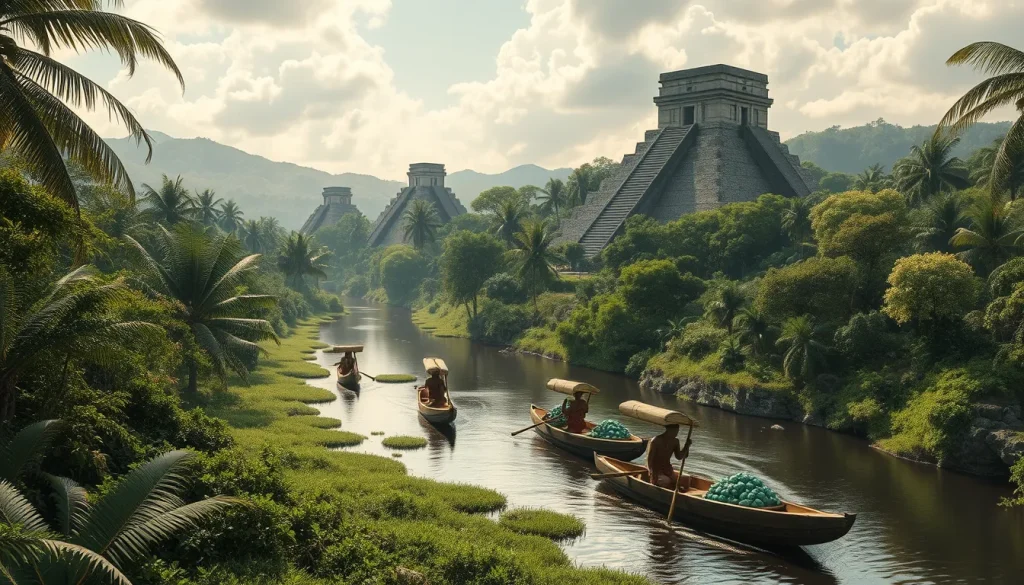
Ancient Maya trade networks functioned as the circulatory system of the civilization, connecting the highlands, where volcanic resources like obsidian were sourced, with the lowlands, where jade and agricultural products were prominent. Traditional anthropological theory often portrayed these exchanges as dyadic relationships between elites, characterized by gifting and tribute rather than commercial transaction. Recent conceptual analyses, however, suggest that Maya economics incorporated marketplaces and standardized exchange mechanisms that transcended simple redistribution. The circulation of goods was not merely economic but deeply embedded in social and political strategies, where control over trade routes equated to geopolitical power.
Key commodities drove these networks. Obsidian, essential for cutting tools and weapons, was imported from highland sources such as El Chayal and Ixtepeque. Jade, revered for its spiritual and aesthetic value, circulated through both elite and commoner spheres, though its interpretation as a standardized commodity remains debated. Ceramics served dual purposes as utilitarian vessels and markers of regional identity, with stylistic changes often reflecting shifting political alliances. The integration of these materials into daily life and ritual contexts underscores the complexity of Maya economic systems, which adapted to environmental constraints and political upheavals over centuries.
Political dynamics significantly influenced trade stability. During the Early Classic period, specific polities exerted dominance over key routes. For instance, Tikal and its allies are evidenced to have controlled trade along the Pasión River between approximately A.D. 460 and 550. This control allowed them to act as active agents in interregional trade between the Maya highlands and lowlands. However, these networks were vulnerable to conflict. The defeat of Tikal by Caracol in A.D. 562 marked a significant geopolitical shift, resulting in Tikal losing its influence over the Chixoy-Pasión trade route. Such events demonstrate that trade networks were not static infrastructure but fluid systems subject to the fortunes of war and diplomacy.
Evidence & Sources
Reconstructing these ancient economic systems relies on a multi-proxy approach combining archaeological excavation with modern scientific analysis. Lithic analysis provides crucial data regarding the importation of raw materials. Quantitative reevaluations of collections, such as the Pennsylvania lithic collection at Tikal, demonstrate drastic increases in obsidian and jade importation during periods of political dominance. These material shifts correlate with stylistic changes in locally manufactured ceramics, suggesting that control over trade routes facilitated not only the movement of goods but also the diffusion of cultural styles.
Geochemical sourcing is another pivotal method in this archaeological framework. By analyzing the chemical signatures of obsidian and jade artifacts, researchers can trace items back to their specific geological origins. This technology bridges archaeology and digital heritage through the use of databases that map source locations against find sites. Research at sites like Cancuen, Guatemala, has utilized such sourcing analysis to reconstruct production and exchange systems. Statistical analyses of debitage, including flakes and cores, reveal patterns of manufacturing intensity and distribution that challenge earlier assumptions about centralized production.
Ceramic evidence further substantiates the existence of broad exchange networks. Stylistic evaluations of pottery found in contexts like the Candelaria Caves and other Pasión River sites show strong influences from dominant powers like Tikal during specific periods. These findings indicate that ceramics were not merely local products but part of a broader interregional interaction sphere. Furthermore, recent studies on jade production challenge the expectation that jade blanks were commoditized through standardization. Archaeological deposits show a dearth of standardized jade blanks, suggesting that value was derived from the material’s inherent qualities and social context rather than uniform metric standards. This nuance highlights the importance of distinguishing between modern economic concepts and ancient value systems when interpreting archaeological data.
Deep Dive Analysis
Module A: Definition of Maya Trade Networks
Definition
Ancient Maya Trade Networks refer to the interconnected systems of exchange, transportation, and distribution that facilitated the movement of goods, ideas, and people across the Maya region. These networks encompassed both formal marketplaces and informal exchange spheres, operating within a framework of political alliances and territorial control.
How it works
The system operated through a combination of local markets and long-distance trade routes. Goods moved from production zones, such as highland obsidian sources, to consumption centers in the lowlands. Exchange was mediated by merchants, elites, and commoners, with value assigned based on scarcity, utility, and symbolic meaning. Political entities often secured these routes through military alliances or direct conquest, ensuring a steady flow of tribute and trade goods.
Key components
- Trade Routes: Physical pathways including rivers like the Pasión and overland trails connecting highlands and lowlands.
- Commodities: Obsidian for tools, jade for prestige and ritual, and ceramics for utility and identity.
- Nodes: Urban centers like Tikal, Caracol, and Cancuen that acted as hubs for redistribution and production.
- Agents: Merchants, elite administrators, and artisan producers who facilitated exchange.
Example
A primary example is Tikal’s domination of the Great Western Trade Route during the Early Classic period (ca. A.D. 460–550). During this time, Tikal controlled the flow of obsidian and jade along the Pasión River. This dominance is evidenced by increased importation rates and stylistic influences in local ceramics. Following Tikal’s defeat by Caracol in A.D. 562, this control ceased, illustrating the fragility of network dominance based on political power.
Historical evidence
Archaeological data from the Candelaria Caves and lithic collections provide tangible proof of these networks. Sourcing analysis confirms the movement of materials across hundreds of kilometers. Additionally, institutional research published in 2025 highlights that sufficient data now exists to define these economic systems beyond elite strata, acknowledging the role of collective action and marketplaces in Maya society.
Common misconceptions
- Elite Exclusivity: It is often assumed that trade was restricted to elites. Evidence suggests jade and other goods circulated in commoner spheres as well.
- Standardization: There is a misconception that jade blanks were standardized commodities. Research indicates a lack of evidence for such standardization, implying value was not based on uniform metrics.
- Static Systems: Trade networks are sometimes viewed as static. In reality, they shifted dynamically with political fortunes, as seen in the Tikal-Caracol conflict.
FAQ
Did the Ancient Maya have marketplaces?
Recent research suggests that Maya economic systems included marketplaces and collective action, moving beyond the traditional view of purely elite redistribution.
Was jade considered a standardized commodity?
No, archaeological evidence indicates a dearth of standardized jade blanks, suggesting they were not commoditized in the modern sense.
How did political conflict affect trade?
Political conflicts, such as Caracol's defeat of Tikal in A.D. 562, could disrupt control over trade routes like the Pasión River, altering economic influence.




Leave a Reply