
Short Answer
The Maya 819-day count stands as one of the most enigmatic components of ancient Mesoamerican timekeeping. For decades, archaeologists and epigraphers struggled to understand its purpose, finding only sparse references in glyphic inscriptions compared to the ubiquitous Tzolk’in and Haab cycles. Recent breakthroughs in 2023 have finally illuminated the function of this cycle, revealing it as a sophisticated mechanism for tracking planetary astronomy over extended periods. This article explores the structure, history, and astronomical significance of the 819-day count based on the latest academic research.
Main Explanation
The 819-day count is a calendrical cycle used by the Classic Maya civilization, primarily recorded in inscriptions associated with rulers and significant cosmological events. Unlike the 260-day Tzolk’in or the 365-day Haab, the 819-day count does not stand alone but operates within a larger framework. The core unit is 819 days, which is multiplied by four to create a grand cycle of 3,276 days. This four-part structure is intrinsically linked to a color-directional scheme, where each station of the count corresponds to a specific cardinal direction and color: East (Red), North (White), West (Black), and South (Yellow).
Each 819-day station is not merely a count of days but a ritual and astronomical marker. When a date falls within the 819-day count, it is associated with one of these four directions. The completion of four stations (4 x 819 = 3,276 days) brings the count back to its starting point in terms of directionality, though it continues to mesh with other calendar rounds. The significance of the number 819 itself has been the subject of intense debate. Early theories suggested it was derived from the synodic period of Mercury, which is approximately 117 days. When multiplied by seven, 117 equals 819. However, this explanation was considered too limited to account for the complexity of the inscriptions.
Modern analysis suggests the count was designed to synchronize the movements of multiple visible planets, including Jupiter and Saturn, over a much larger timeframe than previously suspected. The 819-day count acts as a gear in a larger cosmic clock, allowing Maya astronomers to predict planetary positions and align them with ritual activities. This integration of mathematics, astronomy, and cosmology highlights the advanced intellectual achievements of the Maya scribes who devised the system.
Evidence & Sources
The primary evidence for the 819-day count comes from glyphic inscriptions found at major Maya sites such as Palenque, Quirigua, and Copan. One of the most famous examples is the Tablet of the Sun from Palenque, which contains glyphs referring to the 819-day count. For many years, these inscriptions were understood mechanically but lacked a cohesive explanatory context. Scholars like J.E. Thompson devoted significant attention to the cycle in the mid-20th century, noting its rarity and complexity.
A pivotal moment in understanding the count occurred in April 2023, when anthropologists John Linden and Victoria Bricker from Tulane University published their findings in the journal Ancient Mesoamerica. Their research, covered extensively by institutions like Cambridge University Press and Tulane University, proposed that the calendar represents a much longer timescale than earlier scholars had considered. They argued that the four-part, color-directional scheme is too short to fit well with the synodic periods of the visible planets if viewed in isolation. Instead, the cycle must be viewed as part of a extended sequence that aligns multiple planetary returns.
Prior to this 2023 study, researchers had noted the connection to Mercury’s synodic period (117 days x 7 = 819 days). However, Linden and Bricker demonstrated that the cycles cover a broader astronomical framework. This conclusion was supported by analyzing the spacing of dates in ancient inscriptions and comparing them to calculated planetary positions. The research indicates that the Maya were tracking the synodic periods of planets visible to the naked eye, using the 819-day count as a modular unit within a grander astronomical schema. This decipherment solves a mystery that has stumped researchers for decades, transforming the 819-day count from an obscure numerical curiosity into a key component of Maya planetary astronomy.
Deep Dive Analysis
Units and Calculation
The fundamental unit of this system is the 819-day period. The calculation is straightforward in its base form but complex in its application. The cycle progresses in increments of 819 days. A full completion of the color-directional scheme requires four of these increments. Therefore, the calculation for a full directional cycle is 819 multiplied by 4, resulting in 3,276 days. This number is significant because it is divisible by the synodic periods of several planets when accumulated over multiple grand cycles. The mathematics involved required a deep understanding of modular arithmetic, a skill for which the Maya are renowned.
Diagram Description
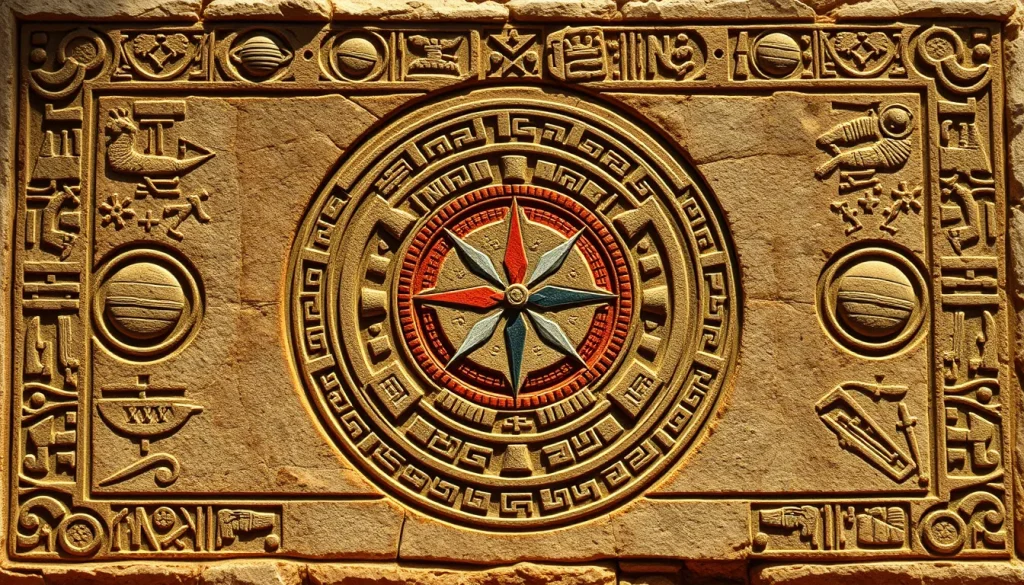
If visualized, a diagram of the 819-day count would show a circular or square mandala divided into four quadrants. Each quadrant represents one 819-day station. The East quadrant would be colored Red, the North White, the West Black, and the South Yellow. Arrows would indicate the clockwise progression from one station to the next. Surrounding this central figure would be rings representing the Tzolk’in and Haab calendars, showing how the 819-day count interlocks with the standard Calendar Round. Additional outer rings might depict the positions of Jupiter and Saturn, illustrating their synchronization with the 819-day stations over long periods.
Example Date
Inscriptions often record Period Ending dates that coincide with the completion of a 819-day station. For example, an inscription might note a date where the 819-day count reaches completion in the West (Black) direction. This would be recorded alongside the standard Long Count date. While specific Gregorian conversions vary based on the correlation constant used, the relative position within the 819-day cycle remains constant. A date falling on day 819 of the count would reset the count to day 1 while advancing the directional station to the next color.
Relationship to Other Calendars
The 819-day count does not replace the Tzolk’in or Haab but complements them. It is often found in conjunction with Lunar Series and other astronomical data in inscriptions. The relationship is synergistic; the 819-day count provides a long-term astronomical framework, while the Tzolk’in provides the ritual day quality. The 3,276-day grand cycle (4 x 819) is also significant because it is a multiple of the 260-day Tzolk’in (3,276 divided by 260 equals 12.6, but over larger multiples they synchronize). This interlocking nature ensures that specific astronomical events always fall on specific ritual days within the broader cosmological model.
Historical Use
Historically, the 819-day count was likely used by the elite priesthood and rulers to schedule ceremonies related to planetary movements. Given the association with directions and colors, it may have governed rituals intended to maintain cosmic balance. The rarity of glyphic mentions suggests it was reserved for high-status events or specific astronomical epochs rather than daily timekeeping. It served as a tool for legitimizing rule by connecting the king’s actions to the predictable movements of the heavens, particularly the slow-moving planets like Jupiter and Saturn.
Current Traditions
While the Tzolk’in continues to be used by contemporary Maya communities in Guatemala and Mexico, the 819-day count is not known to be in active traditional use today. Its practice appears to have been specialized to the Classic Period court astronomers. However, the knowledge of its structure remains vital for modern Maya daykeepers and scholars seeking to understand the full scope of ancestral timekeeping. It stands as a testament to the sophistication of pre-Columbian science.
Misconceptions
A common misconception is that the 819-day count was solely based on Mercury. While the 117-day synodic period of Mercury fits into the math (117 x 7 = 819), recent research indicates this was only part of a larger system involving Jupiter and Saturn. Another misconception is that it was a standalone calendar like the Haab. In reality, it was a supplementary count used for specific astronomical and ritual purposes. Finally, some New Age interpretations suggest mystical properties without archaeological backing; academic consensus grounds the count in observable planetary astronomy and mathematical coherence.
FAQ
What is the primary purpose of the Maya 819-day count?
The 819-day count was used to track planetary astronomy, specifically the synodic periods of visible planets like Mercury, Jupiter, and Saturn, within a ritual color-directional framework.
Who solved the mystery of the 819-day calendar?
Anthropologists John Linden and Victoria Bricker from Tulane University published the decipherment in April 2023.
Is the 819-day count still used today?
No, unlike the Tzolk'in, the 819-day count is not known to be in active use by contemporary Maya communities and was likely specialized for Classic Period astronomers.


Leave a Reply