
Short Answer
The global fascination with the date December 21, 2012, represents one of the most significant intersections of modern pop culture and ancient Mesoamerican history in recent decades. Widespread speculation suggested that the Maya civilization predicted the end of the world on this date, citing the completion of a major cycle in their Long Count calendar. However, rigorous archaeological investigation and epigraphic analysis reveal that these apocalyptic narratives were modern inventions rather than reflections of ancient Maya belief. The date marked the conclusion of a 13-baktun cycle, spanning approximately 5,125 solar years, which the Maya understood as a period of renewal and continuation rather than destruction. Understanding the distinction between the actual archaeological record and contemporary myth requires a detailed examination of Maya timekeeping, specific monumental inscriptions, and the consensus of modern specialists in Mesoamerican culture.
Main Explanation
The core of the 2012 phenomenon lies in the mechanics of the Maya Long Count calendar. This system was designed to track linear time over vast periods, distinguishing it from the cyclical calendars used for daily agricultural and ritual purposes. The Long Count is composed of nested units of time. A single day is known as a kin. Twenty kins make a uinal (20 days), and 18 uinals make a tun (360 days). Twenty tuns constitute a katun (7,200 days), and twenty katuns form a baktun (144,000 days). The cycle that concluded in 2012 was composed of 13 periods, called baktuns, totaling 1,872,000 days or roughly 5,125.366 solar years. This grand cycle began on the Long Count calendar date 13.0.0.0.0 4 Ajaw 8 Kumk’u, which corresponds to August 11, 3114 BCE in the Gregorian calendar. This starting point is considered by the Maya to be the creation date of the current or fourth era.
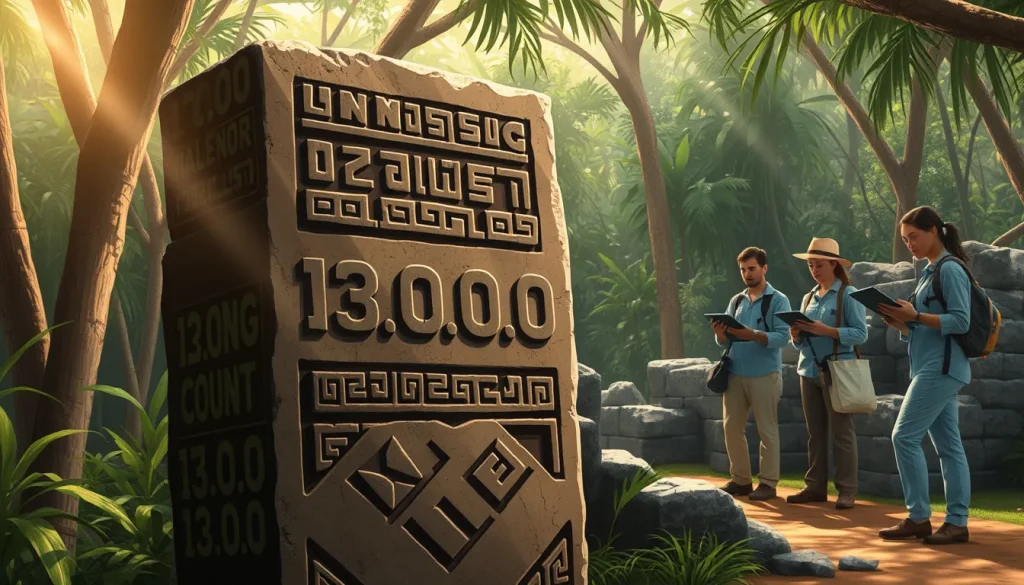
As the calendar approached December 2012, it reached the end date of 13.0.0.0.0 4 Ajaw 3 Kank’in. Contrary to doomsday prophesies, the completion of the 13th baktun did not signify the end of time itself. Experts compare the event to the way a 1960s automobile odometer would click over at mile 99,999.9 and reset to zero. William Saturno, an expert on Maya archaeology at Boston University, noted that while the calendar resets, it does not mean time stops, just as reaching 100,000 miles on a car does not mean the vehicle ceases to function. The Maya Long Count calendar consists of three separate calendars used simultaneously: the Long Count, the Tzolkin (divine calendar), and the Haab (civil calendar). While the latter two identify days within a year, the Long Count identifies the years themselves. The completion of the 13th baktun was simply the end of one great era and the beginning of another, akin to a millennium celebration in the modern Gregorian calendar, rather than an apocalypse.
Evidence & Sources
The assertion that the Maya predicted a catastrophe lacks support in the primary source material. The archaeological record provides specific monuments that document the start and end dates of this cycle without mentioning destruction. Stela C, located at the archaeological site of Quiriguá in Guatemala, records the creation date of the current era. This monument establishes the historical baseline for the Long Count, anchoring the 5,125-year cycle in a specific cosmological context. More critically, Monument 6 from the archaeological site of Tortuguero in Tabasco, México, records the only known Maya inscription of the end date of the 13-baktun cycle. This inscription confirms that the Maya were aware of the date December 21, 2012, centuries before it occurred, but the text does not prophesy doom.
Scholarly analysis further dismantles the apocalyptic narrative. Publications surrounding the 2012 phenomenon often relied on non- and pseudo-scientific interpretations rather than academic rigor. Erik Boot, a researcher associated with Università degli studi di Milano, highlighted that many authors working on 2012 publications operated outside standard archaeological methodologies. These works claimed the calendar end would herald worldwide disasters such as earthquakes, tsunamis, solar storms, and magnetic pole inversions. However, credible scientists eschew such predictions. The American Association for the Advancement of Science notes that while there have been predictions that the world would end on certain dates throughout history, none have come to pass. The Mayan Long Count calendar ending on December 21, 2012, was simply the most imminent of these dates, but it possessed little basis in science. The correlation between the Maya and Christian calendars, specifically the 584,283 correlation constant, allows researchers to accurately translate these dates, confirming that the cycle ends without implying physical destruction of the planet.
Deep Dive Analysis
To fully understand the discrepancy between public perception and archaeological reality, we must analyze the specific claims made during the 2012 phenomenon through a Myth vs Fact framework. This analysis separates verified historical data from modern speculation.
Claim: The Maya Predicted the End of the World
Verdict: False. There is no archaeological evidence supporting the claim that the Maya predicted global destruction.
Origin of Claim: The myth originated from a misinterpretation of the Long Count cycle completion combined with New Age spiritualism and commercial media sensationalism in the early 21st century. Non-scientific publications suggested the end of the cycle meant the end of civilization as we know it or a transition to a new level of joint consciousness.
Evidence: Monument 6 at Tortuguero is the primary textual evidence for the 2012 date. The inscription mentions the descent of a deity associated with the cycle’s completion but does not mention catastrophe. Furthermore, the Maya concept of time was cyclical. As noted by National Geographic experts, the calendar resets akin to an odometer. The existence of dates in Maya inscriptions that extend beyond 2012 also contradicts the idea that they believed time would stop. The cycle spans 5,126 solar years, and the completion was anticipated as a routine calendrical event.
Scholar Consensus: Experts on Mesoamerican culture, including archaeologists and epigraphers, agree that the doomsday scenario is total fiction. William Saturno and other specialists emphasize that the calendar reset implies continuity. The Smithsonian Institution’s Living Maya Time project confirms that while the world did not end, the date marked the completion of an important cycle. The AAAS reinforces that credible scientists reject doomsday predictions based on calendar cycles.
Remaining Uncertainties: While the apocalyptic claim is debunked, scholars continue to study how different Maya city-states may have celebrated the event. The Tortuguero inscription is fragmentary, leaving some details about the specific rituals planned for 2012 open to interpretation. However, the fundamental nature of the event as a renewal rather than destruction remains settled science.
Claim: The Calendar Ends Permanently in 2012
Verdict: False. The Long Count is capable of continuing beyond 13 baktuns.
Origin of Claim: Misunderstanding of the base-20 mathematical system used by the Maya, assuming 13 was the maximum number rather than a cycle limit.
Evidence: The Long Count uses a modified vigesimal system. While the baktun cycle discussed is 13 periods, the mathematical structure allows for higher orders of time beyond the 13th baktun. The reset to 0.0.0.0.0 implies the start of a new count, not the cessation of counting.
Scholar Consensus: Archaeologists confirm the calendar continues. The comparison to an automobile odometer resetting illustrates that the mechanism remains functional after the cycle completes.
Remaining Uncertainties: There is limited inscriptional evidence detailing how the Maya intended to notate dates far beyond the 13th baktun in practical daily use, as most inscriptions focused on the current era. However, the theoretical capacity of the system is well understood by mathematicians and archaeologists.
FAQ
Did the Maya predict the end of the world on December 21, 2012?
No. Experts confirm that the Maya predicted the end of a calendar cycle, not the end of the world. The date marked the completion of the 13th baktun.
What happens to the Long Count calendar after 2012?
The calendar resets to zero and begins a new cycle, similar to an odometer rolling over. Time continues linearly beyond the 13th baktun.
Which monument records the 2012 end date?
Monument 6 from the archaeological site of Tortuguero in Tabasco, México, records the only known Maya inscription of the end date of the 13-baktun cycle.
When did the current Maya era begin?
The current era began on August 11, 3114 BCE, corresponding to the Long Count date 13.0.0.0.0 4 Ajaw 8 Kumk’u.
Leave a Reply