
Short Answer
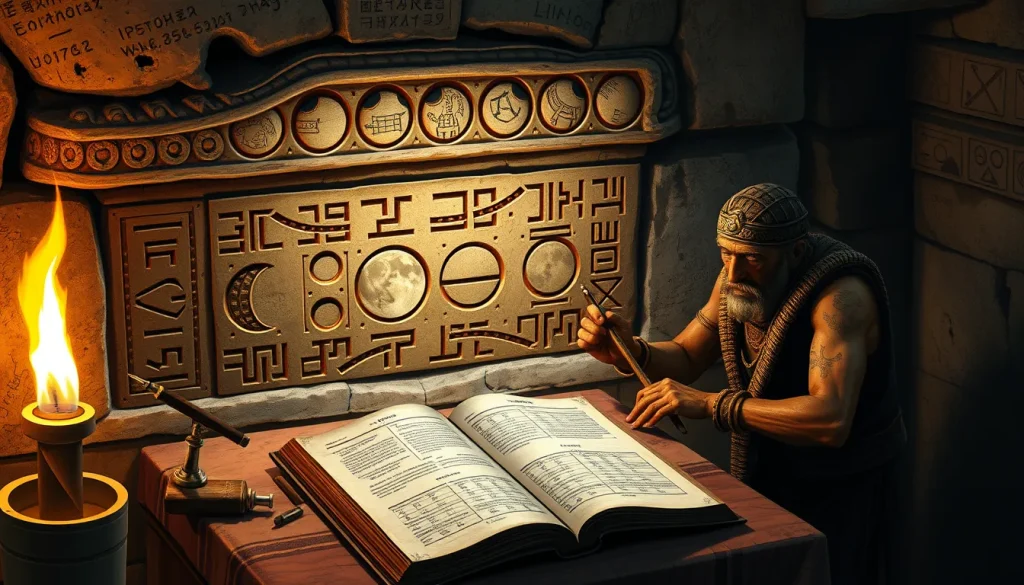
The ancient Maya civilization developed one of the most sophisticated calendrical systems in human history, capable of tracking celestial phenomena with extraordinary precision. Central to their timekeeping was the ability to monitor the Moon, a celestial body deeply intertwined with their cosmology and ritual life. Unlike modern calendars that fix lunar months arbitrarily, the Maya integrated lunar tracking directly into their primary chronological framework, the Long Count. This integration was achieved through a mechanism known as the Lunar Series, often referred to as the Supplementary Series. The Lunar Series was not a standalone calendar but rather a set of glyphs appended to Long Count dates to record the age and phase of the Moon on any given day. This system allowed Maya timekeepers to maintain a running count of lunar months alongside the solar and ritual cycles, ensuring that religious ceremonies aligned with specific lunar phases.
Main Explanation
The Lunar Series functioned as a detailed record of the Moon’s synodic cycle, which is the time it takes for the Moon to return to the same phase, such as from new moon to new moon. The Maya understood that the lunar month was not a fixed integer of days but alternated between 29 and 30 days. To accommodate this, their system utilized an alternating sequence of months to achieve an average length of 29.5 days. While the true lunar synodic month is approximately 29.53059 days, the Maya approximation of 29.5 days was sufficient for most calendrical purposes, though it required periodic correction over long periods. The Lunar Series was composed of a specific sequence of glyphs, identified by scholars as Glyphs E, D, C, X, B, and A. These glyphs provided information on the current lunar month number within a half-year cycle, the length of the current lunation, and the position within a larger eighteen-month cycle.
Glyph X, in particular, has been identified as representing an eighteen-month lunar synodic calendar, indicating a higher-order organization of lunar time beyond simple monthly counts. This suggests that the Maya were not merely counting days but were modeling the lunar cycle within a broader structural framework. The Lunar Series was typically inscribed alongside historical records on stelae and lintels, particularly during the Classic Period. By attaching this data to the Long Count, the Maya ensured that every recorded historical event was contextualized within the cosmic order represented by the Moon. This dual recording system highlights the importance of astronomy in Maya historiography, where terrestrial events were inextricably linked to celestial patterns. The complexity of the Lunar Series demonstrates a deep mathematical understanding, as it required maintaining parallel counts that drifted at different rates over centuries.
Evidence & Sources
Archaeological and epigraphic evidence for the Lunar Series is found across numerous Maya sites, with significant contributions from recent scholarly analysis. Research published in American Antiquity details the function of Glyph X within the Lunar Series, confirming its role in an eighteen-month lunar synodic calendar structure. This finding underscores the sophistication of Maya lunar modeling, moving beyond simple observation to structured calendrical prediction. Further evidence comes from the site of Yaxchilan, where the use of the Xultun Lunar Table has been analyzed in relation to the Lunar Series. Studies indicate that the Maya computed lunar intervals using rules such as the rule of three, allowing them to manage the discrepancy between the 29.5-day average and the true synodic month of 29.53059 days. Calculations show that the lunar calendar and the mean Moon would differ by one day after approximately 964.4 days, necessitating adjustments that were likely managed by calendar specialists.

The Dresden Codex provides another critical source of evidence, specifically regarding eclipse tables. Recent analysis published in Science Advances in 2025 suggests that the famous 405-month eclipse table was originally implemented as a general lunar calendar table. This implies that the eclipse predictions were derived from a broader understanding of lunar intervals compiled as stations of an eclipse table. Additionally, research on the Lunar Series and eclipse cycles at Palenque, Chiapas, reveals that Maya timekeepers used Distance Numbers representing multiples of 11,960 days. While these intervals evoke eclipse cycles found in the Dresden Codex, scholars argue they should be treated as intervals to compute the Lunar Series rather than purely eclipse cycles. This distinction is vital for understanding how the Maya prioritized lunar tracking over strict eclipse prediction in certain contexts. The convergence of data from Xultun, Yaxchilan, Palenque, and the Dresden Codex paints a picture of a pan-Maya scientific tradition focused on lunar precision.
Deep Dive Analysis
Units and Calculation
The fundamental unit of the Lunar Series was the lunation, alternating between 29 and 30 days. The calculation relied on maintaining a running count that averaged 29.5 days per month. As noted in archaeological studies, the discrepancy between this average and the true synodic month (29.53059 days) results in a drift of one day every 964.4 days. Maya astronomers likely monitored this drift and applied corrections to keep the calendar aligned with observed phases. The system involved complex arithmetic, potentially utilizing the rule of three to compute intervals and adjustments over long periods.
Diagram Description
A conceptual diagram of the Lunar Series would show the Long Count date at the center, flanked by the Supplementary Series glyphs. On one side, Glyphs E and D would indicate the current lunar month number (1 through 6) and the length of the lunation (29 or 30 days). On the other side, Glyphs C, X, B, and A would represent the position within the larger eighteen-month cycle and the ruling deity or patron of the lunar period. This visual arrangement emphasizes the subordination of lunar time to the absolute Long Count while granting it equal epigraphic weight.
Example Date
An example of this system in practice can be found on monuments at Yaxchilan. A Long Count date might be accompanied by a Lunar Series stating that it is the 15th day of a 30-day moon, which is the third moon in a half-year cycle. This specific configuration allows modern researchers to verify the accuracy of the Maya record against astronomical retrocalculations. The consistency of these records across different sites confirms a standardized method of lunar tracking.
Relationship to Other Calendars
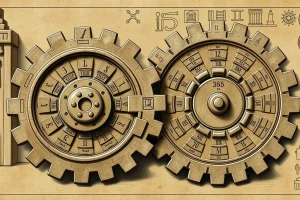
The Lunar Series was attached to the Long Count but operated independently of the 260-day Tzolk’in and the 365-day Haab’. While the Tzolk’in and Haab’ formed the Calendar Round, the Lunar Series provided a third layer of temporal context. This tripartite system allowed the Maya to synchronize ritual, agricultural, and astronomical cycles. The Lunar Series did not reset with the Calendar Round but continued its count based on lunar observations, creating a unique intersection of linear and cyclic time.
Historical Use
Historical use of the Lunar Series is predominantly documented during the Classic Period (c. 250–900 CE). Sites like Palenque and Yaxchilan show extensive use of the Supplementary Series in royal inscriptions. The system was likely maintained by a specialized class of scribes and astronomers who served the royal court. The precision of the records suggests that lunar data was considered essential for legitimizing royal power and scheduling state rituals.
Current Traditions
While the specific Lunar Series mechanism of the Classic Period is no longer in use, modern Maya communities maintain rich traditions of lunar observation. Agricultural practices and ritual ceremonies often still consider lunar phases, though the complex glyphic recording system has not survived. The knowledge of the ancient system is preserved through archaeological research and the study of codices rather than continuous oral tradition regarding the glyphs themselves.
Misconceptions
A common misconception is that the Lunar Series was primarily an eclipse prediction tool. While related to eclipse cycles, as seen in the Dresden Codex, recent scholarship argues that intervals like the 11,960-day multiples at Palenque were used to compute the Lunar Series rather than strictly for eclipses. Additionally, some believe the Maya calendar was perfectly accurate without drift; however, the 964.4-day drift rate indicates that active management was required to maintain alignment with the true Moon.
FAQ
What is the Lunar Series in the Maya calendar?
The Lunar Series is a set of glyphs attached to Long Count dates that record the age and phase of the Moon, consisting of glyphs E, D, C, X, B, and A.
How accurate was the Maya lunar calendar?
It used an average of 29.5 days per month, differing from the true 29.53059 days by one day every 964.4 days, requiring periodic adjustment.
Did the Maya use the Lunar Series for eclipses?
While related to eclipse tables like the Dresden Codex, recent research suggests some intervals were used to compute the Lunar Series rather than solely for eclipse prediction.
Leave a Reply