
Short Answer
The Great Ball Court at Chichén Itzá represents a pinnacle of Mesoamerican architectural engineering and ritual significance. As the largest ball court discovered in the region, it serves as a critical case study for understanding the intersection of Maya cosmology, public performance, and acoustic design. While early excavations in the 1920s noted unusual sound phenomena, modern archaeological acoustics have validated these observations, suggesting intentional design rather than accidental artifacts. This article examines the structural dimensions, acoustic capabilities, and the evolving scholarly interpretation of the site’s sensory environment.
Main Explanation
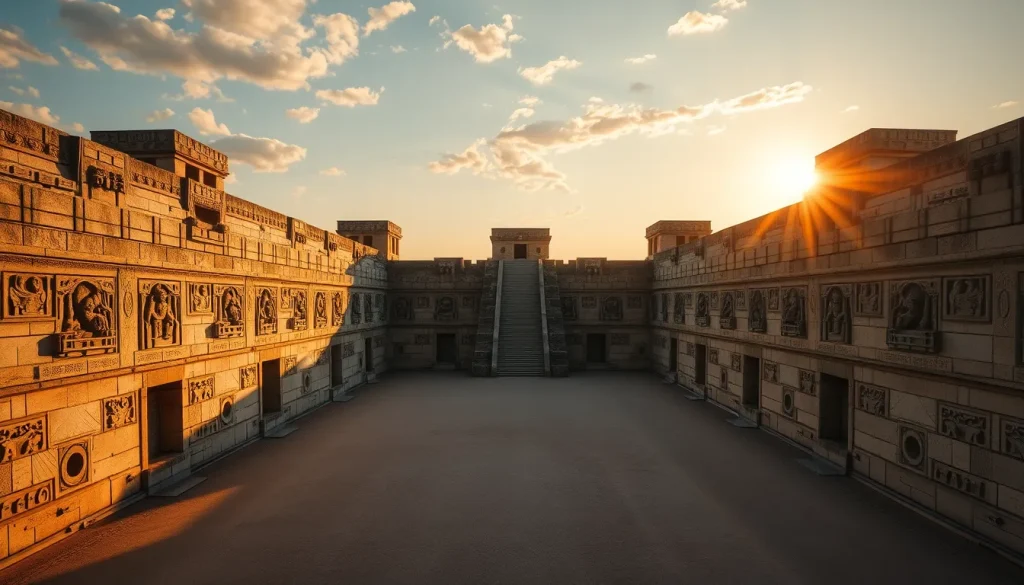
The Great Ball Court (GBC) is defined by its massive scale and unique architectural features that distinguish it from earlier Maya ball courts. The playing field is flanked by two parallel walls that function not only as boundaries for the game but as acoustic reflectors. According to acoustic measurements published in the Journal of the Acoustical Society of America, the playing field walls are approximately 270 feet (82 meters) long and 28 feet (8.5 meters) high, spaced about 119 feet (36 meters) apart. Other architectural surveys describe the overall complex as measuring up to 168 by 79 meters, dwarfing modern athletic fields.
Two primary acoustic phenomena characterize the site. First, a “whispering gallery” effect permits voice communication between temples located at opposite ends of the court, approximately 460 feet (140 meters) apart. A voice spoken softly at one end can be heard distinctly at the other, defying normal sound attenuation over distance. Second, a profound flutter echo occurs between the massive parallel walls of the playing field. This creates a sustained, reverberating sound when noise is generated within the court, transforming the space into a resonant cavity. These features are not merely physical byproducts but are increasingly understood as integral to the ceremonial function of the ballgame, which has played a central role in Mayan religion and culture for 5000 years.
The architectural uniqueness of the GBC includes inverted hoops intricately carved with decorative feathers located at the center of the walls. Stunning panels depicting ball players line the interior walls, showcasing the artistry and cultural significance of the site. The acoustics are extraordinary, with a voice spoken softly at the northern wall clearly heard at the southern wall. This remarkable sound phenomenon may have been intentional, adding to the ceremonial and symbolic importance of the court, facilitating communication between priests or players separated by significant distances during rituals.
Evidence & Sources
The documentation of the Great Ball Court’s acoustics spans nearly a century of archaeological inquiry. The earliest recorded observation dates to the 1920s during excavations led by American archaeologist Silvanus Morley, Director of the Carnegie Institution’s Chichen Itza project. In a 1925 National Geographic article, Morley wrote: “Standing in this temple one can speak in a low voice & be heard distinctly at the other end of the court, 500 ft away.” Despite this early testimony, the claim faced skepticism throughout the late 20th century. Queries on archaeological discussion groups around 2000-2001 found little belief in a whispering gallery among mesoamericanists, with many opining that any such effect would be a design accident or an artifact of ballcourt ageing or reconstruction.
However, stimulated by archaeological acoustic studies and reports since 1999, the consensus has shifted. A pivotal 2006 study published in the Journal of the Acoustical Society of America provided empirical data supporting Morley’s claims. The study confirmed the whispering gallery permits voice communication between temples located about 140 meters apart and documented the flutter echo between the parallel walls. This scientific validation prompted eminent Mayanists Stephen Houston and Karl Taube to reinterpret certain Mayan glyphs as vibrant sounds and ballcourt echoes, famously calling for a new archaeology of the senses, especially hearing, sight, and smell.
Recent hypotheses continue to explore the mathematical relationships of the architecture. A 2026 preprint analysis examined acoustic cavity resonances in Maya ball courts, including Chichén Itzá and Uxmal. While this paper proposed mathematical relationships with Schumann resonance frequencies, it explicitly noted this is a hypothesis-generating analysis requiring experimental validation. Such contemporary research underscores the transition from dismissing acoustical features as unintended artifacts to recognizing them as potential components of intentional design, though rigorous experimental protocols remain necessary to separate archaeological evidence from modern speculation.
Deep Dive Analysis
Module B: Building/Site Analysis
Location
The Great Ball Court is situated within the monumental core of Chichén Itzá, a major Maya city in the Yucatán Peninsula, Mexico. It is part of a larger ceremonial complex, positioned to maximize visibility and acoustic projection within the sacred landscape.
Construction and History
The Great Ball Court is a late development in the history of the Mesoamerican ballgame. Thousands of ball courts have been discovered across the region, but the GBC at Chichen Itza is architecturally unique. Its construction reflects the Terminal Classic period, showcasing advanced engineering capabilities. The site’s preservation allows for detailed acoustic measurement, unlike many earlier courts that have degraded significantly.
Architecture
The court’s parallel walls stretch approximately 95 meters long and rise 8 meters high according to some surveys, while acoustic studies specify 82 meters long and 8.5 meters high. At the center of these walls are inverted hoops intricately carved with decorative feathers. The sheer mass of the stone walls serves as a reflective surface for sound waves, creating the conditions necessary for the flutter echo and whispering gallery effects. The interior walls are lined with panels depicting ball players, showcasing the artistry and cultural significance of the site.
Astronomical Interpretation
While the primary focus of recent study has been acoustics, architectural orientation often holds astronomical significance in Maya construction. Recent analyses of ball court architecture, such as at Uxmal, document N-S orientation and solar zenith passages. While specific astronomical alignments for the Chichén Itzá GBC are less explicitly detailed in acoustic literature, the integration of the court within the broader ceremonial complex suggests alignment with cosmological principles common to Maya architecture.
Archaeological Evidence
Evidence for the court’s function comes from both structural analysis and historical reporting. The 1920s excavation reports by Silvanus Morley provide the primary historical testimony regarding the whispering gallery. Modern acoustic measurements confirm the physical possibility of these phenomena. The presence of carved panels depicting players provides iconographic evidence of the ritual activities performed within this acoustic space.
Alternative Interpretations
For decades, the prevailing interpretation was that the acoustics were unintended. Skeptics argued that modern mesoamericanists were missing something or that the ancient Maya might not have possessed the requisite knowledge for intentional design. Some opined that any WG would surely be a design accident or an artifact of ballcourt ageing or reconstruction. The shift toward intentional design is relatively recent, driven by the new archaeology of the senses.
Scholar Consensus
Until recently, most archaeologists dismissed acoustical features at Mayan sites as unintended artifacts. That is now changing. Eminent Mayanists have reinterpreted certain Mayan glyphs as vibrant sounds and ballcourt echoes. The current consensus acknowledges the acoustic features as real phenomena, with growing support for the hypothesis that they were intentionally utilized for ritual communication, though debate continues regarding the depth of acoustic engineering knowledge possessed by the builders.
Visitor Misconception
Visitors often attribute mystical or supernatural properties to the acoustics, sometimes influenced by New Age interpretations regarding energy frequencies or Schumann resonances. While recent papers have explored mathematical relationships with resonance frequencies, these are hypothesis-generating analyses requiring experimental validation. It is crucial to distinguish between verified archaeological evidence, such as the whispering gallery confirmed by acoustic measurement, and speculative theories regarding metaphysical resonance that lack empirical validation.
FAQ
Was the whispering gallery at the Great Ball Court intentional?
While early archaeologists dismissed it as an accident, modern studies and Mayanists like Stephen Houston now suggest it may have been intentional design for ritual communication.
How far apart are the temples connected by the whispering gallery?
The temples are located about 460 feet (140 meters) apart, allowing voice communication between them.
What causes the flutter echo in the ball court?
The flutter echo is caused by sound waves bouncing between the two massive parallel walls of the playing field, which are about 119 feet (36 meters) apart.


Leave a Reply