
Short Answer
In the complex tapestry of ancient Maya cosmology, Xibalba—translated from Kʼicheʼ as the “place of fright”—was far more than a mere destination for the deceased. It functioned as a critical axis in a tripartite universe consisting of the celestial realm, the terrestrial plane, and the subterranean underworld. While often depicted as a court of death ruled by twelve lords, Xibalba was inextricably linked to astronomical phenomena. For the ancient Maya, the movements of the stars, the phases of the moon, and the trajectory of the Milky Way were not merely markers of time, but maps that mirrored the geography of the underworld, creating a seamless integration between the observable sky and the invisible realms of the dead.
The Astronomical Nature of the Underworld
Xibalba was conceptualized as a mirror image of the heavens. Just as the gods resided in the upper reaches of the cosmos, the Lords of Xibalba, led by Hun-Came (“One Death”) and Vucub-Came (“Seven Death”), governed a subterranean court associated with suffering, sickness, and death [3]. However, this realm was not isolated from the sky. The Maya viewed the cosmos as a dynamic system where celestial bodies transitioned between the upper and lower worlds. The sun, for instance, was believed to travel through the underworld during the night, battling the forces of darkness before emerging again at dawn.
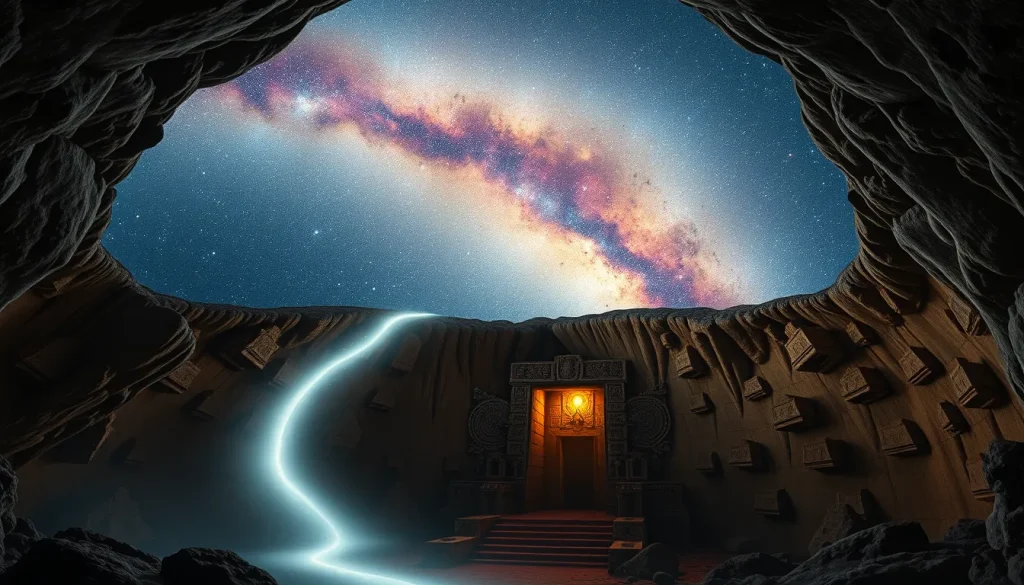
A central tenet of this astronomical mythology is the identification of the Milky Way as the “road to Xibalba” [3]. In various Maya regions, the dense band of stars was perceived as a celestial path that souls traveled to reach the underworld. This connection suggests that the Maya did not view the “underworld” as being exclusively beneath the earth’s crust, but rather as a state or location that could be accessed through specific celestial portals. This duality allowed the Maya to synchronize their terrestrial agricultural calendars with the perceived movements of deities and ancestors across the galactic plane.
Evidence and Sources
The reconstruction of Xibalba’s role in astronomy relies on a multidisciplinary approach combining ethnohistory, iconography, and epigraphy. The Popol Vuh, the sacred text of the Kʼicheʼ Maya, provides the primary narrative framework, describing Xibalba as a court of trial and torment [3]. However, archaeological evidence from the Classic Period provides a more nuanced, astronomical perspective. Decipherments of inscriptions at sites such as Quirigua, Palenque, and Copan have revealed that creation events were often associated with specific constellations and the movement of the Milky Way [2].
At Quirigua, Stela C describes the “appearance or manifestation of an image” involving three stone-settings and a jaguar throne placed by the Paddler, linking the act of creation to astronomical alignments [2]. Furthermore, the use of caves as physical portals to Xibalba—such as those found near Cobán, Guatemala, and in Belize—served as terrestrial anchors for these celestial beliefs [3]. These caves often align with specific solar or stellar events, suggesting that the Maya used “dirt archaeology” and architectural alignment to bridge the gap between the subterranean road and the starry path above [1].
Deep Dive Analysis: The Milky Way as a Celestial Object
Celestial Object: The Milky Way (the Galactic Plane).
Observational Cycle: The Maya observed the Milky Way’s shifting position throughout the year. Depending on the season, different portions of the galactic center were visible, which the Maya interpreted as the “Road to Xibalba” or the “World Tree” in a horizontal orientation.
How the Maya Observed It: Using horizon-based observations and specialized architecture, Maya astronomers tracked the rise and set points of the galactic center. This allowed them to determine the timing of critical rituals associated with the underworld and the transition of souls.
Archaeological/Textual Evidence: Textual evidence from the Popol Vuh and later ethnohistoric sources confirm the association between the underworld and celestial paths [3]. Iconographic evidence from Palenque and Copan shows the integration of creation myths with the movement of the Milky Way across the sky [2].
Calendar Connection: The movement of the galactic plane was tied to the long-term cycles of the Maya calendar. The transition of the sun through the “underworld” portion of its annual path coincided with key dates in the Haab’ and Tzolk’in calendars, marking periods of regeneration and death.
Architecture Connection: Many Maya structures were aligned to mark the solstices and equinoxes, but some also align with the position of the Milky Way during significant dates. Caves, viewed as the physical entrance to Xibalba, were often treated as astronomical markers, where the play of light and shadow during specific celestial alignments signaled the opening of the portal to the underworld [3].
Cultural Meaning: The Milky Way served as a visual reminder of the inevitability of death and the cycle of rebirth. By mapping Xibalba onto the stars, the Maya transformed the fear of the “place of fright” into a structured, predictable cosmic journey. The road to Xibalba was not just a path to death, but a necessary route for the sun and the Hero Twins to navigate in order to achieve victory over the Lords of Death.
Uncertainty/Debate: There remains a scholarly debate regarding the exact constellations the Maya identified as the “Lords of Xibalba.” While the association with the Milky Way is widely accepted, the specific mapping of individual deities to specific star clusters remains a subject of ongoing research among iconographers and archaeoastronomers [1].
FAQ
Was Xibalba only a place of punishment?
While described as a place of fright and suffering, Xibalba was also a place of trial and transformation. In the Popol Vuh, the Hero Twins use Xibalba as a stage to prove their wit and courage, eventually transforming the realm's power to facilitate their ascent as celestial bodies.
How did the Maya link caves to the stars?
The Maya viewed caves as physical portals to the underworld. Many of these caves are aligned with specific astronomical events, suggesting that the physical 'entrance' to Xibalba was synchronized with the 'celestial road' seen in the Milky Way.
Who were the main gods of Xibalba?
The underworld was ruled by twelve lords, the most senior being Hun-Came (One Death) and Vucub-Came (Seven Death), who presided over a court that assigned different forms of suffering to humans.
Leave a Reply