
Short Answer
The concept of the Wacah Chan, often translated as the “Raised-Up Sky” or World Tree, stands as one of the most fundamental pillars of ancient Maya cosmology. Far more than a simple botanical motif, this symbolic structure functioned as the axis mundi, the central point around which the universe was organized and through which divine energy and souls traversed. In the Maya conception of the cosmos, the universe was not a void but a structured layered reality consisting of the underworld (Xibalba), the terrestrial realm (Earth), and the heavens. The Wacah Chan provided the vertical connectivity between these distinct planes, serving as a pathway for shamans, kings, and deities to communicate across spiritual boundaries. Understanding the Wacah Chan requires an interdisciplinary approach, combining archaeology, iconography, and ethnohistory to decipher how the Maya visualized their place within the celestial order.
Main Explanation
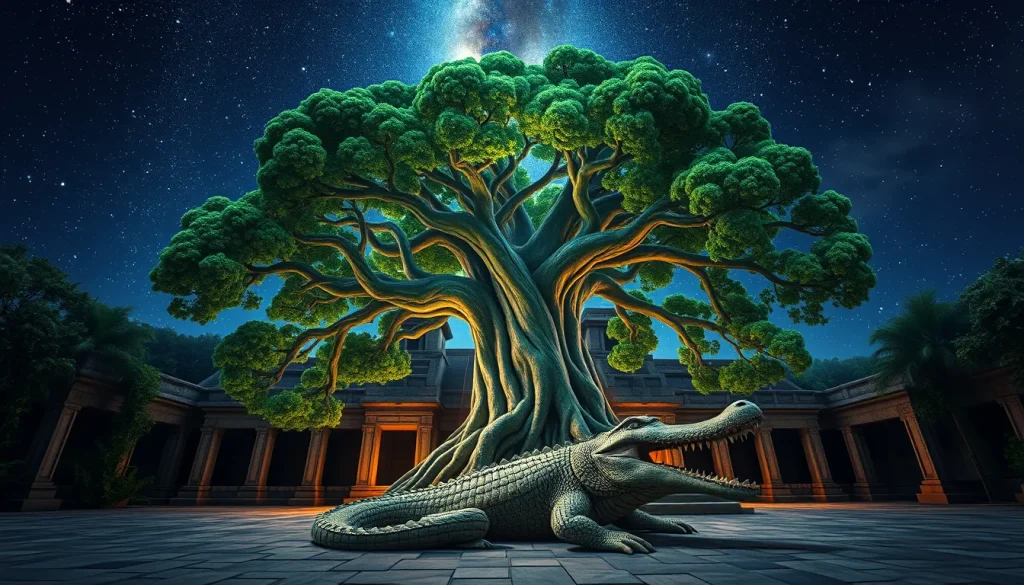
The Wacah Chan was not merely a mythological abstraction but a structural necessity within the Maya worldview. During the Classic period (c. 250–900 AD), this concept was pervasive in art, architecture, and ritual. The tree was envisioned as a massive entity rooted deeply in the earth, often depicted emerging from a crocodilian monster or a turtle carapace representing the terrestrial surface, and reaching upward toward the sun and the celestial realms. At its summit sat the Principal Bird Deity, known as Itzam-Ye, signifying the connection to the highest divine powers. This vertical axis was complemented by a horizontal structure, where four additional trees marked the cardinal directions, creating a quincunx pattern that stabilized the cosmos.
Botanically, the World Tree is most frequently associated with the Ceiba tree (Ceiba pentandra), known in Yucatec Maya as Ya‚xche’. The Ceiba’s physical characteristics—its towering height, massive buttress roots, and thorny trunk—mirrored the cosmological requirements of a tree that could physically bridge the underworld and the sky. However, scholarly analysis suggests the symbolism was polymorphous. Research indicates that in certain contexts, particularly on ceramic vessels and stone stelae, the World Tree motif may also represent the maize plant (Zea mays). This duality reflects the Maya understanding of creation; just as maize sustains human physical life, the cosmic tree sustained the metaphysical structure of the universe. The vegetative motif represents metaphysical principles of cosmogenesis, natural creation, and eternal recurrence.
Astronomically, the Wacah Chan had a direct correlate in the night sky. The Maya observed the Milky Way galaxy and, during certain seasons, viewed its upright position as the glowing manifestation of the World Tree. This celestial alignment reinforced the belief that the cosmos was interconnected; events in the sky were reflections of processes on earth and in the underworld. The tree was thus a dynamic symbol, changing with the seasons and the movement of celestial bodies, yet remaining the fixed center around which time and space revolved. This integration of astronomy and mythology ensured that the World Tree was not static but a living component of the Maya temporal cycles.
Evidence & Sources
Archaeological and iconographic evidence for the Wacah Chan is abundant across the Maya region. One of the most famous depictions is found on the lid of K’inich Janaab’ Pakal’s sarcophagus at Palenque. Dating to the king’s death in 683 C.E., the lid depicts the deceased ruler falling back into the roots of a massive World Tree, symbolizing his death and subsequent rebirth into the heavens. This imagery confirms the tree’s role as a conduit for souls and divine energy, facilitating the transition between life and death. The iconography shows the tree emerging from a earth monster, reinforcing the connection between the terrestrial realm and the underworld.
Further evidence is found in the Izapa Stela 5, a monument from the Late Formative period that predates the Classic Maya but shares significant cosmological motifs. This tableau shows a multi-layered tree with birds, which scholars propose represent souls who have not yet descended into the underworld. The presence of such early depictions indicates that cosmic tree symbolism among pre-Columbian societies of Mesoamerica traces from the Preclassic period. Additionally, glyphic texts explicitly refer to the wacah chan and yax imix che, providing textual confirmation of the concepts seen in art. These inscriptions often appear in contexts related to creation myths and royal accession, linking the king’s authority to their ability to maintain the cosmic order through the World Tree.
Modern archaeological assessments continue to refine our understanding of these symbols. While earlier interpretations often favored a singular botanical identification, contemporary analysis acknowledges the symbolic permutations of the motif. Attempts to identify the plant in a botanical context usually favor determinations as a kapok tree or maize plant, depending on the specific morphic and ecological characteristics depicted in the art. This nuance is critical for avoiding oversimplification of Maya religious thought. The persistence of the motif across cultures such as the Aztec, Mixtec, and Olmec further underscores its pan-Mesoamerican significance as a symbolic axis mundi which connects the planes of the Underworld and the sky with that of the terrestrial realm.
Deep Dive Analysis
Module A: Definition and Conceptual Framework
Definition: The Wacah Chan is defined as the central cosmic axis in Maya cosmology, functioning as a world tree that connects the three primary layers of existence: the underworld, the earth, and the heavens. It is both a physical metaphor (the Ceiba tree) and an astronomical phenomenon (the Milky Way).
How it works: The World Tree operates as a conduit. Spirits, ancestors, and deities travel along its trunk to move between realms. For the living, particularly kings and shamans, rituals were performed at the base of physical trees or effigies to open this channel. The tree stabilizes the cosmos; without it, the sky would fall and the earth would dissolve into the primordial sea. It embodies the four cardinal directions, creating a centralized structure that organizes space and time.
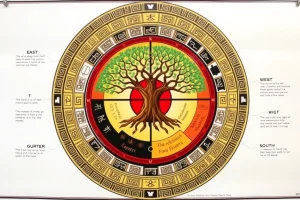
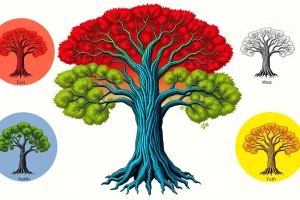
Key components: The structure consists of three main parts. The roots anchor into the underworld, often depicted as water lilies or emerging from a caiman. The trunk represents the earthly realm and the path of ascent. The branches support the sky, often holding the Principal Bird Deity or the Milky Way. Additionally, the concept includes four directional trees (Red, White, Black, Yellow) surrounding the central Green tree, representing the fourfold nature of the cosmos.
Example: The sarcophagus lid of Pakal the Great at the Temple of the Inscriptions in Palenque is the quintessential example. It visually narrates the king’s journey down the tree into death and his resurrection as maize god, utilizing the World Tree as the mechanism for this transformation. Another example is the murals at San Bartolo, which depict early versions of the tree of life associated with creation myths.
Historical evidence: Evidence spans from the Mid/Late Formative periods (Izapa) through the Classic period (Palenque, Tikal) and into the Postclassic (Codices). Glyphic texts refer to it as Wakah-Chan (Raised Up Sky) or Yax Imix Che. Ethnohistoric records from the Colonial period also describe the Yaxche as the tree where souls rest, showing continuity in belief systems.
Common misconceptions: A frequent misconception is that the World Tree was worshipped as a deity itself. In reality, it was a structural symbol and a pathway, not necessarily a god. Another error is assuming it was always a Ceiba; iconography shows it could be maize or a composite monster. Finally, modern New Age interpretations often detach the tree from its rigorous astronomical and calendrical context, treating it as a generic spiritual symbol rather than a specific cosmological tool used to track time and celestial events.
FAQ
What is the Wacah Chan in Maya culture?
The Wacah Chan is the Maya World Tree, a cosmic axis that connected the underworld, the earth, and the heavens, serving as a pathway for souls and divine energy.
Is the World Tree always a Ceiba tree?
While often envisioned as a Ceiba tree, archaeological evidence shows it was also represented as a maize plant or a composite monster depending on the context.
How does the Milky Way relate to the World Tree?
The Maya viewed the upright Milky Way in the night sky as the glowing celestial manifestation of the World Tree, linking astronomy with cosmology.
Leave a Reply