
Short Answer
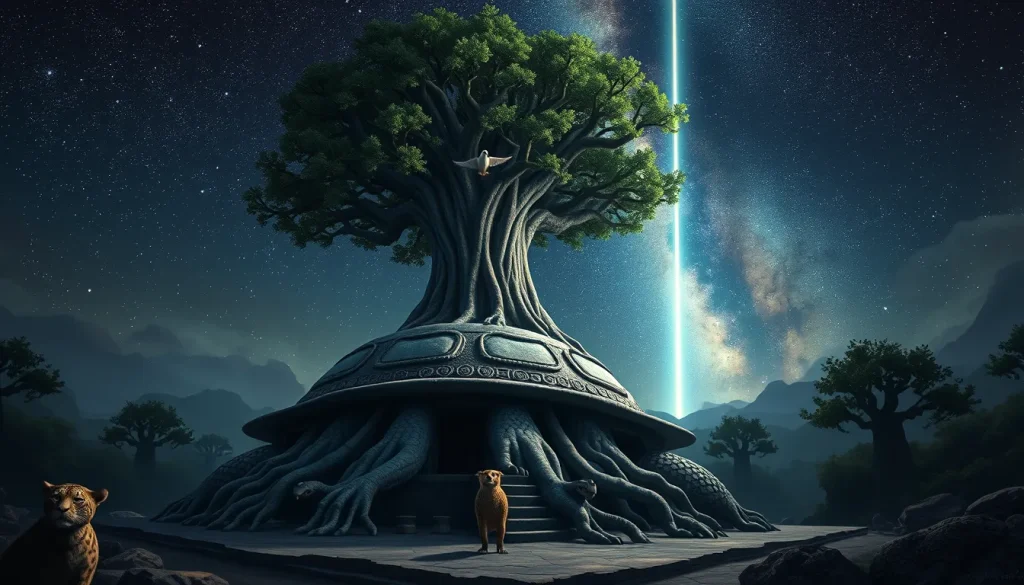
The Wacah Chan, frequently translated as the “Raised Up Sky,” stands as the fundamental structural element of ancient Maya cosmology. Far more than a simple mythological motif, this concept represented a structural necessity within the Maya understanding of the universe. Envisioned variously as a massive Ceiba tree or a crocodilian monster, the Wacah Chan functioned as the axis mundi, the central pillar that connected the underworld, the earth, and the heavens. This vertical axis formed the critical pathway for souls and divine energy, allowing interaction between the different layers of existence. In the Classic period, circa 250–900 AD, it was known specifically as the Wakah-Chan, while in the Yucatan region, it was often referred to as the Ya’axche’. This cosmological structure was not static; it was viewed as a sacred organism in constant motion, defining the living spaces for gods, spirits, and humans alike.
Main Explanation
At the absolute center of the ancient Maya universe stood the World Tree. The botanical model for this cosmic structure was typically the Ceiba tree (Ceiba pentandra), known for its immense height and distinctive structure. The tree’s roots descended deep into the underworld, known as Xibalba, while its trunk occupied the terrestrial realm, and its branches reached upward into the heavens, or Caan. This tripartite division of the cosmos was essential to Maya religious thought. The heavens were believed to consist of thirteen levels, while the underworld comprised nine levels, all revolving around this sacred axis. The physical earth was often conceptualized as the base of this tree, sometimes depicted as a turtle carapace or a crocodilian monster, grounding the cosmic structure in the tangible world.
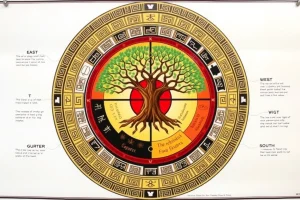
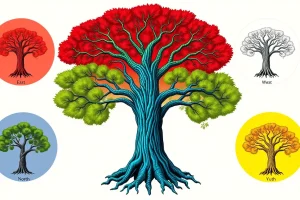
Surrounding this central axis were four additional trees located at the corners of the universe. These directional trees were associated with the four cardinal directions and specific sacred colors: red, white, black, and yellow. Together, the central tree and the four directional trees created a quincunx pattern, stabilizing the cosmos and preventing the sky from falling. The top element of the central World Tree was often crowned by the Principal Bird Deity, known as Itzam-Ye, signifying divine authority and celestial connection. This complex arrangement ensured that the universe remained balanced, with the Wacah Chan serving as the conduit through which cosmic order was maintained. The Maya viewed the upright Milky Way in the night sky as the glowing manifestation of this World Tree, linking terrestrial observation with celestial mythology.
Evidence & Sources
Archaeological and iconographic evidence supports the prevalence of the World Tree motif across pre-Columbian Mesoamerica. Depictions of world trees are found in the art and mythological traditions of cultures such as the Maya, Aztec, Izapan, Mixtec, and Olmec, dating to at least the Mid/Late Formative periods. One of the most significant archaeological artifacts illustrating this concept is Izapa Stela 5. This monument features a complex tableau often interpreted as the Tree of Life, showing a multi-layered tree with birds. Scholars propose that the birds represented souls who had not yet descended into the underworld, while the central tree represented the Mesoamerican world tree. This stela provides crucial visual evidence of how the cosmos was mapped onto stone monuments during the Formative period.
Further evidence comes from the Western Mexico shaft tomb tradition. Tableaus from this tradition show multi-layered trees with birds, reinforcing the idea that the tree served as a conduit for souls. In Maya iconography specifically, the World Tree is frequently depicted on ceramic vessels and murals from the Classic period. These depictions often show the tree emerging from the mouth of a crocodile or a turtle, symbolizing the earth’s surface. Textual evidence from Maya glyphs also references the Wakah-Chan as the “Raised Up Sky,” confirming that this was not merely an artistic convention but a named cosmological entity. The consistency of these depictions across different regions and time periods suggests a shared underlying cosmological framework that persisted for centuries. The linkage of the Milky Way to the World Tree is supported by ethnoastronomical analysis, indicating that the Maya observed the night sky to validate their cosmic models.
Deep Dive Analysis
Definition
The Wacah Chan is defined as the axis mundi or central pillar of the Maya universe. It is a symbolic structure that connects the planes of the Underworld and the sky with that of the terrestrial realm. In the Mesoamerican context, world trees embodied the four cardinal directions, which also serve to represent the fourfold nature of a central world tree. This definition distinguishes it from ordinary botanical trees, elevating it to a cosmic function.
How it works
The World Tree operates as a vertical pathway. It allows gods to travel between layers of the cosmos and facilitates the movement of souls after death. The roots access the nine levels of the underworld, while the branches access the thirteen levels of heaven. The trunk anchors the human realm. This verticality is mirrored by the horizontal plane of the four directional trees, creating a three-dimensional grid that organizes space and time. The tree is not passive; it is a structural necessity holding up the sky, often described as the “Raised Up Sky.”
Key components
Several key components define the Wacah Chan. The botanical model is the Ceiba tree. The top element is the Principal Bird Deity (Itzam-Ye). The base element is the physical earth, depicted as a turtle carapace or a crocodilian monster. The directional aspects involve four sacred colors associated with the cardinal points. The celestial link involves the Milky Way, viewed as the glowing tree in the night sky. These components combine to form a complete cosmological model.
Example
A primary example of the Wacah Chan in action is the Maya visualization of the Milky Way. When the Milky Way stands upright in the night sky, the Maya viewed it as the glowing World Tree. This astronomical phenomenon provided a visible confirmation of the cosmic axis. Another example is the depiction on Izapa Stela 5, where the tree tableau visually maps the cosmos for the viewer, showing the relationship between the celestial birds and the earthly roots.
Historical evidence
Historical evidence spans from the Mid/Late Formative periods through the Classic period (c. 250–900 AD). The term Wakah-Chan is specific to the Classic period, while Ya’axche’ is used in the Yucatan. Artifacts include shaft tomb tableaus, stelae like Izapa Stela 5, and Classic period ceramic iconography. Glyphic texts also reference the concept, confirming its linguistic and cultural entrenchment.
Common misconceptions
A common misconception is that the World Tree was merely a metaphor without structural significance. In reality, it was conceived as a structural necessity holding up the sky. Another misconception arises from modern New Age interpretations that detach the symbol from its archaeological context. While modern spiritual groups may adopt the symbol, the ancient record defines it strictly within the framework of Maya cosmology, astronomy, and state religion. It was not a generic “tree of life” but a specific cosmic axis with directional and astronomical correlations.
FAQ
What is the Wacah Chan?
The Wacah Chan is the Maya World Tree, serving as the central pillar or axis mundi that connects the underworld, earth, and heavens.
What tree represents the Wacah Chan?
It is most commonly represented by the Ceiba tree (Ceiba pentandra), known for its height and spiritual significance.
How does the Wacah Chan relate to astronomy?
The Maya viewed the upright Milky Way in the night sky as the glowing manifestation of the World Tree.
What sits at the top of the World Tree?
The Principal Bird Deity, known as Itzam-Ye, is typically depicted at the top of the tree.
Leave a Reply