
Short Answer
The traditional Maya religion represents one of the most enduring spiritual frameworks in the Americas, persisting for more than two and a half millennia as a recognizably distinct phenomenon. Spanning the regions of Guatemala, Belize, western Honduras, and the Mexican states of Tabasco, Chiapas, Quintana Roo, Campeche, and Yucatán, Maya religious practices were not monolithic but varied across indigenous kingdoms. The pantheon consisted of numerous supernatural beings who linked the cosmos, the earthly realm, and the underworld. While the Spanish conquest suppressed open worship and blended many practices with Roman Catholicism, archaeological evidence and ethnographic records preserve the identities and functions of the principal deities.
Main Explanation
The Maya religious system was deeply polytheistic, characterized by a fluid hierarchy of gods and goddesses who governed specific aspects of nature, time, and human activity. Unlike static religious systems, the Maya pantheon evolved over centuries, adapting to political shifts and environmental changes. Before the advent of Christianity, these deities were worshipped across many independent city-states, each maintaining local traditions while sharing a broader Mesoamerican religious frame. Today, traditional Maya religion coexists with Christianity and Pan-Mayan syncretism, where modern movements sometimes reinvent traditions based on historical records.
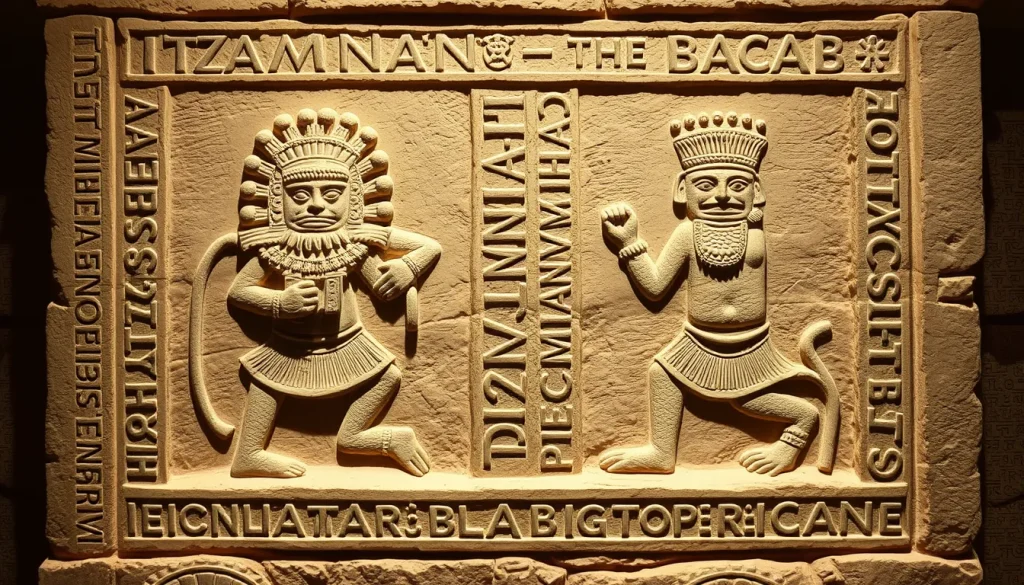
Central to this pantheon was Itzamná, widely regarded as the chief deity. He was associated with creation, wisdom, and the sky, and held a central role in rituals, ceremonies, and festivals. Temples and ceremonial centers dedicated to Itzamná have been identified throughout the Maya region, underscoring his importance in the pre-conquest period. However, the importance and characteristics of specific gods could vary significantly between city-states and time periods. Following the Spanish conquest, the worship of these deities was suppressed, and many stories were lost or blended with Christian beliefs, yet inscriptions and texts from the pre-conquest period allow archaeologists to reconstruct their roles.
Evidence & Sources
Our understanding of the Maya pantheon relies on a convergence of archaeological, textual, and ethnographic sources. One valuable source detailing traditional Maya religion is the Maya peoples themselves, including incumbents of positions within the religious hierarchy, diviners, and tellers of tales. Historically, knowledge was shared by those who transmitted their understanding to outsiders, as well as anthropologists who documented these traditions in the modern era.
For the Classic (200–1000 CE), Post-Classic (1000–1539 CE), and Contact Period (1511–1697), names of deities are mainly taken from specific historical documents. Key sources include the Books of Chilam Balam, Lacandon ethnography, the Madrid Codex, the work of Diego de Landa, and the Popol Vuh. Depending on the source, most names are either Yucatec or Kʼicheʼ. Classic Period names, belonging to the Classic Maya language, are only rarely known with certainty. Digital heritage initiatives now assist in preserving and analyzing these codices, allowing for detailed study of glyphic representations of gods without handling fragile originals.
Deep Dive Analysis
Definition
The Maya Pantheon refers to the collective group of gods and supernatural beings recognized within Maya cosmology. It is not a fixed list but a dynamic network of entities that interact with humans and the natural world. These deities were pivotal figures linking the cosmos, the earthly realm, and the underworld.
How it works
The pantheon functioned through a system of reciprocity and ritual. Deities required sustenance through offerings, prayers, and ceremonies to maintain cosmic order. Priests and rulers acted as intermediaries, conducting rituals to ensure agricultural fertility, rain, and protection from the underworld. The hierarchy was fluid, with certain gods gaining prominence in specific regions or eras.
Key components
The pantheon included creator gods, celestial deities, and gods of specific domains like agriculture or war. Notable figures include Itzamná, the chief deity associated with creation; Bacab, the old god of the interior of the earth and thunder, sometimes depicted as four entities representing the directions; and Awilix, the goddess of the Moon and the night. Other specialized deities included Ah-Muzen-Cab, the god of bees and honey, and Acan, the god of wine and intoxication identified with the drink Balché.
Example
Itzamná serves as a primary example of a principal deity. He was widely worshipped throughout the Maya region and had various temples and ceremonial centers dedicated to him. His role in creation myths positions him at the apex of the spiritual hierarchy, similar to how modern religious figures might be viewed within their respective faiths.
Historical evidence
Evidence for these deities comes from inscriptions, carvings, and texts that have survived from the pre-conquest period. The Madrid Codex and Popol Vuh provide names and narratives, while archaeological sites reveal temples aligned with cosmological beliefs. The work of Diego de Landa also provides colonial-era descriptions, though filtered through a European lens.
Common misconceptions
A common misconception is that the Maya pantheon was static and uniform across all regions. In reality, traditions varied between kingdoms, and names often differ between Yucatec and Kʼicheʼ sources. Additionally, while some modern interpretations suggest purely spiritual meanings, archaeological evidence shows these deities were integrated into political power structures and daily economic activities, such as honey production or tattooing, governed by gods like Acat.
FAQ
Who was the most important god in the Maya pantheon?
Itzamná is often regarded as the chief deity, associated with creation and widely worshipped throughout the Maya region.
How did the Spanish conquest affect Maya religion?
Worship of Maya deities was suppressed, and many stories and practices were lost or blended with Christian beliefs.
Are Classic Period deity names known?
Classic Period names belonging to the Classic Maya language are only rarely known with certainty; most names come from later Yucatec or Kʼicheʼ sources.


Leave a Reply