
Short Answer
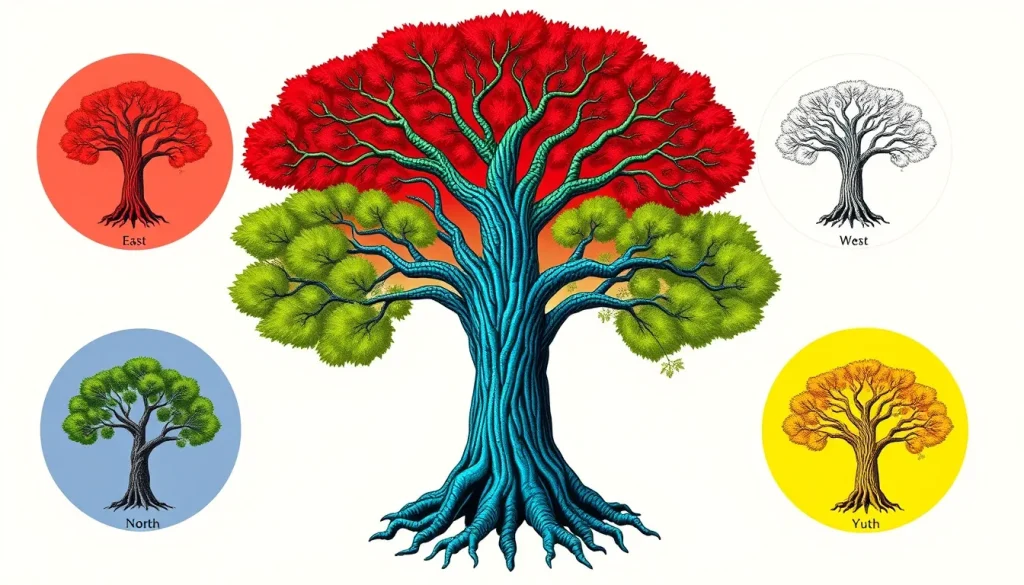
In the ancient Maya worldview, space was not an empty void but a intensely sacred and deeply structured environment. The cosmos was organized around a central axis known as the World Tree, flanked by four additional trees marking the cardinal directions. Together, these five world trees formed the foundational framework of Maya cosmology, anchoring the physical and spiritual realms. Each direction was associated with a specific color, deity, and symbolic meaning, creating a color-coded map of the universe that guided ritual practice, architecture, and daily life. This cosmological model was not merely metaphorical; it was a lived reality that dictated how the Maya interacted with their environment and understood their place within the cosmic order.
Main Explanation
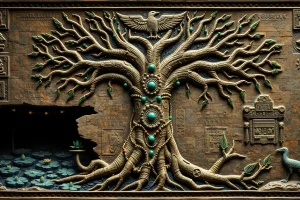
The concept of the five world trees serves as the structural backbone of Maya sacred geography. At the center stands the primary axis mundi, often identified as the Ceiba tree (Ceiba pentandra), which connects the three layers of the universe: the underworld (Xibalba), the terrestrial realm, and the sky. This central tree is associated with the color blue-green, known as Yax in the Maya language. Surrounding this center are four directional trees, each guarding a specific quadrant of the cosmos. According to established cosmological frameworks, the East is associated with the color Red (Chak), linked to the rising sun and blood. The North is White (Sak), connected to ancestors and the Milky Way. The West is Black (Ek), representing the setting sun and the entrance to the underworld. The South is Yellow (K’an), associated with the right hand of the sun’s path and prosperity.
This directional color scheme was not arbitrary but reflected observed celestial phenomena and agricultural cycles. The movement of the sun defined the primary axis between East and West, while the solstitial extremes often informed the North-South orientation. The trees themselves were not always depicted as literal botanical specimens but as symbolic markers imbued with supernatural power. In some contexts, the world tree motif merges with maize symbolism, reflecting the Maya belief that humanity was formed from maize dough. The interplay between the Ceiba tree and maize plant imagery suggests a complex cosmological symbol that embodied both stability and sustenance. This five-part structure ensured balance; if one direction was neglected, the cosmic order could be threatened, leading to disaster or chaos.
Evidence & Sources
Archaeological and ethnohistorical evidence supports the prevalence of the world tree motif across Mesoamerica, with specific variations among the Maya. Iconographic depictions appear on ceramic vessels, stucco reliefs, and stone stelae dating from the Preclassic through the Postclassic periods. For instance, the Izapa Stela 5 presents a tableau of a multi-layered tree with birds, which scholars propose represents the Mesoamerican world tree with souls awaiting descent into the underworld. Among the Maya, the central world tree is variously known as wacah chan or yax imix che, reinforcing its identity as a cosmic axis. Botanical assessments of these depictions usually favor determinations as either the Kapok tree or the maize plant, indicating that the symbol was morphically flexible to suit specific ritual contexts.
Textual sources from the colonial period provide further insight, though they must be analyzed critically for syncretism. During his visit to Nojpeten in 1696, Fray Andrés de Avendaño reported observing the Itzá Maya worshipping a stone column called yax cheel cab, translated as the first tree of the world. Avendaño noted that the Itzá claimed this was the tree from which their first father Adam ate, indicating a hybrid cosmology where pre-Hispanic beliefs merged with Christian introduced narratives. No known pre-Hispanic source uses the term yax cheel cab, suggesting this specific phrasing may be a product of colonial interaction. However, the underlying concept of a central sacred tree predates European contact, as evidenced by Classic period iconography. The persistence of these symbols into the colonial era demonstrates the resilience of Maya cosmological structures even under pressure to conform to foreign religious frameworks.
Deep Dive Analysis
Definition
The Five World Trees concept defines a cosmological model where the universe is structured around five pivotal points: a center and four cardinal directions. Each point is anchored by a symbolic tree that supports the sky and roots into the underworld. This model transforms abstract space into sacred place, imbuing every direction with specific spiritual qualities and colors.
How it works
The system functions as a coordinate grid for spiritual and physical navigation. Rituals were oriented according to these directions to ensure cosmic balance. For example, offerings might be placed in four corners of a temple to honor the directional trees, with a central offering for the axis mundi. The colors served as visual codes; a priest wearing yellow vestments might be invoking southern energies associated with the sun’s zenith.
Key components
The primary components include the Central Tree (Blue-Green/Yax), the East Tree (Red/Chak), the North Tree (White/Sak), the West Tree (Black/Ek), and the South Tree (Yellow/K’an). Additional associations often include specific birds and deities for each direction, creating a complex web of correspondences that organized all physical and spiritual space.
Example
A tangible example is found in the layout of Maya cities, which often mirrored this cosmological map. Causeways (sacbeob) radiating from a central plaza might align with the cardinal directions, effectively turning the city into a microcosm of the universe. The central plaza acts as the base of the World Tree, where rituals connecting the human and divine realms were performed.
Historical evidence
Evidence spans from Preclassic cosmic tree symbolism to Postclassic codices. The 1696 report by Fray Andrés de Avendaño regarding the yax cheel cab at Nojpeten provides ethnohistorical confirmation of tree worship, albeit through a colonial lens. Iconographic evidence on stone stelae and ceramic vessels confirms the motif’s prevalence in lowland Maya attribution.
Common misconceptions
A common misconception is that the yax cheel cab term is purely pre-Hispanic; scholarly analysis indicates it may reflect hybrid cosmologies involving Christian Adam narratives. Another error is assuming the tree is always biologically literal; while often identified as Ceiba, it sometimes represents maize or abstract cosmic axes. Finally, modern interpretations sometimes strip the colors of their sacred geography context, treating them as decorative rather than structural elements of the cosmos.
FAQ
What tree represents the Maya World Tree?
While often identified as the Ceiba tree (Kapok), botanical assessments suggest it may also represent a maize plant depending on the context.
What color is associated with the center direction?
The center is associated with Blue-Green (Yax), representing the axis mundi and the World Tree.
Is the term Yax Cheel Cab pre-Hispanic?
No known pre-Hispanic source uses the term; it appears in colonial reports from 1696 and may reflect hybrid Christian-Maya cosmologies.
How many world trees are there in Maya cosmology?
There are five world trees: one central tree and four directional trees marking the cardinal points.
Leave a Reply